Brushed vs Polished Watches: Which Finish Looks Better and Scratches Less?
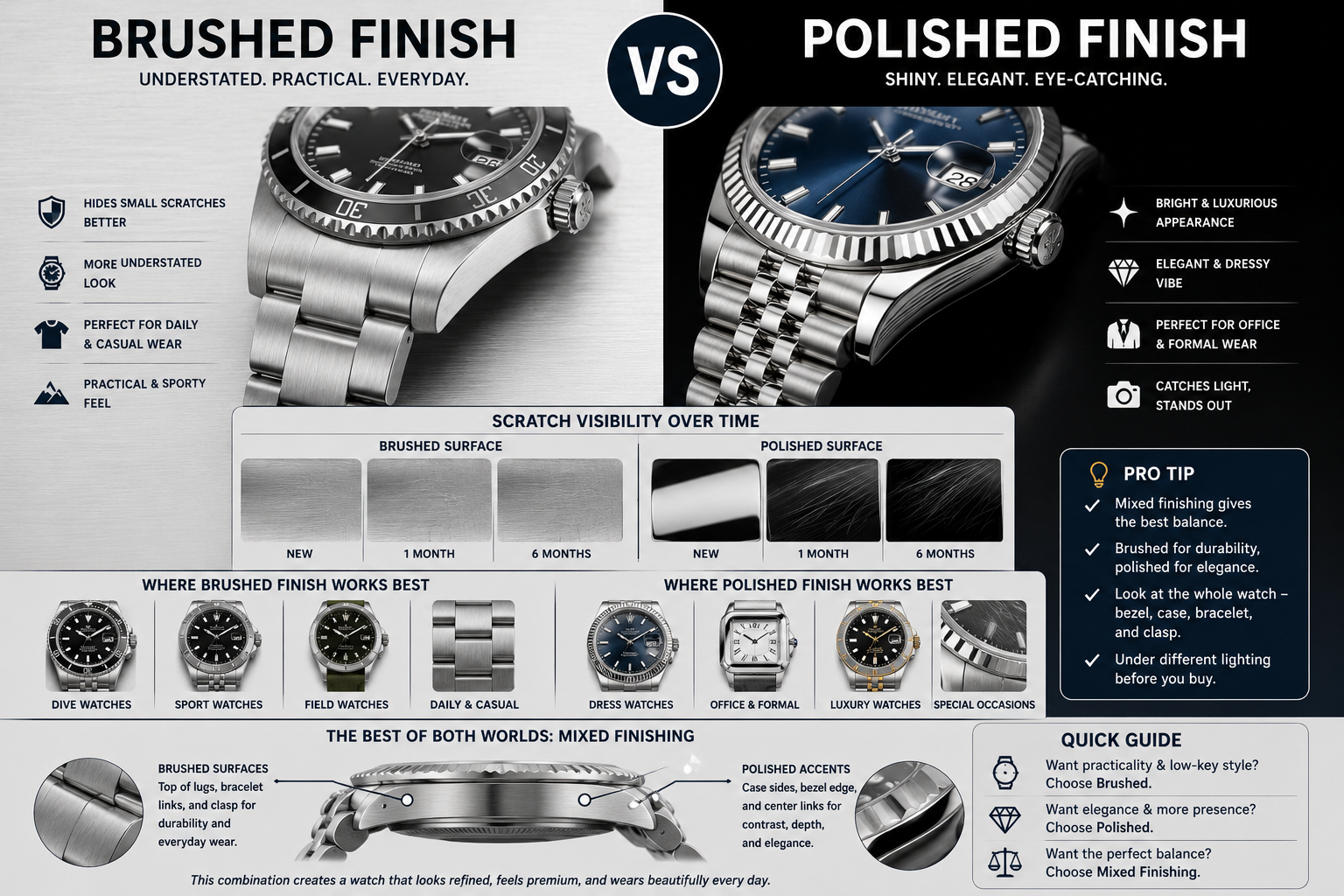
Brushed vs Polished Watches: Which Finish Looks Better and Scratches Less?
Most buyers compare watch brands, sizes, dial colors, bracelets, and movements.
But there is one detail that quietly changes how a watch looks every single day:
The finishing.
A brushed watch looks more understated, sporty, and practical.
A polished watch looks brighter, dressier, and more luxurious.
At first, this sounds like a simple style choice. But in real life, finishing affects scratches, fingerprints, office wear, daily comfort, wrist presence, replica QC, and how expensive the watch feels under different lighting.
This is why two watches with the same case size and dial color can feel completely different on the wrist.
A brushed Oyster bracelet feels tool-like and low-key.
A polished center link bracelet feels more refined and noticeable.
A polished bezel can make a watch look dressier.
A brushed case can make the same watch feel more casual and wearable.
If you are still learning how design details change real wrist presence, start with our guide on 36mm vs 40mm watches. Size matters, but finishing can make a watch look larger, shinier, quieter, or more formal even when the diameter is the same.
This guide compares brushed and polished watches from a real buyer’s point of view: daily wear, office style, scratch visibility, replica buying, bracelet choice, and long-term ownership.
The Quick Answer
Choose brushed finishing if you want a more practical, understated, scratch-friendly daily watch.
Choose polished finishing if you want a brighter, dressier, more luxurious look.
For everyday wear, brushed finishing is usually easier to live with.
For office, dinner, dress-casual outfits, and more elegant style, polished details can make the watch feel more premium.
The best watches often use both: brushed surfaces for durability and polished edges or center links for visual contrast.
A Real Buyer Example
Imagine a buyer choosing between two Datejust-style watches.
Both are 36mm.
Both have silver dials.
Both are on steel bracelets.
The first has a smooth polished bezel and Oyster bracelet. It looks clean, simple, and modern.
The second has a fluted bezel and Jubilee bracelet. It reflects more light, catches the eye faster, and feels dressier.
The buyer originally thinks he is choosing between bracelets and bezels. But what he is really choosing is finishing.
More brushed surfaces make the watch feel quieter.
More polished surfaces make the watch feel brighter.
If you are comparing Datejust configurations, our guide on Rolex Datejust smooth bezel vs fluted bezel explains this clearly. The smooth bezel feels simpler and more low-key, while the fluted bezel creates more shine and visual presence.
That same idea applies to many watches, not just the Datejust.
What Does Brushed Finishing Mean?
Brushed finishing has fine directional lines on the metal surface.
Instead of reflecting light like a mirror, it softens the reflection. This makes the watch look more matte, technical, and understated.
You often see brushed finishing on:
- sports watches
- dive watches
- tool watches
- field watches
- integrated bracelets
- Oyster-style bracelets
- titanium watches
Brushed finishing gives a watch a more practical feeling. It looks like something meant to be worn often, not just kept for special occasions.
This is one reason brushed surfaces are common on watches like the Rolex Submariner, Tudor Black Bay, Omega Seamaster, and many everyday steel sports watches.
If you are comparing watch materials too, our watch case materials guide explains how steel, titanium, ceramic, and bronze each interact differently with finishing, scratches, and daily wear.
What Does Polished Finishing Mean?
Polished finishing is smooth and reflective.
It catches light quickly and creates a more luxurious impression. A polished bezel, polished case side, or polished bracelet center link can make a watch look more expensive and more dressed-up.
You often see polished finishing on:
- dress watches
- luxury steel watches
- precious metal watches
- Cartier-style watches
- Datejust-style watches
- integrated bracelet luxury sports watches
- polished bezels and case edges
Polishing gives a watch sparkle.
That can be beautiful, but it also means the watch becomes more noticeable. Under office lights, restaurant lighting, or sunlight, polished surfaces attract attention quickly.
This is not a problem if that is what you want.
But if your goal is a low-key daily watch, too much polished finishing may feel louder than expected.
Which Finish Scratches Less?
This is where many buyers get confused.
Brushed and polished metal both scratch.
The difference is how visible the scratches look.
Brushed surfaces usually hide light scratches better because the brushing already has fine lines. Small marks blend into the texture.
Polished surfaces show hairline scratches more easily because the surface is mirror-like. Even tiny marks can become visible under certain lighting.
This is why polished center links often develop visible hairlines quickly, especially if you wear the watch at a desk, near laptops, on metal tables, or during travel.
The scratches may be normal, but they can bother buyers who expect the watch to stay perfect.
If scratch appearance concerns you, read our guide on Should You Polish a Watch?. It explains why polishing is not always the best solution and why preserving shape often matters more than removing every mark.
The Desk-Diver Problem
Many watch scratches do not come from extreme activity.
They come from normal desk life.
Your bracelet touches a laptop edge.
Your clasp rubs against a desk.
Your polished center links touch a keyboard area.
Your watch case brushes a door frame.
Your bracelet hits a metal chair arm.
These small contacts create hairline marks over time.
Brushed bracelets handle this better visually. Polished bracelets show it faster.
This is why people who wear a watch every day often prefer brushed bracelets or bracelets with limited polished surfaces.
If bracelet comfort and fit are also part of your decision, our watch bracelet sizing guide helps explain how tight a bracelet should be and why a poor fit can cause more rubbing, discomfort, and visible wear.
Brushed Watches for Daily Wear
For daily wear, brushed finishing is usually easier.
It looks more relaxed. It hides minor marks better. It does not flash too much in public. It pairs well with casual clothing, travel outfits, and everyday activities.
Brushed watches work especially well with:
- denim
- T-shirts
- casual jackets
- polos
- sneakers
- travel outfits
- outdoor clothing
- simple office wear
A brushed watch feels like something you can actually live with.
This is why many people choose brushed sports watches as their main daily watch. They are not necessarily more durable in a technical sense, but they feel more forgiving in daily use.
If you prefer understated watches, our guide to Best Low-Key Replica Watches includes several models where brushed finishing helps keep the watch quiet and wearable.
Polished Watches for Office and Dress Wear
Polished finishing becomes more useful when you want elegance.
A polished bezel or polished bracelet detail can make a watch look more refined with shirts, jackets, suits, and dinner outfits.
This is why watches like the Cartier Santos, Rolex Datejust, and many dress-casual watches use polished surfaces strategically.
Polish reflects light. Light creates formality.
A fully brushed watch may look too casual in some dress settings. A watch with polished accents can bridge that gap between daily wear and elegance.
If office style is your priority, read our guide on Best Replica Watches for Office Professionals. The best office watches are not always the most expensive-looking ones; they are the ones that look refined without becoming distracting.
The Best Choice Is Often Mixed Finishing
Many great watches do not choose only brushed or only polished.
They use mixed finishing.
For example:
- brushed top surfaces
- polished case sides
- brushed outer bracelet links
- polished center links
- polished chamfers
- polished bezel edge
- brushed clasp surface
Mixed finishing gives depth. It makes the watch look more expensive because light moves across different textures.
This is one reason high-quality watches often feel more dimensional than cheaper watches. The shape is not the only factor. The finishing transitions matter.
For replica buyers, this is very important. A watch can have the right shape and dial, but if the brushed and polished transitions look soft, uneven, or incorrect, the watch may feel less refined.
Before confirming a purchase, use our Replica Watch QC Checklist Before Buying. Finishing, bracelet edges, case brushing, polished bevels, clasp feel, and real wrist shots all deserve attention.
Rolex Datejust: A Perfect Example
The Rolex Datejust is one of the easiest ways to understand finishing.
A Datejust on Oyster bracelet with smooth bezel usually feels cleaner and slightly sportier.
A Datejust on Jubilee bracelet with fluted bezel feels brighter, dressier, and more classic.
Even if the case size and dial color are similar, the finishing changes the personality.
That is why our Rolex Datejust Jubilee vs Oyster bracelet comparison matters so much. Jubilee has more small reflective surfaces, while Oyster often feels simpler and more direct.
If you are still choosing your first Datejust setup, read Best Rolex Datejust Configuration to Buy First. Size, bezel, bracelet, dial, and finishing all work together.
Cartier Santos: Polished Style With Bracelet Presence
The Cartier Santos shows the dressier side of finishing.
Its design uses screws, polished edges, brushed surfaces, and a structured bracelet to create a watch that feels both stylish and daily wearable.
The Santos is not simply a shiny watch. Its charm comes from contrast. The case shape, bezel, bracelet, and screw details all interact with light.
This is why Santos buyers often care so much about size and finishing. A Medium can feel refined and balanced, while a Large can feel stronger and more noticeable.
If you are comparing sizes, our Cartier Santos Medium vs Large guide is useful before choosing. If you are comparing Cartier styles, Cartier Santos vs Cartier Tank explains why the Santos feels more like a bracelet watch, while the Tank feels more formal and elegant.
For replica buyers, the Santos also requires careful finishing inspection. The bezel, screws, bracelet articulation, and polished edges are a big part of the look. Our Replica Cartier Santos vs Real guide explains what details matter most.
Integrated Bracelet Watches: Finishing Matters Even More
On integrated bracelet watches, finishing becomes one of the most important parts of the design.
Watches like the Audemars Piguet Royal Oak and Vacheron Constantin Overseas rely heavily on brushed surfaces, polished bevels, and sharp transitions. The bracelet is not just a strap; it is part of the watch architecture.
If the brushing is flat or the polished bevels are weak, the whole watch loses presence.
This is why integrated bracelet replicas should be checked carefully. The dial may look good, but the bracelet finishing often determines whether the watch feels convincing on the wrist.
If you are considering this style, read our guides on Replica Audemars Piguet Royal Oak vs Real and Replica Vacheron Constantin Overseas vs Real. Both watches show why finishing, bracelet shape, and edge definition are central to the buying decision.
Brushed vs Polished for Small Wrists
Finishing can change how large a watch appears.
Polished watches often look more noticeable because they reflect more light. A polished bezel or shiny center links can make the watch feel larger than the actual case diameter.
Brushed watches usually look more compact because they reflect light less aggressively.
This matters if your wrist is small.
A 40mm brushed watch may feel wearable.
A 40mm polished watch may feel louder and larger.
A 36mm polished watch may still have plenty of presence because the finishing catches light.
If you have a smaller wrist, do not choose size alone. Consider dial color, bezel type, bracelet shine, and case finishing. Our Replica Watch Size Guide explains why wrist shots and mirror photos are more useful than close-up product photos.
Brushed vs Polished With Different Dial Colors
Dial color changes the effect of finishing.
A black dial with brushed finishing feels sporty and low-key.
A black dial with polished accents feels more formal.
A blue dial with polished surfaces can look bright and modern.
A silver dial with polished details can feel very dressy.
A white dial with brushed finishing can feel fresh and casual.
This is why finishing should not be chosen separately from dial color.
If you are still choosing between dial colors, read our guides to black dial vs blue dial watches and white dial vs silver dial watches. Dial color, finishing, and size all affect how the watch appears in daily life.
Can You Polish Scratches Later?
Yes, but you should be careful.
Polishing can remove scratches, but it can also soften edges, change case shape, and reduce the original definition of the watch.
This is especially important for luxury watches and higher-grade replica watches where case shape and finishing lines matter.
A slightly scratched watch with sharp original lines often looks better than an overpolished watch with rounded edges.
If you are buying pre-owned, read How to Tell If a Watch Is Overpolished Before You Buy. It explains how softened lugs, rounded case edges, and weak brushing can affect value and appearance.
For daily wear, it is usually better to accept small marks rather than constantly polish the watch.
Strap Changes and Finishing
Straps also affect how finishing feels.
A polished watch on a leather strap can look elegant.
A brushed watch on rubber can look sporty.
A brushed watch on leather can feel casual and vintage-inspired.
A polished case on a bracelet can look dressier and more noticeable.
If you like changing straps, choose a watch whose finishing works with multiple strap styles.
A fully polished case may look strange on a rough nylon strap. A heavily brushed tool watch may not feel natural on glossy dress leather.
For practical strap decisions, read our Watch Strap Materials Guide. Replica buyers should also check Replica Watch Bracelet and Strap Guide, especially if choosing between Oyster, Jubilee, rubber, leather, or integrated bracelets.
If you plan to change straps yourself, use the right tool and tape the lugs if needed. Our Spring Bar Tool Guide explains how to avoid scratching the case while changing straps.
Replica Watch Buyers: What to Check
For replica buyers, finishing should be part of every QC review.
Do not only check the logo and dial.
Check:
- brushing direction
- brushing consistency
- polished case sides
- polished bevels
- transition lines
- bracelet edge finishing
- clasp brushing
- screw finishing
- bezel polish
- case shape from the side
- how the watch reflects light in video
A good replica watch should not only look correct from the front. It should also look convincing when light moves across the bracelet and case.
This is especially true for watches with mixed finishing. If the brushed and polished areas are not cleanly separated, the watch can look less refined.
If you are new to quality levels, read Super Clone Watches Explained. Finishing is one of the details that often separates basic copies from better daily-wear pieces.
One-Watch Collection: Brushed or Polished?
If this will be your only watch, choose mostly brushed with some polished accents.
That is usually the safest balance.
A mostly brushed watch is easier to wear daily and hides small marks better. Polished accents keep it from looking too plain.
Good one-watch finishing usually looks like this:
- brushed bracelet tops
- polished case sides
- clean polished bevels
- not too many shiny center links
- balanced bezel finishing
This works for office, casual wear, travel, and weekends.
If you are planning a smaller rotation, our guide on 2-Watch vs 3-Watch Collection explains how different watches can have different roles. A brushed daily watch and a polished dress watch can work very well together.
Second Watch: Why Polished Can Make Sense
If you already own a brushed sports watch, a polished or mixed-finish watch can add variety.
For example:
- brushed Submariner-style watch for travel and daily wear
- polished Datejust or Santos for office and dinners
Or:
- brushed Explorer for casual daily use
- polished Cartier Tank for dressier moments
This gives your collection contrast.
The goal is not to own watches that all look similar. The goal is to have watches that serve different situations.
Practical Buying Checklist
Before choosing brushed or polished finishing, ask yourself these questions.
Do I want a quiet daily watch?
Choose brushed or mostly brushed.
Do I want a dressier watch?
Choose polished or mixed finishing.
Do scratches bother me?
Choose brushed surfaces, especially on the bracelet.
Do I work at a desk?
Avoid too many polished center links if hairline scratches will annoy you.
Do I wear suits or dress-casual clothing often?
Polished accents can make the watch look more refined.
Do I have a small wrist?
Remember that polished surfaces can make the watch appear larger.
Am I buying a replica?
Check brushing, polishing, bevels, bracelet edges, and transition lines carefully before confirming.
Final Verdict
Choose brushed finishing if you want practicality, subtle style, easier daily wear, and a watch that handles small marks more gracefully.
Choose polished finishing if you want elegance, brightness, dressier presence, and a more luxurious look.
For most everyday buyers, the best choice is mixed finishing: brushed where the watch needs durability, polished where the watch needs refinement.
For replica buyers, finishing is one of the most important QC details. A good dial matters, but the case and bracelet finishing are what make the watch feel convincing in real life.
The best finish is not the one that looks brightest in photos.
It is the one that still looks right after months of actual wear.