2-Watch vs 3-Watch Collection: The Simple Formula That Actually Fits Real Life
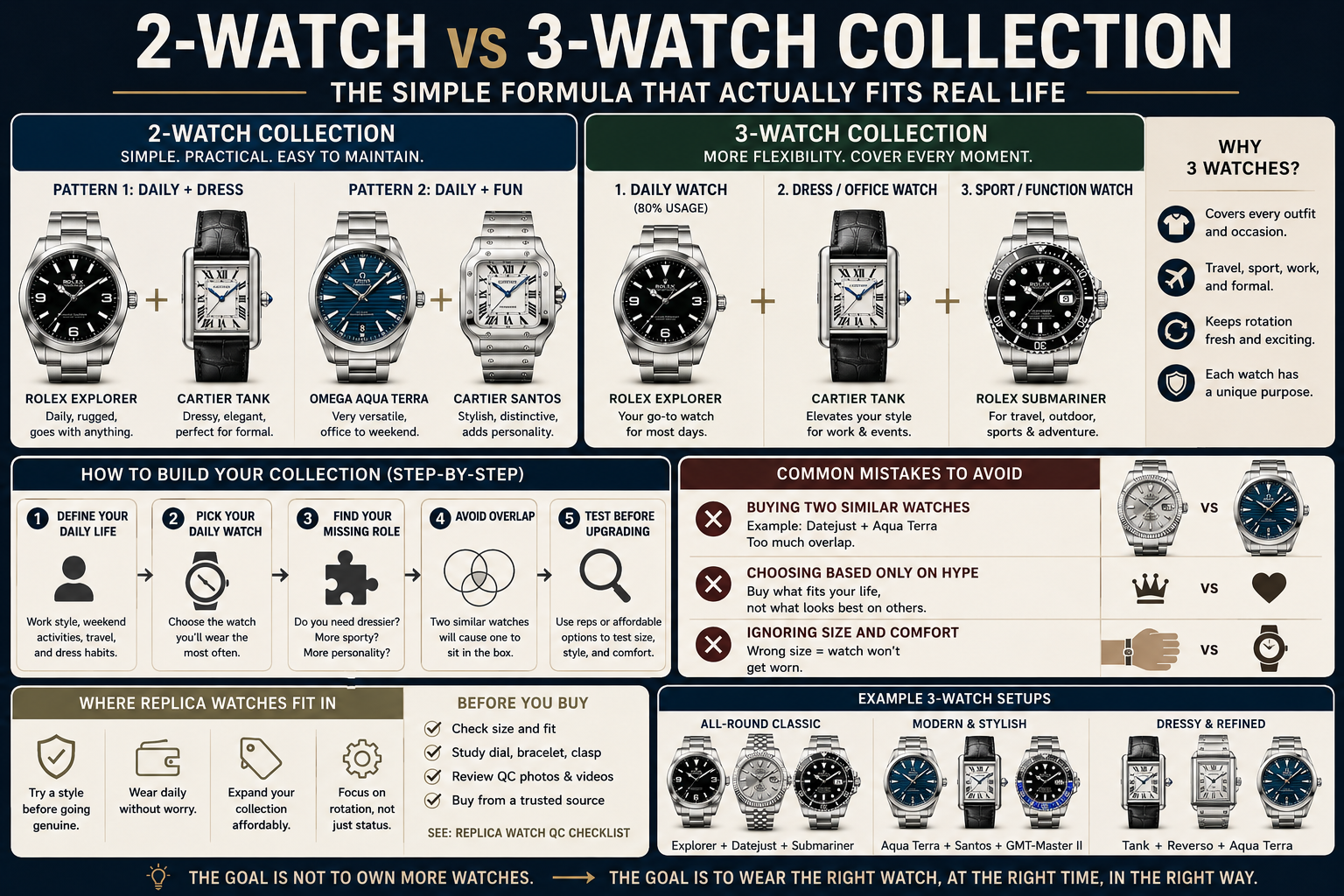
2-Watch vs 3-Watch Collection: The Simple Formula That Actually Fits Real Life
Most people start thinking about watches the wrong way.
They think in terms of “the next watch I want to buy,” instead of thinking about how watches actually work together in daily life. That is why so many buyers end up with watches they rarely wear, or collections that feel repetitive.
In reality, a good watch collection is not about quantity. It is about roles.
Once you understand that, the entire buying process becomes much clearer.
For most people, the real decision is not between Rolex, Omega, or Cartier. It is between building a 2-watch rotation or a 3-watch rotation that actually fits your lifestyle.
The Core Idea: Watches Need Jobs, Not Just Brands
A watch collection only works when each watch has a different job.
If two watches do the same thing, one of them will naturally become unused.
A simple framework looks like this:
- Daily Watch (the one you wear most)
- Secondary Watch (different style or function)
- Optional Third Watch (special occasion or personality piece)
This is why many collectors eventually settle into a 2 or 3 watch system without realizing it.
If you are still deciding your first serious watch, our guide on watch size guide: case diameter, lug-to-lug & thickness is useful before choosing any model.
2-Watch Collection: The Minimal Practical Setup
A 2-watch collection is ideal for people who want simplicity.
It usually follows one of these two patterns:
Pattern 1: Daily + Dress
- One everyday sports watch
- One more elegant or formal watch
Example:
- Rolex Explorer (daily)
- Cartier Tank (dress)
This combination works because it covers both ends of your lifestyle without overlap.
The Explorer handles travel, casual outfits, weekends, and daily wear. The Tank handles office, dinners, and more refined situations.
This is also where many buyers naturally include both genuine and replica options depending on budget and use case. For example, a high-quality replica Explorer for daily wear and a dress watch reserved for more formal moments.
If you are exploring different usage styles, our best everyday replica watches guide explains how people typically structure daily rotation choices.
Pattern 2: Daily + Fun Watch
- One main daily watch
- One personality or style watch
Example:
- Omega Aqua Terra (daily)
- Cartier Santos (style watch)
This setup is more modern. It allows your daily watch to stay practical while your second watch adds identity.
2-Watch Collection Mistake Most People Make
The most common mistake is buying two similar watches.
For example:
- Rolex Datejust + Omega Aqua Terra
- Submariner + Seamaster
- Two steel sports watches with similar dials
In that case, one watch almost always becomes unnecessary.
If you already own a Datejust or are considering one, comparing it with alternatives like in Rolex Datejust vs Omega Aqua Terra helps avoid overlap decisions.
3-Watch Collection: The Real “Complete Setup”
A 3-watch collection is where things become flexible.
It usually follows this structure:
Watch 1: Daily Watch (80% usage)
A watch that works in almost every situation.
Examples:
- Rolex Explorer
- Omega Aqua Terra
- Rolex Oyster Perpetual
Watch 2: Dress or Office Watch
Something more refined and intentional.
Examples:
- Cartier Tank
- Cartier Santos
- JLC Reverso style watches
Watch 3: Personality / Sport Watch
Something more expressive or functional.
Examples:
- Rolex Submariner
- GMT watch
- Chronograph
If you are deciding between sport models, our Rolex Submariner vs GMT-Master II guide is useful for understanding how function changes real-life usage.
Real Buyer Case Study: What Actually Happens
Let’s take a real-world scenario.
A buyer starts with one watch: a Rolex Datejust.
At first, it feels perfect. It works for office wear, dinners, and weekends.
After a few months, he realizes something:
- It feels slightly too formal for casual outfits
- It is not ideal for travel or sports use
- He hesitates to wear it in rough environments
So he adds a second watch: a Submariner.
Now he has:
- Datejust (dress-casual)
- Submariner (sport)
But then another issue appears: both watches are Rolex, both steel, both similar presence levels. One becomes “special occasion only.”
Finally, he adds a third watch:
- Cartier Santos
Now the collection works:
- Datejust = office
- Submariner = sport
- Santos = style / daily flexibility
This is a very common progression, even if buyers do not plan it in advance.
If you are still early in your buying journey, our best first replica watch guide shows how first choices often determine later collection structure.
The Smart 3-Watch Formula (Simple Version)
If you want a clean formula, use this:
- 1 simple daily watch (neutral, easy to wear)
- 1 dress or elegant watch (style-focused)
- 1 sport or function watch (rugged or technical)
This structure prevents overlap and ensures every watch has a purpose.
Where Replica Watches Fit Into This Strategy
Replica watches often enter collections for practical reasons:
- Testing a style before committing to a genuine purchase
- Wearing a watch daily without worry
- Expanding variety without overspending
For example:
- Genuine Cartier Tank for special wear
- Replica Omega Aqua Terra for daily use
This combination is common among practical buyers who care more about rotation than status signaling.
If you want to understand quality levels better, our replica watch QC checklist explains what actually matters before buying.
Wrist Size Still Matters (More Than People Think)
Even in a collection strategy, size consistency matters.
A common issue:
- One watch feels perfect
- Another feels too large or too small
- So it never gets worn
Before building a rotation, check proportions carefully using our watch size guide.
For smaller wrists especially, a 36–38mm range often works best across multiple watches.
How to Build Your Own Collection (Step-by-Step)
Step 1: Define your daily watch first
Do not start with the “fun watch.” Start with the watch you will wear most.
Step 2: Identify your missing category
Ask:
- Do I need dressier?
- Do I need sportier?
- Do I need more personality?
Step 3: Avoid overlap
If two watches feel similar, remove one.
Step 4: Test before upgrading
This is where replica or affordable models can help you understand size and style before committing long-term.
Step 5: Keep rotation simple
More than 3–4 watches often reduces actual wear frequency.
Final Verdict: 2 vs 3 Watches?
Choose a 2-watch collection if:
- You want simplicity
- You wear one style most of the time
- You do not want decision fatigue
Choose a 3-watch collection if:
- You want flexibility
- You have different outfits and lifestyles
- You enjoy switching based on mood or situation
In most real cases, 3 watches is the “comfortable maximum” before the collection becomes inefficient.
The goal is not to own more watches.
The goal is to actually wear them.