- Home
- Best Rolex Datejust Configuration to Buy First: Size, Bezel, Bracelet, and Dial Explained
Best Rolex Datejust Configuration to Buy First: Size, Bezel, Bracelet, and Dial Explained
Buying your first Rolex Datejust sounds easier than it actually is.
At the beginning, the decision seems simple: just buy a Datejust.
Then the real problem starts.
Do you go 36 or 41? Smooth bezel or fluted? Jubilee or Oyster? Blue dial, black dial, silver dial, or Wimbledon? The more you look, the less obvious it becomes. And that is exactly why so many first-time buyers spend weeks, sometimes months, stuck in the same loop.
They are not really asking which Datejust is best.
They are asking which Datejust is the safest choice to live with for years.
That is a much better question.
Because the wrong Datejust is usually not “bad.” It is just slightly wrong for the person wearing it. Too flashy. Too plain. Too large. Too dressy. Too trendy. Too specific. And once you spend this kind of money, “slightly wrong” starts feeling expensive very quickly.
So what is the best Rolex Datejust configuration to buy first?
The short answer is this: for most first-time buyers, the safest all-around choice is a Datejust 36 with a fluted bezel, Jubilee bracelet, and a versatile dial like blue, silver, or black.
That does not mean it is the only right answer.
But it is usually the configuration that gives you the fewest regrets and the widest long-term satisfaction.
The short answer
If you want the fastest version, here it is:
For most people buying their first Datejust, the best configuration is:
- 36mm for classic proportion and long-term wearability
- fluted bezel for the full Datejust identity
- Jubilee bracelet for the most iconic and comfortable Datejust feel
- blue, silver, or black dial for the safest long-term versatility
If you already know you want something more modern and sportier, then a 41mm Datejust on Oyster bracelet may suit you better.
But if you are honestly unsure, the safer answer is usually closer to the classic Datejust formula than the sportier one.
That is because first-time buyers rarely regret choosing the Datejust that feels timeless.
They more often regret choosing the Datejust that felt exciting for ten minutes.
Why first-time Datejust buyers get stuck
The Rolex Datejust is one of the most configurable luxury watches in the world.
That should make it easier to buy.
Instead, it often makes it harder.
Too many good options create a strange kind of decision paralysis. Every version looks good in a different way. The smooth bezel feels cleaner. The fluted bezel feels more Rolex. The Oyster bracelet feels more practical. The Jubilee feels more special. The blue dial feels rich. The Wimbledon feels more distinctive.
And because none of these options are obviously wrong, buyers start comparing endlessly.
That is usually where mistakes happen.
Because once people get trapped in endless comparison mode, they stop asking the most important question:
Which Datejust will I actually enjoy wearing most often after the excitement fades?
That is the real question.
Not which one looks best in a dealer light box.
Not which one photographs best on social media.
Not which one feels most impressive for 30 seconds.
The one that keeps working in normal life is the one that matters.
Start here: choose the overall personality first
Before talking about size, bezel, bracelet, or dial, you need to decide one bigger thing:
Do you want your first Datejust to feel more classic, or more modern?
That one answer makes the rest much easier.
If you want your Datejust to feel timeless, elegant, and unmistakably “Datejust,” you should lean toward:
- 36mm
- fluted bezel
- Jubilee bracelet
- classic dial colors
If you want your Datejust to feel cleaner, more casual, and a little sportier, you should lean toward:
- 41mm
- smooth bezel or fluted on Oyster
- Oyster bracelet
- darker, cleaner dial choices
Most first-time buyers think they want “the best configuration.”
What they actually need is the right personality.
Because once the overall personality is right, the watch starts making sense.
Size: why 36mm is still the safest first Datejust
Let’s start with the biggest decision.
If you are buying your first Datejust, 36mm is usually the safest choice.
Not because 41mm is bad.
Because 36mm is harder to regret.
The Datejust 36 feels balanced in a way that makes immediate sense once you live with it. It works across formal and casual settings. It wears easily under sleeves. It feels classic without becoming old-fashioned. It looks intentional, not trend-driven.
That is why so many experienced buyers eventually land here, even if they started by looking at 41mm.
The 41mm Datejust can absolutely be the right answer if you prefer more wrist presence, wear larger watches already, or want the watch to feel more contemporary. But it is less forgiving. It asks a bit more from your wrist, wardrobe, and confidence.
That is why, if you are truly undecided, 36 is usually the smarter first purchase.
If you want the deeper breakdown, Rolex Datejust 36 vs 41: Which Size Is Actually Better for Real Daily Wear? should be required reading before buying.
Bezel: why fluted is usually the right first-Datejust answer
This is where many first-time buyers try to be rational.
And sometimes that works against them.
A smooth bezel Datejust is cleaner, calmer, and often easier for everyday wear. It can feel more understated and more modern. That is a real advantage.
But if you are buying your first Datejust, the fluted bezel usually makes more sense.
Why?
Because the fluted bezel is a huge part of what makes the Datejust feel like a Datejust. It catches light beautifully. It adds character. It makes the watch feel richer and more complete. And most importantly, it satisfies the emotional part of the purchase.
That matters.
A lot of first-time buyers choose smooth because it seems more sensible, then keep staring at fluted Datejust photos afterward. That is a bad sign.
If you want the full comparison, Rolex Datejust Smooth Bezel vs Fluted Bezel: Which One Should You Actually Buy? breaks this down in much more detail.
My honest view is simple:
- If you want the safest “true Datejust” first buy, choose fluted
- If you already know you prefer quieter, more understated watches, choose smooth
But for most first-time buyers, fluted is the better emotional and long-term choice.
Bracelet: why Jubilee usually wins the first-Datejust argument
This decision matters more than it looks.
A Datejust on Jubilee and a Datejust on Oyster can feel like two different watches.
The Jubilee bracelet gives the watch softness, texture, and classic Rolex identity. It feels more traditional, more expressive, and, for many owners, more comfortable over long wear. It also completes the classic Datejust image in a way that is hard to ignore.
The Oyster bracelet is cleaner and sportier. It makes the watch feel more grounded and more daily-oriented. For some buyers, that is exactly the point.
But again, if this is your first Datejust, Jubilee usually makes more sense.
Why?
Because first-time buyers generally want the Datejust they have been imagining, not the one that sounds safest in a spreadsheet. And that imagined Datejust is very often on Jubilee.
If bracelet comfort, style, and resale questions are still bothering you, Rolex Datejust Jubilee vs Oyster Bracelet: Comfort, Style, and Resale Differences is the natural next read.
The simple version is this:
- Jubilee = more classic, more special, more Datejust
- Oyster = more sporty, more understated, more daily-tool energy
For a first purchase, Jubilee usually wins unless you already know you want the cleaner look.
Dial: the safest first-Datejust dial colors
This is where a lot of buyers get unnecessarily adventurous.
There is nothing wrong with distinctive dials. But when buying your first Datejust, you usually want a dial that will not feel limiting later.
That is why the safest first-Datejust dial colors are usually:
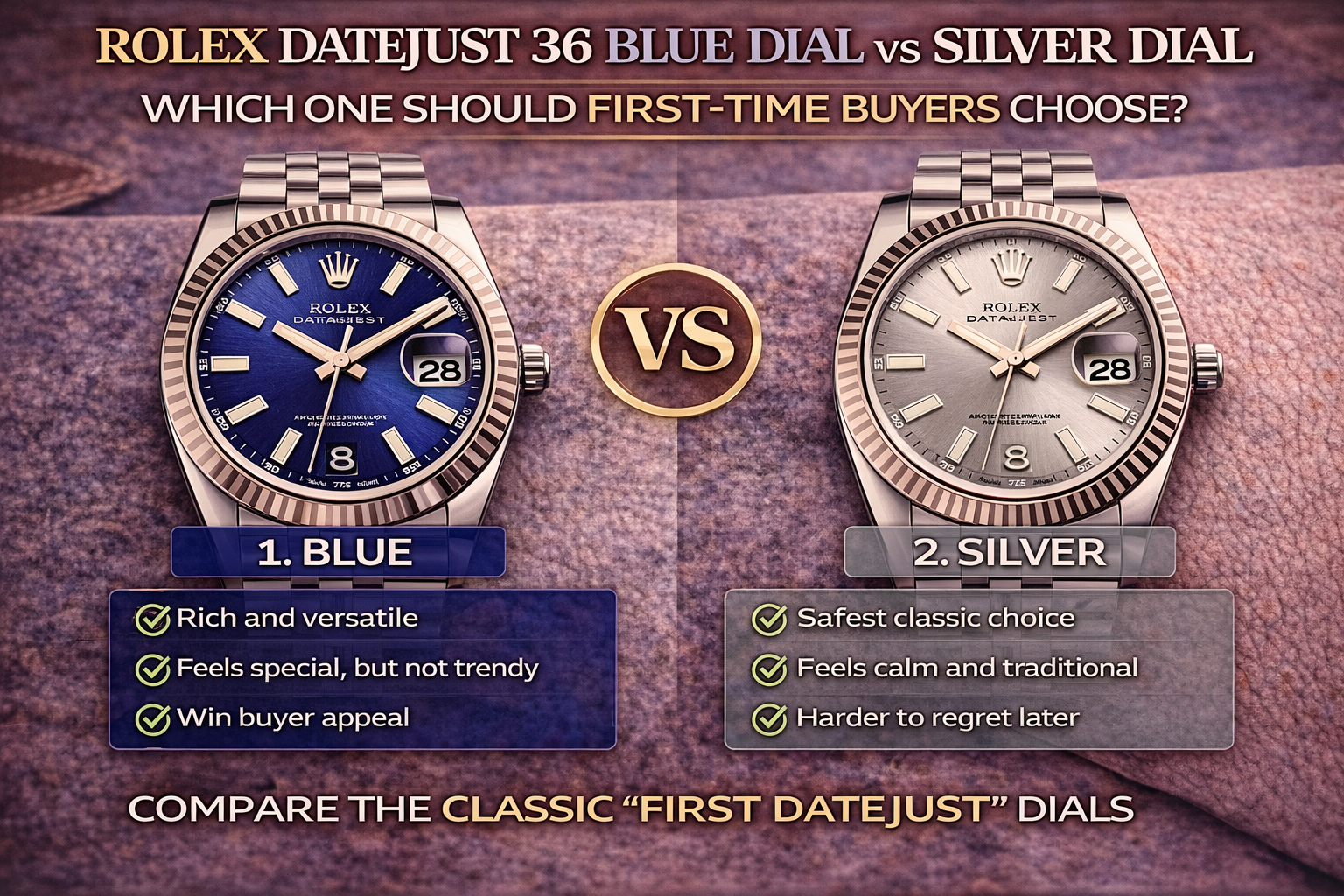
- blue
- silver
- black
These colors work because they are easy to live with. They fit more wardrobes, more seasons, and more moods. They do not rely too much on novelty or niche taste. They also tend to age better emotionally.
For most first-time buyers, blue is the strongest all-around choice. It gives the watch richness and personality without becoming difficult. It feels special without trying too hard.
Silver is the most classic and understated.
Black is clean, strong, and easy to style.
More distinctive dials, like Wimbledon, can be brilliant if you truly love them. But they should be chosen because you are sure, not because they feel more interesting in the moment. That is why Rolex Datejust Blue Dial vs Wimbledon: Which One Should You Actually Buy? is such an important comparison for first-time buyers.
If you are unsure, blue is usually the safest emotional and visual choice.
The best first-Datejust configuration for most people
If I had to recommend one Datejust configuration to the broadest group of first-time buyers, it would be this:
Rolex Datejust 36, fluted bezel, Jubilee bracelet, blue dial.
Why this one?
Because it sits in the sweet spot.
It is:
- classic without feeling old
- luxurious without feeling too loud
- versatile without feeling plain
- iconic without becoming costume-like
- easy to wear, but still emotionally rewarding
It is not the only great Datejust.
It is simply the one most likely to make sense now and still make sense later.
The best first-Datejust configuration if you want a sportier feel
Not everyone wants the classic formula.
Some buyers want their Datejust to feel more modern, cleaner, and less jewelry-like. If that sounds like you, the better first-Datejust setup is often:
Rolex Datejust 41, smooth bezel or fluted on Oyster, Oyster bracelet, blue or black dial.
This version makes more sense if you:
- already wear larger watches
- dress more casually most of the time
- want the Datejust to feel closer to a luxury sports watch
- are turned off by too much visual shine or classic dressiness
This is not the most “pure” Datejust formula.
But it can absolutely be the right real-life formula for the right buyer.
A real buyer example: how the right configuration becomes obvious
A buyer I know spent weeks trying to “optimize” his first Datejust.
At first he thought he wanted the biggest and boldest version possible. He looked at 41mm, smooth bezel, Oyster bracelet, and darker dials. It all felt modern and safe.
Then he tried on a 36mm fluted bezel on Jubilee almost as a reference point.
That changed everything.
It felt more complete. More alive. More like a Rolex he would remember buying, not just a nice watch he happened to choose. The sportier setup still made sense on paper. But the classic one made more sense on his wrist.
He bought the 36 fluted Jubilee.
Six months later, he told me something very common among first-time Datejust buyers: “I thought I wanted the most practical version. I ended up wanting the most Datejust version.”
That is exactly why so many first buyers land on the classic formula in the end.
The biggest mistakes first-Datejust buyers make
There are a few mistakes that show up again and again.
1. Buying the showroom winner instead of the life winner
A bigger, shinier, more dramatic Datejust often wins in the mirror. That does not mean it wins six months later.
2. Choosing “safe” over what you actually want
Too many buyers talk themselves into smooth bezel or Oyster bracelet because it sounds more sensible, then keep admiring fluted Jubilee Datejusts afterward.
3. Going too specific on the first one
A very niche dial or highly taste-driven configuration can be great, but first watches usually benefit from broader versatility.
4. Ignoring fit
Size is not just diameter. That is why Watch Size Guide: Case Diameter, Lug-to-Lug & Thickness (How to Choose the Perfect Fit) matters before you commit.
5. Overlooking bracelet comfort
A Datejust that is slightly wrong on the wrist can feel wrong overall. That is also why Watch Bracelet Sizing Guide: How Tight Should It Be? (Comfort, Fit Tests & Fixes) is more important than most first-time buyers realize.
What about buying pre-owned for your first Datejust?
For many buyers, that is actually the smart move.
A pre-owned Datejust can give you a better configuration, less initial depreciation risk, and a more realistic entry point into genuine Rolex ownership. But you need to buy carefully.
If you go pre-owned, your research should not stop at configuration. You also need to understand condition, authenticity, polishing, and originality. That means reading:
- How to Spot a Fake Rolex Before You Buy: 13 Red Flags That Actually Matter
- How to Tell If a Rolex Datejust Is Fake Before You Buy
- How to Tell If a Watch Is Overpolished Before You Buy
- How to Check a Used Watch in Person: 15 Things to Inspect Before You Buy
- Used Watch Full Set vs Watch Only: How Much Do Box and Papers Really Matter?
A great configuration on a bad watch is still a bad buy.
The best decision framework before you spend money
If you want a practical system, use this:
Step 1: decide classic vs modern
That settles most of the configuration questions faster than endless option comparison.
Step 2: choose size second
If you are unsure, lean 36. If you know you want more presence, consider 41.
Step 3: choose bezel third
If this is your first Datejust and you love the classic look, lean fluted.
Step 4: choose bracelet fourth
If you want full Datejust identity, choose Jubilee. If you want simpler daily wear, choose Oyster.
Step 5: choose dial last
Keep it versatile unless you are truly certain you want something more specific.
This order matters.
Too many buyers start with dial color because it is exciting, when they should be starting with the personality of the whole watch.
So what is the best Rolex Datejust configuration to buy first?
Here is my honest answer.
For most first-time buyers, the best Rolex Datejust configuration to buy first is:
Datejust 36 + fluted bezel + Jubilee bracelet + blue dial.
That is the lowest-regret answer.
Not because it is objectively perfect.
Because it gives you the broadest combination of timelessness, Rolex identity, comfort, and long-term satisfaction.
If you know you want something cleaner and more modern, then adjust from there.
But if you are genuinely torn, do not overcomplicate it.
Start with the version most likely to still feel right when the excitement fades.
Final verdict
The best first Rolex Datejust configuration is usually not the most dramatic, the most modern, or the most unusual one.
It is the one that keeps working after you stop trying to optimize the purchase.
For most people, that means:
- 36mm
- fluted bezel
- Jubilee bracelet
- blue, silver, or black dial
That formula has lasted for a reason.
It feels like a Datejust.
And when you are buying your first one, that matters more than people think.
FAQ
What is the best Rolex Datejust size for a first-time buyer?
For most people, 36mm. It is the safer and more timeless long-term choice.
Should I buy fluted or smooth bezel for my first Datejust?
Usually fluted, especially if you want the full classic Datejust experience.
Is Jubilee or Oyster better for a first Datejust?
Usually Jubilee, unless you already know you want a cleaner, sportier look.
What is the best dial color for a first Datejust?
Blue is often the strongest all-around choice. Silver and black are also very safe.
What is the single safest first-Datejust configuration?
Datejust 36, fluted bezel, Jubilee bracelet, blue dial.