Should You Polish a Watch? Scratch Reality, Resale Value & Better Alternatives
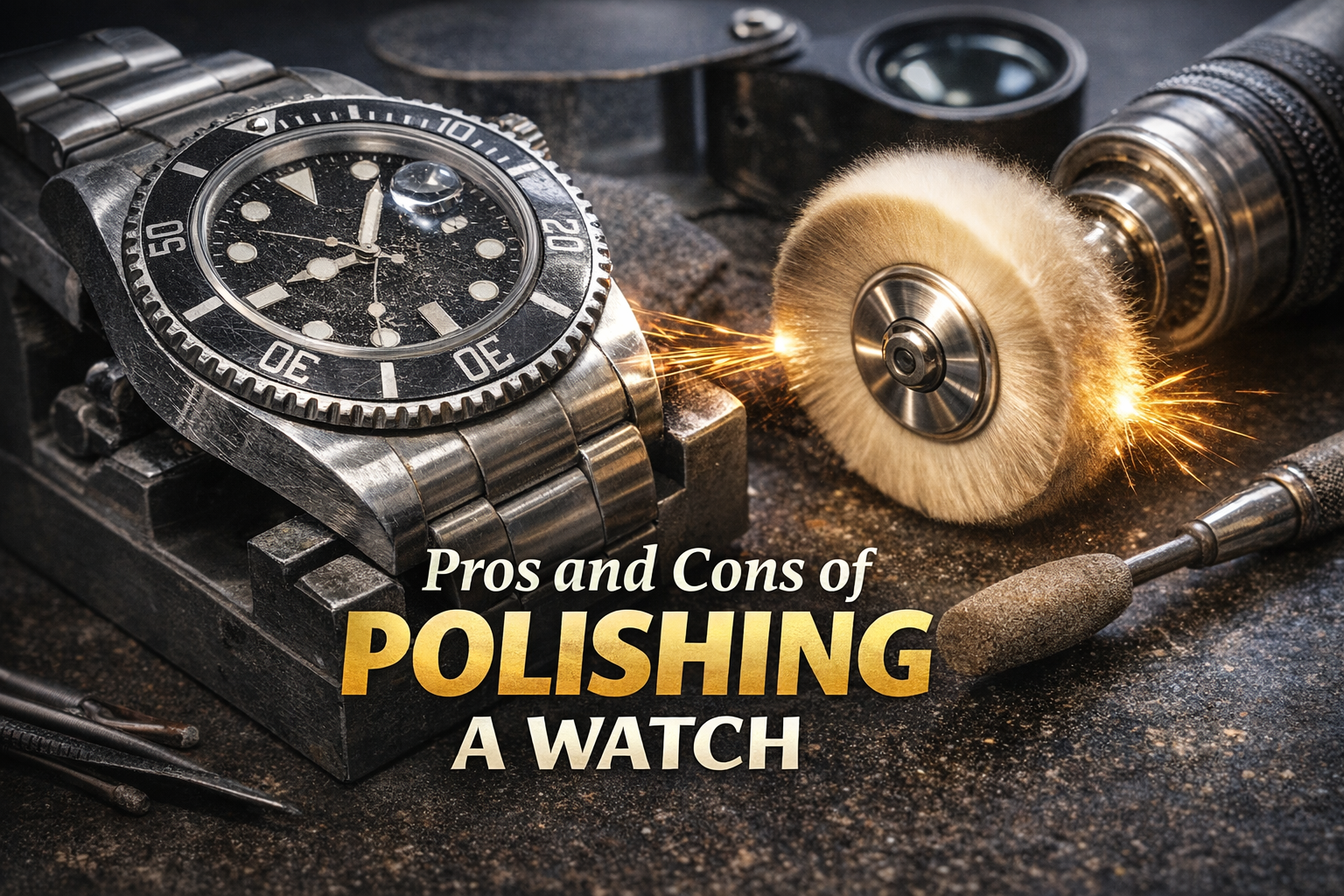
If you own a watch long enough, it will get scratched.
Not ruined. Not “destroyed.” Just scratched.
That is where the polishing question usually begins.
A few marks appear on the clasp. A hairline shows up on the case side. The polished bezel no longer looks fresh in sunlight. And suddenly you start wondering whether the watch needs a polish, a refinish, or some kind of cosmetic reset.
Sometimes that is a reasonable idea.
Quite often, it is not.
Here is the honest short answer:
Most watches do not need polishing as quickly as their owners think they do.
And in many cases, polishing too early does more damage to long-term appearance and resale value than the scratches themselves.
That is because scratches are normal. Metal loss is permanent.
So the better question is not:
“Can this watch be polished?”
It is:
“Should this watch be polished now, later, lightly, or not at all?”
That is what this guide is here to answer.
Who this guide is for
This article is for you if:
- your watch has visible scratches and you are tempted to “clean it up,”
- you are thinking about polishing before selling,
- you want to know whether polishing hurts resale value,
- or you are unsure whether your watch needs a full refinish, light clean-up, or nothing at all.
If you are buying pre-owned and want to understand the other side of this issue, How to Tell If a Watch Is Overpolished Before You Buy should be read alongside this one.
The short answer
You should consider polishing a watch if:
- the scratches genuinely bother you,
- the watch is not rare or especially sensitive to case-shape loss,
- the work will be done lightly and correctly,
- and the case lines can be preserved.
You should usually avoid polishing a watch if:
- the scratches are light and normal,
- the watch still has strong original lines,
- you are doing it only to make it “look newer,”
- the watch has already been polished before,
- or resale originality matters more than surface shine.
In plain English:
Light wear is usually easier to live with than a badly polished case.
Why people want to polish too early
This is a very normal emotional reaction.
A watch often feels personal. You wear it daily, notice it closely, and see it under lighting conditions no one else is using to judge it. So even a small scratch can start feeling bigger than it really is.
There is also a strange psychological trap here:
A scratch feels like damage.
Polishing feels like repair.
But polishing is not magic. It is controlled material removal.
And that changes the decision completely.
Many owners assume polishing simply “removes scratches.”
What it actually does is remove enough surrounding metal to reduce the visual depth of those scratches.
That is why restraint matters.
A real-world example
Imagine a steel sports watch worn for two years.
The owner notices:
- clasp wear from desk use,
- light hairlines on the case side,
- one small mark near the bezel,
- and the usual signs of actual life.
Nothing unusual. Nothing ugly. Just normal use.
Then the owner sees photos of the same model online in glossy condition and starts thinking the watch now looks tired. They send it for a full cosmetic refinish.
When it comes back, the watch is brighter. Cleaner. More reflective.
But something is off.
The lugs are slightly softer.
The chamfers are less defined.
The brushing no longer looks as crisp as before.
The watch looks “newer” for a week.
Then it simply looks slightly less correct.
That is the core problem.
Bad polishing solves the wrong issue.
What polishing actually does
Polishing is not the same as cleaning.
Cleaning removes dirt, sweat, skin oils, and residue. Polishing changes the metal surface itself.
That can include:
- removing fine scratches,
- blending deeper marks,
- restoring polished surfaces,
- re-establishing brushed areas,
- and refining the case cosmetically.
When done well, polishing can improve a watch’s appearance significantly.
When done badly, it can:
- soften case edges,
- weaken lug definition,
- erase chamfers,
- blur transitions between brushed and polished surfaces,
- flatten bezel details,
- and reduce the sharp visual identity of the watch.
That is why the question is not whether polishing works.
It does.
The question is whether the result is worth the trade-off.
Not every “scratch” is a polishing problem
This is the first thing to understand before doing anything.
A surprising number of owners think their watch needs polishing when the actual issue is something else.
Common examples:
- the crystal looks scratched, but it is really anti-reflective coating wear,
- the clasp looks dull because it is dirty, not damaged,
- the bracelet looks tired because the brushing is oily and smeared,
- the watch feels older-looking because the strap is worn out, not the case.
Before you assume the watch needs polishing, rule out the easier possibilities.
If you are unsure whether the crystal itself is damaged, read AR Coating Explained: Why Your Watch Crystal Looks Scratched (But Isn’t) and Sapphire vs Mineral vs Acrylic Watch Crystal: Pros, Cons & Scratch Reality.
That one distinction alone saves a lot of people from making the wrong cosmetic decision.
Scratch reality: what is normal and what is not
Most watches that are actually worn will show some combination of:
- desk marks on the clasp,
- light side hairlines,
- bracelet swirl marks,
- small bezel contact marks,
- and tiny surface signs of everyday life.
That is normal.
It is not a sign that your watch has aged badly.
It is a sign that you are using it.
Owners often judge these marks much more harshly than anyone else ever will.
The trick is learning the difference between:
- honest wear, and
- damage serious enough to justify metal removal.
Honest wear usually looks better than a watch that has been polished into softness.
When polishing can make sense
There are situations where polishing is a reasonable decision.
1. The watch has one or two genuinely distracting marks
If a deeper scratch or visible impact mark keeps catching your eye and is hurting enjoyment, a careful refinish may make sense.
2. The watch is not especially rare or geometry-sensitive
Some watches tolerate light refinishing better than others. A watch with simpler lines is usually less risky than one known for sharp bevels, crisp brushing, or strong case architecture.
3. The watch has not been polished repeatedly before
A first light refinish is very different from repeated “cleanup” over the years.
4. The work will be done by someone who understands case geometry
This is not the place for guesswork or lazy buffing.
5. The watch is being serviced anyway
A light, correctly executed refinish during proper service can make more sense than a separate cosmetic-only intervention.
That said, even in these cases, “possible” does not automatically mean “best.”
When you should probably not polish
This list is longer because most owners lean toward polishing too soon, not too late.
1. The watch only has light normal wear
If the problem is mostly small hairlines, you may simply need perspective.
2. The watch still has strong original lines
Once those are softened, they rarely come back properly.
3. You are polishing mainly for resale photos
This is often the wrong move. Many serious buyers prefer honest wear over lost shape.
4. The watch has already been refinished before
Repeated polishing is where watches start looking “clean but wrong.”
5. The watch is vintage, sharp-edged, or especially sensitive to shape loss
Some watches lose their character quickly if polished carelessly.
6. You are tempted to DIY the case
This is where small cosmetic annoyance becomes permanent case regret.
Does polishing hurt resale value?
Often, yes.
But not always in the simplistic way people assume.
A badly overpolished watch usually hurts resale value because it loses originality, shape, and buyer confidence. Sharp buyers notice soft lugs, weak chamfers, blurred brushing, and tired geometry very quickly.
A lightly worn, unmolested watch often sells more easily to informed buyers because it still looks honest.
A carefully refinished watch done to a high standard may still sell perfectly well. The problem is that many polish jobs are not careful enough, and many sellers think “freshly polished” sounds more valuable than it actually is.
Real-world resale truth
There are two common pre-owned buyers:
Buyer A wants the watch to look clean in photos.
Buyer B wants the watch to still look correct in person.
The more serious the buyer, the more they usually behave like Buyer B.
That is why polishing for resale should never be automatic. If you are selling a pre-owned watch, it is often smarter to show honest condition clearly than to chase fake freshness.
This is exactly why Should You Buy a Used Luxury Watch Online? 12 Checks Before You Pay and How to Tell If a Watch Is Overpolished Before You Buy matter so much in the same content cluster.
Different case materials change the answer
Not all watches respond to refinishing the same way.
A steel case may tolerate a light correct refinish reasonably well. Titanium, coated surfaces, ceramic, and bronze all raise different issues.
That is why material matters before any cosmetic decision.
If you need a broader material perspective first, Watch Case Materials Explained: Steel vs Titanium vs Ceramic vs Bronze (Pros & Cons) is the right background read.
As a general rule:
- the more surface-specific or geometry-sensitive the watch is,
- the more cautious you should be about polishing.
Better alternatives to polishing
This is where many owners realize they never needed polishing in the first place.
1. Clean the watch properly
A dirty watch often looks more worn than it really is. Oil, grime, dust, and residue dull surfaces and exaggerate marks.
Start with Everyday Watch Care Guide: How to Keep Your Watch Looking New and Weekly Watch Care Routine: A Simple 10-Minute System to Extend Your Watch’s Life before you assume the case needs intervention.
2. Change the strap or bracelet setup
A watch can feel dramatically refreshed simply by changing the strap.
Sometimes what feels like “the watch looks tired” is actually “the current setup looks tired.”
A fresh strap can reset the whole experience without touching the case at all. Watch Strap Materials Guide: Bracelet vs Leather vs Rubber vs Nylon (What to Choose) is a smart place to start, and if you want to do the swap safely, Spring Bar Tool Guide: Which One to Buy & How to Change a Strap Without Scratching Lugs is the practical follow-up.
3. Accept honest wear
This sounds simple, but it is often the best answer.
A well-worn watch with correct original lines usually ages better than a freshly polished one with softened geometry.
4. Polish later, not now
Sometimes the right answer is not “never.” It is “not yet.”
If the watch will likely need service in the future anyway, and the marks are not serious, waiting may be the smarter move.
5. Improve how you wear and store it
A lot of cosmetic wear is preventable.
If your watch keeps picking up the same avoidable marks, polishing the case without changing habits is just treating the symptom. How to Store Watches Properly When Not Wearing Them is a helpful place to tighten up those habits.
A 7-step decision framework before you polish
Here is the simplest practical process.
Step 1: Identify what is actually bothering you
Is it one deep mark? General swirl? Dirty surfaces? Crystal glare? Worn strap? Do not use “it just looks old” as your diagnosis.
Step 2: Clean the watch first
A proper clean changes how many watches look.
Step 3: Check whether the scratch is on metal, crystal, or coating
Do not solve the wrong problem.
Step 4: Ask whether the wear is normal or truly distracting
Be honest. Not perfectionist. Honest.
Step 5: Think about originality and future resale
Would you rather own a sharp lightly worn watch or a brighter softer one?
Step 6: Consider the watch type
Simple steel everyday piece? Different answer from sharp sports model or vintage case.
Step 7: If still undecided, wait two weeks
This sounds trivial, but it works. Many polishing urges fade once the emotional reaction fades.
What to ask before approving polishing work
If you are seriously considering polishing, do not hand the watch over with vague instructions like “just make it look nicer.”
Ask direct questions:
- Will this be a light refinish or a full polish?
- How will you preserve the original case lines?
- How do you handle brushed and polished transitions?
- Has the watch been polished before?
- Are you refining the clasp too, or only the case?
- What marks are realistic to improve, and what should be left alone?
A good professional will answer clearly.
A weak one will answer cosmetically.
When polishing a clasp makes more sense than polishing the case
This is one of the most practical middle-ground decisions.
Clasp wear is often the first visible wear on a regularly worn watch. It is also one of the least emotionally important areas compared with the case shape itself.
That means some owners are happiest doing this:
- leave the case mostly alone,
- accept honest wear,
- and only refresh the clasp lightly if it has become visually distracting.
That approach often protects the more important geometry while still improving the watch’s day-to-day appearance.
The mistake people regret most
It is usually not “I should have polished this sooner.”
It is:
“I should have left it alone.”
That regret tends to appear after the first glow wears off and the owner realizes the watch now looks cleaner but less sharp, less original, and somehow less satisfying.
That is the strange thing about polishing.
It can make a watch look newer without making it look better.
Bottom line
Yes, you can polish a watch.
But that does not mean you should.
Most watches look better with honest wear and strong original lines than with unnecessary cosmetic refinement. If the marks are minor, live with them a little longer. Clean the watch properly. Change the strap. Improve storage. Let the watch be a worn object instead of trying to force it back into showroom language.
Polish only when the benefit is real, the watch type makes sense, and the work will be done carefully enough to preserve what actually matters.
Because the truth is simple:
Scratches are normal. Lost metal is permanent.
And in the long run, permanence is the part that deserves more respect.
FAQ
Should I polish my watch before selling it?
Usually not automatically. Many informed buyers prefer honest wear over a badly refinished case. If you do polish, it should be light and correctly done.
Does polishing remove scratches completely?
Not always. Fine marks may improve a lot, but deeper scratches may only be reduced, not erased, unless too much metal is removed.
Is polishing bad for resale value?
Bad polishing often is. Light, correct refinishing may be acceptable, but overpolishing usually hurts buyer confidence and originality.
Can I polish my watch at home?
Cleaning, yes. Proper case polishing, usually no. DIY polishing often creates more obvious and more permanent cosmetic problems.
Are light scratches worth worrying about?
Usually not. Light wear is normal on a watch that is actually worn.
What is the best alternative to polishing?
Start with proper cleaning, strap change, better storage, and a little time. Many watches feel “fixed” long before polishing is necessary.