36mm vs 40mm Watches: Which Size Looks Better for Everyday Wear?
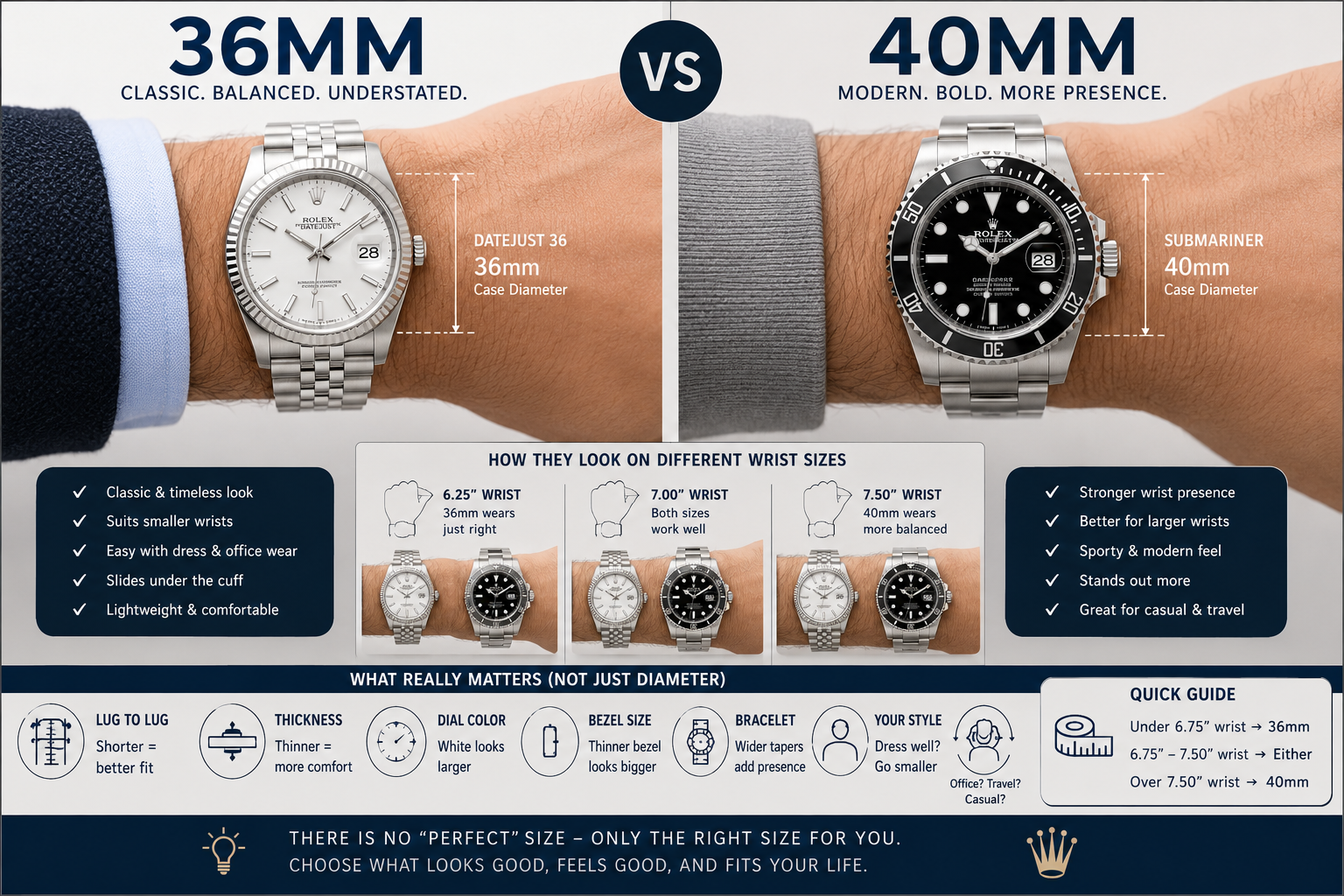
36mm vs 40mm Watches: Which Size Looks Better for Everyday Wear?
Choosing between 36mm and 40mm sounds like a small decision.
It is only four millimeters.
But on the wrist, those four millimeters can completely change how a watch feels. A 36mm watch can look classic, balanced, and easy to wear. A 40mm watch can look stronger, sportier, and more modern. Neither size is automatically better, but one of them will usually fit your wrist, wardrobe, and daily routine more naturally.
This matters even more if you are buying your first luxury watch or your first high-quality replica watch. In product photos, almost every watch looks perfect. In real wrist shots, mirror photos, and daily outfits, the difference between 36mm and 40mm becomes much more obvious.
If you are still learning how watch size works, start with our full watch size guide. It explains case diameter, lug-to-lug, thickness, and why the same diameter can feel very different depending on the design.
This guide focuses on the practical buyer question: should you choose 36mm or 40mm for everyday wear?
The Quick Answer
Choose 36mm if you want a classic, balanced, understated watch that works well for office wear, smaller wrists, dress-casual outfits, and long-term comfort.
Choose 40mm if you want more wrist presence, a sportier look, better casual impact, and a watch that feels more modern in daily wear.
For most wrists under 6.75 inches, 36mm is usually safer.
For most wrists from 6.75 to 7.5 inches, both 36mm and 40mm can work.
For wrists above 7.5 inches, 40mm often feels more natural.
But wrist size is only one part of the decision. The shape of the case, dial color, bezel thickness, bracelet style, lug-to-lug length, and your clothing style all matter.
A Real Buyer Example
Imagine a buyer choosing his first Rolex-style everyday watch.
He sees a 40mm model online and likes how strong it looks in photos. The watch fills the frame, the dial looks bold, and the bracelet has presence. It feels like a serious daily watch.
Then he tries on a 36mm model in person.
At first, it looks smaller than expected. But after wearing it for a few minutes, it starts to feel natural. It slides under a sleeve, does not overpower his wrist, and looks better in a mirror photo than in a close-up wrist shot.
This is the mistake many buyers make.
They judge watch size from close-up photos instead of real-life distance.
A 40mm watch often looks better in product photos.
A 36mm watch often looks better in daily life.
That does not mean 36mm is always better. It means you should not choose size based only on online photos.
If you are choosing your first replica watch, our guide to Best First Replica Watch to Buy is a good starting point because size, lifestyle, and model choice should be decided together.
Why 36mm Watches Still Work So Well
36mm watches have stayed popular because they are easy to wear.
They do not dominate the wrist. They do not fight with your outfit. They usually feel lighter, thinner, and more comfortable for long days.
A good 36mm watch can work with:
- office shirts
- suits
- knitwear
- polos
- casual jackets
- denim
- smart casual clothing
This is why models like the Rolex Datejust 36, Rolex Explorer 36, and many vintage-inspired watches remain so appealing. They feel classic instead of small.
If you are specifically comparing Datejust sizes, our Rolex Datejust 36 vs 41 guide explains why many buyers return to 36mm after trying larger watches.
When 36mm Is the Better Choice
36mm is usually better if you prefer subtle style.
It works especially well if your wardrobe is more refined than sporty. If you wear shirts, jackets, tailored trousers, loafers, knitwear, or clean minimal outfits, 36mm often feels more natural.
It is also a strong option for people who do not want their watch to be the first thing others notice.
This is important for office wear. A 36mm Datejust, Explorer, or Oyster Perpetual can look mature and confident without feeling loud. It also works better under a cuff, which makes it more comfortable for workdays.
If you want a refined daily watch for professional settings, read our guide to Best Replica Watches for Office Professionals. Many of the strongest office watches are not oversized; they win because they look balanced.
Where 36mm Can Feel Too Small
36mm is not perfect for everyone.
If your wrist is larger or your personal style is very casual, sporty, or streetwear-focused, a 36mm watch may feel too quiet. It can disappear too much, especially if the dial is dark and the bezel is thin.
A 36mm watch may also feel smaller if you are used to dive watches, chronographs, or modern sports watches. If your daily wardrobe includes hoodies, oversized jackets, sneakers, and casual clothing, a 40mm watch may match the overall style better.
There is also a psychological factor.
Some buyers simply prefer stronger wrist presence. If you constantly look down and feel the 36mm watch is too small, you may not enjoy wearing it, even if the proportions are technically correct.
Why 40mm Watches Feel More Modern
40mm became popular because it gives more presence without becoming huge.
For many buyers, 40mm feels like the modern sweet spot. It is large enough to look sporty and confident, but not as oversized as 42mm, 44mm, or larger cases.
A 40mm watch usually feels better with:
- casual outfits
- travel clothing
- sports watches
- dive watches
- GMT watches
- larger wrists
- modern street-casual style
This is why watches like the Rolex Submariner, GMT-Master II, Explorer 40, and many Omega sports models feel natural around the 40mm range.
If you are comparing Rolex sport models, our Rolex Submariner vs GMT-Master II guide is useful because both watches show why 40mm can feel practical, sporty, and versatile.
When 40mm Is the Better Choice
40mm is usually better if you want a watch with stronger personality.
It works well if you dress casually most of the time. It also makes sense if you want the watch to look more noticeable in photos, videos, wrist shots, and travel pictures.
A 40mm watch is often better for sportier designs because the case, bezel, dial, and bracelet feel more balanced. A dive watch, GMT watch, or chronograph usually needs more space to look natural.
For example, a Rolex Submariner-style watch in 40mm usually feels right because the bezel and dial need visual space. A smaller version might look more elegant, but it may lose some of the sport-watch character.
If you are looking at Submariner-style options, our guide to Best Rolex Submariner Alternatives compares real, homage, and replica options for different buyers.
Where 40mm Can Be Too Much
40mm can be too large if the watch has long lugs, a thick case, a bright dial, or a wide bracelet.
This is where many buyers make a mistake. They think 40mm is always safe because it sounds moderate. But 40mm on one watch can wear like 39mm, while another 40mm watch can feel closer to 42mm.
A thin bezel makes the dial look larger.
A white dial makes the watch look larger.
Long lugs make the case spread across the wrist.
A thick case makes the watch feel heavier and less elegant.
That is why diameter alone is not enough.
If you are comparing dial colors and visual size, read our guides to black dial vs blue dial watches and white dial vs silver dial watches. A 40mm black dial watch and a 40mm white dial watch can look surprisingly different on the same wrist.
Wrist Size: The Practical Rule
Here is a simple starting point.
If your wrist is under 6.25 inches, 36mm is usually the safer choice.
If your wrist is 6.25 to 6.75 inches, 36mm to 38mm is often ideal, but some 40mm watches can work if the lug-to-lug is short.
If your wrist is 6.75 to 7.25 inches, both 36mm and 40mm can work. Your personal style becomes more important.
If your wrist is 7.25 inches or larger, 40mm will usually feel more natural, although 36mm can still work if you like classic proportions.
For replica buyers, wrist size matters even more because return options may be limited. Our Replica Watch Size Guide explains how to judge case size from QC photos, wrist shots, and real-life proportions before buying.
36mm vs 40mm for Office Wear
For office wear, 36mm usually wins.
It looks refined, controlled, and professional. It does not distract from your outfit. It works well with shirts, jackets, and formal clothing.
A 36mm Datejust, Explorer, or Oyster Perpetual can feel like a natural part of the outfit instead of a separate statement piece.
40mm can still work at the office, especially in modern business-casual environments. An Aqua Terra, Explorer 40, or understated sports watch can look excellent. But if the watch is thick, shiny, or very sporty, it may feel less formal.
If you are choosing between simple Rolex models for daily work, our comparison of Rolex Explorer vs Oyster Perpetual shows why both watches appeal to buyers who want a quieter Rolex.
36mm vs 40mm for Casual Wear
For casual wear, 40mm often has the advantage.
Casual clothing usually has more relaxed proportions. T-shirts, denim, jackets, sneakers, and travel outfits can support a slightly larger watch. A 40mm watch may feel more natural and visible in those settings.
That said, 36mm can also look excellent with casual clothing if your style is clean and understated. A 36mm Explorer or Oyster Perpetual can look especially good with simple outfits because it does not try too hard.
If you like low-key casual watches, our guide to Best Low-Key Replica Watches includes models that stay wearable without looking overly flashy.
36mm vs 40mm for Travel
For travel, the best size depends on the trip.
If you are traveling for business, 36mm or 38mm often makes sense. The watch looks refined, packs easily into different outfits, and does not attract too much attention.
If you are traveling for vacation, outdoor activities, or casual city trips, 40mm may feel more practical. It gives more presence, often offers better legibility, and works well with sportier designs.
A simple three-hand 36mm watch can be perfect for city travel. A 40mm GMT or dive-style watch may be better if you want a more functional travel watch.
If travel is a key part of your buying decision, read our guide to Best Replica Watches for Travel. It compares GMT, dive, everyday, and low-key travel options for different lifestyles.
Model Examples: How 36mm and 40mm Feel Different
The Rolex Datejust is a good example.
A Datejust 36 feels classic, dressy, and balanced. A Datejust 41 feels more modern and noticeable. The same design language becomes a different watch because of size.
The Oyster Perpetual is similar. A 36mm Oyster Perpetual feels clean and restrained. A 41mm Oyster Perpetual feels more casual and contemporary. Our Rolex Oyster Perpetual 36 vs 41 guide explains this difference in more detail.
The Omega Aqua Terra also shows why small size differences matter. A 38mm Aqua Terra feels refined and versatile. A 41mm Aqua Terra feels sportier and stronger. If you are comparing those two, read Omega Aqua Terra 38 vs 41 before deciding.
Cartier works differently because case shape changes everything. A Santos Medium may wear more naturally than expected, while the Large gives much stronger presence. Our Cartier Santos Medium vs Large comparison is useful if you are deciding between square-case sizes. For rectangular dress watches, Cartier Tank Small vs Large explains why shape matters as much as diameter.
Replica Watch Buyers: What to Check Before Choosing Size
Replica buyers should be extra careful with size because small differences in thickness, bracelet fit, and case shape can change the wearing experience.
Before choosing 36mm or 40mm, check:
- real wrist photos
- mirror photos
- lug-to-lug measurement
- case thickness
- bracelet taper
- clasp size
- dial color
- bezel thickness
- how the watch looks from the side
A 40mm replica with a thick case can feel much larger than expected. A 36mm replica with good proportions can feel more premium and comfortable than a larger watch.
Also check the bracelet. A watch that looks right from the front can still feel uncomfortable if the bracelet does not articulate well around the wrist. Our Replica Watch Bracelet and Strap Guide explains how Oyster, Jubilee, leather, rubber, and integrated bracelets change comfort and visual size.
Before confirming an order, use our Replica Watch QC Checklist Before Buying to review dial alignment, date window, case shape, bracelet fit, and real wrist photos.
One-Watch Collection: 36mm or 40mm?
If this will be your only watch, choose the size that works with the most outfits.
For a refined wardrobe, 36mm is often better. It works with office wear, dinners, casual shirts, and formal clothing.
For a casual wardrobe, 40mm may be better. It works with denim, T-shirts, jackets, travel wear, and sportier outfits.
If your wardrobe is mixed, 38mm to 40mm may be the safest middle ground, depending on the model. That is one reason watches like the Aqua Terra 38, Datejust 36, Explorer 36/40, and Santos Medium/Large attract so many daily wear buyers.
If you are thinking beyond one watch, our guide to 2-Watch vs 3-Watch Collection explains how size, style, and watch roles should work together.
Second Watch: Why the Opposite Size Can Make Sense
If you already own a 40mm sports watch, a 36mm dress-casual watch can make your collection feel more balanced.
For example:
- 40mm Submariner-style watch for sport and travel
- 36mm Datejust or Explorer for office and daily wear
If you already own a 36mm refined daily watch, a 40mm sports watch can add more personality.
For example:
- 36mm Datejust for work
- 40mm GMT or diver for weekends and travel
This is how smart collections are built. The goal is not to own watches that all look the same. The goal is to give each watch a role.
Practical Try-On Test
Before buying, do this simple test.
First, take a close-up wrist photo. Then take a mirror photo from normal distance.
The close-up photo will often make the watch look bigger. The mirror photo shows how the watch actually looks to other people.
Next, wear the watch with three outfits:
- a casual outfit
- an office outfit
- a jacket or long-sleeve outfit
If the watch works with all three, the size is probably right.
If it only works in one setting, think carefully before buying.
Finally, check comfort. A watch that looks perfect but feels annoying after two hours is not the right size for daily wear.
Final Verdict
Choose 36mm if you want a classic, comfortable, understated watch that works especially well for office wear, smaller wrists, dress-casual outfits, and long-term daily use.
Choose 40mm if you want more presence, a sportier look, stronger casual impact, and a watch that feels more modern on the wrist.
For first-time buyers, 36mm is often better than expected.
For sport-watch buyers, 40mm is usually more natural.
For replica buyers, do not choose size from product photos alone. Check wrist shots, lug-to-lug, thickness, bracelet fit, and dial color before deciding.
The best size is not the one that looks biggest in photos.
It is the one that still feels right after a full day on your wrist.