- Home
- Rolex Datejust Jubilee vs Oyster Bracelet: Comfort, Style, and Resale Differences
Rolex Datejust Jubilee vs Oyster Bracelet: Comfort, Style, and Resale Differences
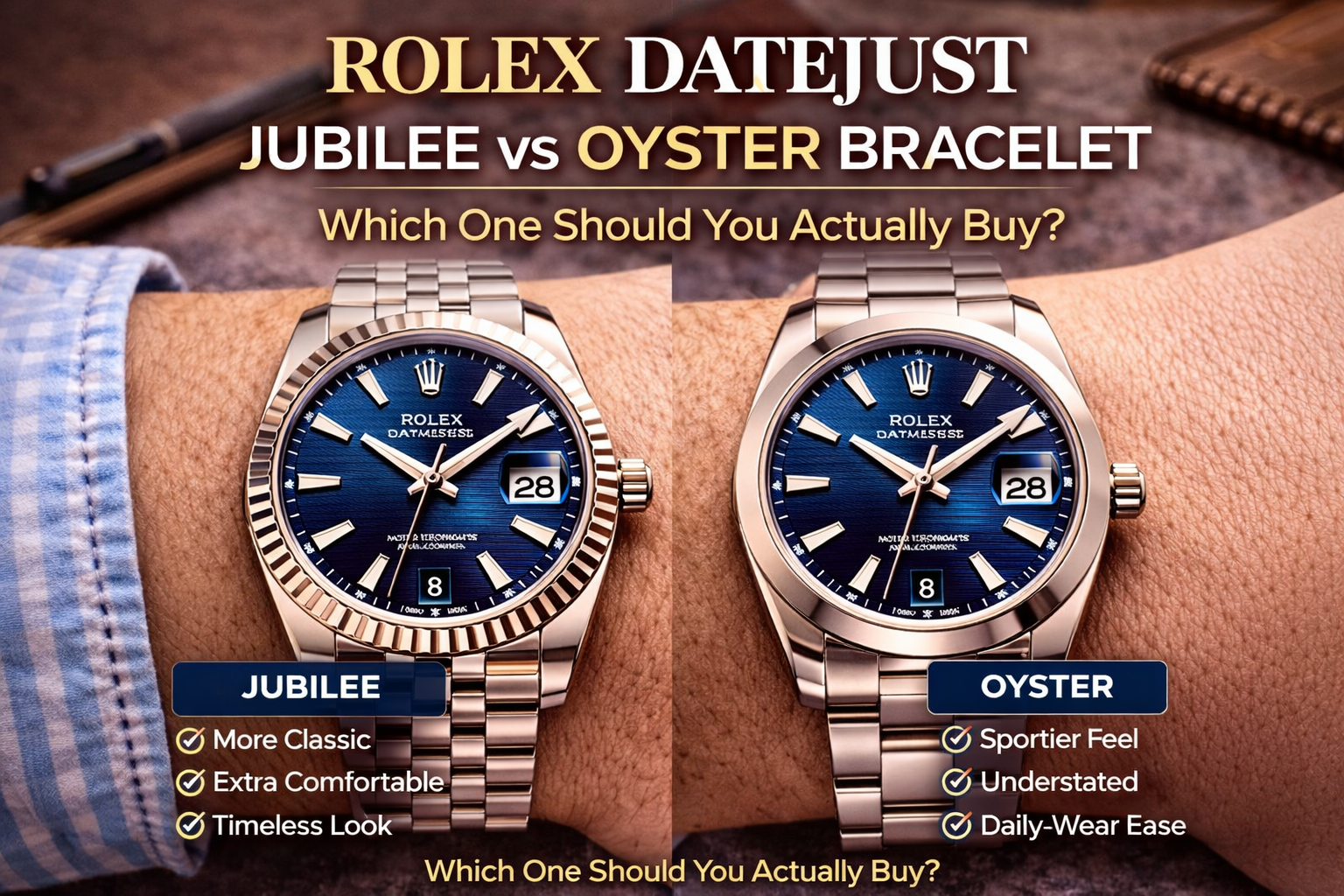
If you are buying a Rolex Datejust, the bracelet decision is not a minor detail.
It is one of the biggest choices you will make.
A lot of buyers spend weeks comparing dial colors, bezel styles, and case sizes, then treat the bracelet like a finishing touch. That is usually a mistake. Because once the watch is on your wrist every day, the bracelet affects almost everything: comfort, visual personality, how dressy the watch feels, how casual it feels, how much attention it gets, and even whether you still love it six months later.
That is why the Rolex Datejust on Jubilee and the Rolex Datejust on Oyster can feel like two different watches, even when the dial, bezel, and case size are the same.
So which one should you actually buy?
The short answer is this: buy the Jubilee bracelet if you want the more classic, more elegant, more unmistakably “Datejust” version of the watch. Buy the Oyster bracelet if you want the cleaner, sportier, more understated daily-wear version.
That is the simple version.
But the real answer depends on whether you want your Datejust to feel more iconic or more relaxed once it becomes part of your real life.
The short answer
Buy the Jubilee bracelet if you want:
- the most classic Datejust look
- more visual texture and light play
- a dressier, more refined feel
- stronger emotional pull and traditional Datejust identity
Buy the Oyster bracelet if you want:
- a cleaner, sportier look
- a more understated daily-wear feel
- easier styling with casual clothes
- a Datejust that feels a little less jewelry-like
If you already know the Rolex Datejust you picture in your head is the classic one, you are probably picturing a Jubilee bracelet.
If you want a Rolex that feels simpler, calmer, and easier to wear with almost anything, Oyster often makes more sense.
Why this bracelet choice matters more than most buyers expect
The bracelet changes the whole tone of the watch.
That is the truth many first-time buyers only understand after trying both on.
The Jubilee bracelet gives the Datejust more character. It makes the watch feel more traditional, more polished, and more visibly luxurious. It catches light differently. It adds more visual movement. It makes the watch feel like a complete Datejust in the most classic sense.
The Oyster bracelet does something else. It simplifies the watch. It reduces some of the visual complexity and makes the Datejust feel more direct, more modern, and more everyday-friendly.
That is why this is not just a comfort choice.
It is an identity choice.
If you are still deciding what kind of Datejust you want overall, it helps to read Rolex Datejust Smooth Bezel vs Fluted Bezel: Which One Should You Actually Buy? and Rolex Datejust 36 vs 41: Which Size Is Actually Better for Real Daily Wear?, because bracelet preference often becomes much clearer once you know whether you want a more classic or more modern Datejust setup.
The Jubilee bracelet: why it feels like the “real” Datejust to so many buyers
Let’s start with the emotional favorite.
For many people, the Jubilee bracelet is not just one option.
It is the Datejust option.
There is a reason for that. The Jubilee bracelet gives the watch a softer, richer, more traditional luxury presence. It adds texture. It adds visual depth. It makes even a simple dial feel more expressive on the wrist. And on a fluted bezel Datejust especially, it creates that unmistakable Rolex combination so many buyers have in their heads long before they ever try one on.
This is why the Jubilee often wins the first emotional reaction.
It feels more special.
It feels more finished.
It feels more like the version of the Datejust someone dreams about when they think of owning one someday.
If your purchase is partly about reward, symbolism, and the full classic Rolex feeling, the Jubilee bracelet has a real advantage.
It does not try to hide what the watch is.
That is exactly why people love it.
The Oyster bracelet: why it often makes more sense for real daily wear
Now let’s talk about the bracelet that quietly wins a lot of long-term ownership arguments.
The Oyster bracelet often makes the Datejust easier to live with.
It looks cleaner. Sportier. More restrained. It removes some of the dressier energy the Jubilee brings and turns the Datejust into something a little more relaxed and a little more casual.
For many buyers, that makes a huge difference.
A Datejust on Oyster often feels more natural with T-shirts, polos, knitwear, denim, travel clothes, and general daily life. It still looks premium, but it does not feel like it is constantly trying to remind you that it is a luxury object.
That is why many buyers who want a true one-watch collection end up leaning Oyster.
Not because it is more exciting.
Because it is easier.
If you are still deciding whether you even want the more classic Datejust personality or something simpler, Rolex Datejust vs Oyster Perpetual: Which One Is the Better One-Watch Luxury Choice? is worth reading too, because some buyers who prefer Oyster bracelet Datejusts are really telling themselves they want the cleaner side of Rolex ownership overall.
Comfort: which bracelet actually feels better?
This is where many people hope for one universal answer.
There is not one.
But there is a pattern.
The Jubilee bracelet often feels more flexible and more fluid on the wrist. Because of its smaller links, it tends to drape more naturally and can feel a little more refined in motion. Many owners love the way it settles around the wrist, especially during longer wear.
The Oyster bracelet often feels more solid, more direct, and a little more substantial. Some buyers prefer that immediately. It can feel simpler and more robust, especially if you like a bracelet that feels a bit more structural rather than silky.
So which one is actually more comfortable?
For many buyers, the Jubilee feels more comfortable in a softer, more adaptive way.
For many buyers, the Oyster feels more comfortable in a cleaner, more stable way.
That sounds subtle, but on the wrist it is not.
A lot depends on sizing too, which is why Watch Bracelet Sizing Guide: How Tight Should It Be? (Comfort, Fit Tests & Fixes) matters so much here. Buyers often blame the bracelet style when the real problem is simply poor fit.
And if you are choosing between Datejust case sizes at the same time, Watch Size Guide: Case Diameter, Lug-to-Lug & Thickness (How to Choose the Perfect Fit) belongs in the same decision process. A watch that is slightly too large or slightly too small can completely distort how a bracelet feels.
A real buyer example: the bracelet that won in the store was not the one he bought
A buyer I know went into a dealer fully convinced he wanted a fluted Datejust on Jubilee.
That was the image he had always liked online. It looked elegant, expensive, and unmistakably Rolex. The first time he tried it on, it gave him exactly the reaction he expected.
Then he tried the Oyster bracelet version.
At first, it felt less special.
Less light play. Less classic energy. Less of that instant “this is the one” feeling.
But on the second visit, something changed.
He noticed the Oyster version looked more like something he would actually wear four or five days a week without thinking about it. It felt easier with his wardrobe. Easier with his work life. Easier with his travel habits. The Jubilee looked better in the showroom. The Oyster looked better in his life.
He bought the Oyster.
A year later, he still thought the Jubilee looked more beautiful in photos. But he also said he was glad he bought the watch he would actually wear more often.
That is a very common story.
The reverse happens too. Some buyers choose Oyster because it feels more rational, then keep looking at Jubilee Datejust photos afterward. That is usually a sign they bought the sensible bracelet, not the one they really wanted emotionally.
Style: which bracelet looks better?
This depends entirely on what you mean by “better.”
If you mean more elegant, more iconic, more classic, and more unmistakably Datejust, the Jubilee looks better.
If you mean cleaner, more modern, more restrained, and more versatile with casual wear, the Oyster looks better.
That is the real split.
The Jubilee wins the traditional Datejust beauty contest.
The Oyster wins the understated daily-wear contest.
And buyers get stuck because they often ask the wrong question.
They ask, “Which bracelet looks better?” when what they really mean is, “Which bracelet will still feel right after the first excitement wears off?”
That is a much smarter question.
Which one works better with different bezel choices?
This matters a lot more than people think.
A fluted bezel on Jubilee is the most classic, most recognizable, and most fully realized Datejust look for many buyers. It is the combo most associated with traditional Datejust charm.
A smooth bezel on Oyster is the cleanest and sportiest interpretation of the Datejust. It feels more relaxed, more understated, and more everyday.
But the mixed combinations are often where things get interesting.
A fluted bezel on Oyster keeps the iconic Rolex energy but tones down some of the dressiness of the full classic setup.
A smooth bezel on Jubilee softens the watch and adds texture without making it quite as bold as a fluted bezel version.
This is why bracelet choice should never be made in isolation. You should think about the whole personality of the watch, not just one component.
If your broader decision is really about whether you want a more classic everyday luxury watch or a more understated one, Rolex Datejust vs Omega Aqua Terra: Which Everyday Luxury Watch Makes More Sense? helps frame that bigger question very well.
Which bracelet is better for real daily wear?
For many people, the Oyster bracelet.
Not because the Jubilee cannot be worn daily. It absolutely can.
But daily wear rewards simplicity. It rewards ease. It rewards the feeling that the watch slips into your life without demanding too much attention from you or from other people.
That is where Oyster often wins.
It feels a little more grounded. A little less ornate. A little more neutral across changing situations. It is often the bracelet people choose when they want their Datejust to behave more like a one-watch collection and less like a classic luxury accessory.
The Jubilee, on the other hand, makes daily wear feel more rewarding for people who actually want to feel that extra bit of elegance every time they check the time.
So again, the real question is not which bracelet is better.
It is this:
Do you want your daily watch to feel easier, or more special?
Oyster is usually easier.
Jubilee is usually more special.
Which bracelet shows wear differently?
This is another area where buyers want a simple winner.
The truth is more practical than that.
The Oyster bracelet has broader brushed surfaces and a simpler overall look, so daily wear can read more directly in certain lighting. Marks on a simpler design can stand out because there is less visual texture to distract from them.
The Jubilee bracelet has more small surfaces and more visual complexity, which can make everyday wear read differently. But it also means buyers often inspect it more closely because it is such a defining part of the watch’s appearance.
Neither bracelet lives in some magical scratch-free world.
The more useful question is how much visible wear bothers you emotionally.
If you know even small cosmetic signs of ownership will drive you crazy, read Should You Polish a Watch? Scratch Reality, Resale Value & Better Alternatives before you make future decisions you may regret. Many owners do more damage trying to erase normal wear than the wear itself ever caused.
Resale: which bracelet is better when it is time to sell?
In general, the Jubilee bracelet often has stronger emotional appeal because it looks more like the Datejust many buyers imagine.
That matters in resale.
A lot of buyers shopping pre-owned want the watch that feels most “Datejust” right away. That usually means classic dial, classic bezel, and often Jubilee bracelet. So if you are thinking in terms of broad instant appeal, Jubilee often has the advantage.
But Oyster should not be underestimated.
The Oyster bracelet appeals strongly to buyers who want a sportier, cleaner, less flashy Datejust. In some cases, that can actually make it easier to sell to buyers who specifically want an everyday Rolex rather than a more traditional one.
So the resale answer is not just about which bracelet is worth more in theory.
It is about which buyer you are selling to later.
Jubilee often wins the classic-emotional resale argument.
Oyster often wins the low-key-practical resale argument.
If you are buying pre-owned, condition still matters more than bracelet type alone. That is why you should already have How to Spot a Fake Rolex Before You Buy: 13 Red Flags That Actually Matter, How to Tell If a Watch Is Overpolished Before You Buy, and Fake vs Aftermarket vs Franken Watch: The Difference That Can Cost You Thousands open before sending money.
And if you are buying in person, How to Check a Used Watch in Person: 15 Things to Inspect Before You Buy matters far more than just bracelet preference.
Which bracelet is better as your first Rolex?
If your first Rolex is about fulfilling the dream, buy the Jubilee.
That is the honest answer for a lot of buyers.
Because many first-time Rolex owners do not just want a good bracelet. They want the bracelet that completes the feeling they have been imagining for years.
If that is you, buying Oyster because it feels more rational may not end well. You may keep admiring Jubilee Datejusts long after you buy.
But if your first Rolex is about getting a watch you can wear almost every day without it feeling too polished or too classic, Oyster may genuinely be the smarter first Rolex choice.
So the answer is simple:
- If your first Rolex is about the full classic Datejust experience, buy Jubilee
- If your first Rolex is about building the easiest long-term daily wearer, buy Oyster
Neither answer is wrong.
The mistake is pretending you want one when you really want the other.
A practical 5-minute try-on test
If you are standing in front of both bracelets and still cannot decide, do this.
Put the Jubilee version on first and leave it there for five minutes. Move naturally. Check the time casually. Slide it under your cuff. Step near light. Notice how much visual activity the bracelet adds.
Then do the same with Oyster.
Now ask yourself:
- Which one feels better after the first excitement fades a little?
- Which one works better with your actual clothes?
- Which one feels more like a watch you would truly wear often?
- Which one feels more like you?
- If you bought the other one, which would you keep thinking about later?
That last question matters most.
Because in luxury watches, the thing you keep thinking about is usually the thing you should have bought.
So which one should you actually buy?
Here is my honest view.
If you are uncertain and want the safer, lower-friction daily-wear choice, buy the Oyster bracelet.
If you are uncertain but know the classic Datejust image is a huge part of why you want the watch at all, buy the Jubilee bracelet.
The Oyster is usually the calmer decision.
The Jubilee is usually the more emotional one.
And because this is Rolex, emotional truth matters more than many buyers want to admit.
Too many people optimize the purchase until they buy the bracelet that makes the most sense on paper, then spend the next year admiring the one they actually wanted.
That is not smart buying.
That is delayed regret.
Final verdict
Choose the Jubilee bracelet if you want the most classic, most expressive, and most unmistakably Datejust version of the watch.
Choose the Oyster bracelet if you want the cleaner, sportier, more understated version that often fits real daily life more easily.
If your priority is timeless Rolex charm and emotional satisfaction, Jubilee makes more sense.
If your priority is versatility, low-key style, and everyday ease, Oyster makes more sense.
The Jubilee is often the harder bracelet to forget.
The Oyster is often the easier bracelet to live with.
And when you are spending this kind of money, that difference matters.
FAQ
Is the Jubilee bracelet more comfortable than Oyster?
For many buyers, yes, because it feels more flexible and drapes more naturally on the wrist. But some people prefer the more solid and straightforward feel of Oyster.
Is the Oyster bracelet better for daily wear?
For many people, yes. It tends to feel sportier, simpler, and easier to style across everyday situations.
Which bracelet is better for resale?
The Jubilee often has stronger classic emotional appeal, but Oyster can be very attractive to buyers who want a cleaner, more understated Datejust.
Which bracelet looks more expensive?
Usually Jubilee, because it has more visual texture and stronger classic luxury presence.
Which one should I buy as a first Rolex?
Buy Jubilee if you want the classic Datejust dream. Buy Oyster if you want the more practical, wear-everywhere version.