- Home
- Replica Watch QC Checklist Before Buying: What to Check in Photos, Videos, and Real Wrist Shots
Replica Watch QC Checklist Before Buying: What to Check in Photos, Videos, and Real Wrist Shots
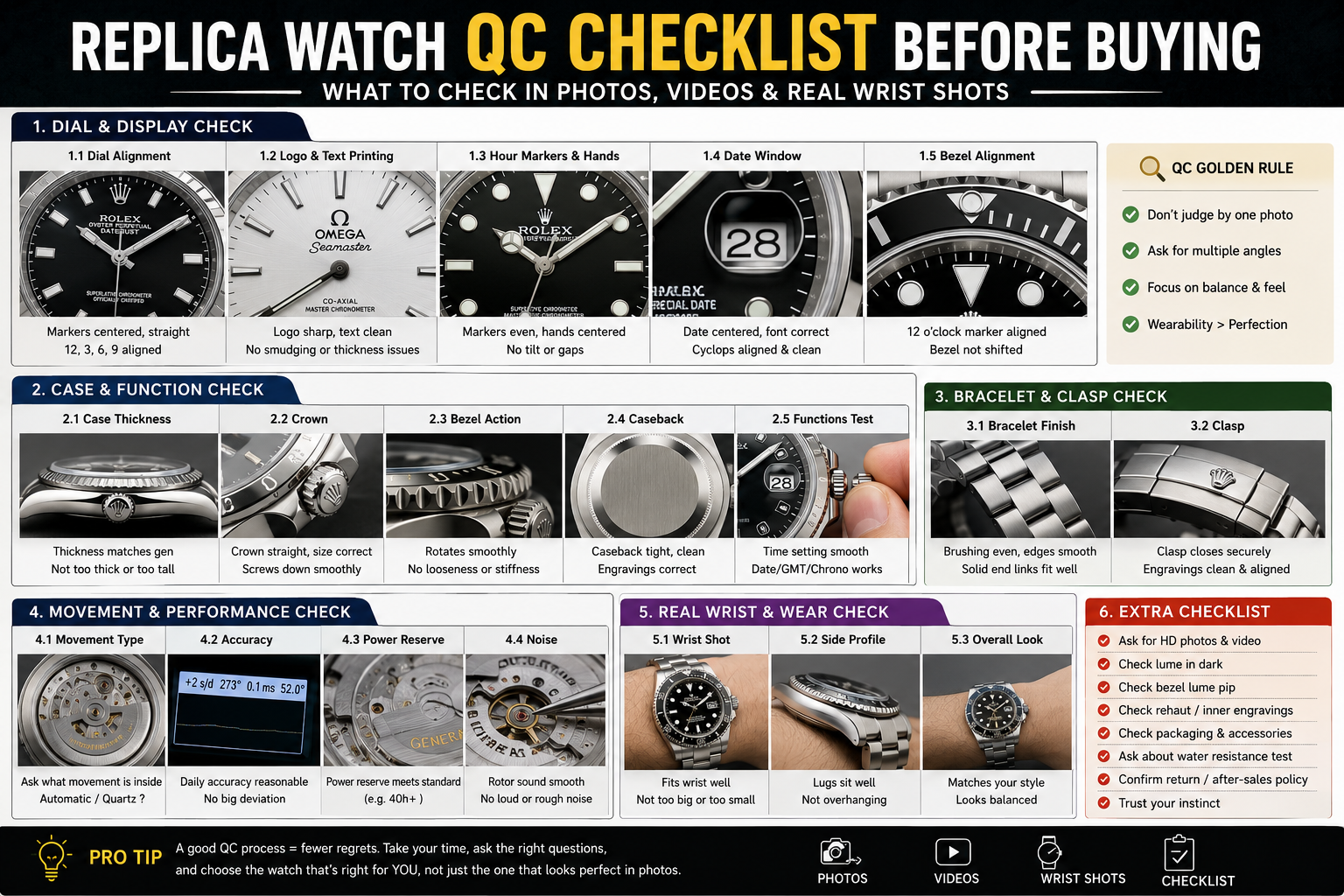
Buying a replica watch should not be based only on one beautiful product photo.
A watch can look excellent from the front, but the real buying decision depends on many small details: dial alignment, date window, bezel position, case thickness, bracelet feel, clasp quality, movement choice, and how the watch looks on a real wrist.
That is why a simple QC checklist matters.
QC means quality check. Before you pay or confirm an order, you should know what to look for in photos, videos, and real wrist shots. You do not need to be a professional watchmaker. But you should be able to spot obvious issues, ask the right questions, and understand whether the watch fits your real use.
This guide gives you a practical replica watch QC checklist for first-time and repeat buyers. It is written for real buying decisions, not just theory.
If you are still choosing your first model, start with our guide on best first replica watch to buy. If you are unsure about size, read our replica watch size guide before checking final photos.
Quick Answer: What Should You Check Before Buying a Replica Watch?
Before buying a replica watch, check these points:
Dial alignment
Hour marker position
Logo and text printing
Date window alignment
Cyclops magnification if the model has one
Bezel alignment and action
Case thickness
Crown position and operation
Bracelet finishing
Clasp quality
Movement type
Time-setting and date-setting function
Real wrist fit
Side profile
Water-resistance testing if needed
Seller photos and videos
The goal is not to chase perfection under extreme zoom. The goal is to make sure the watch looks balanced, functions properly, and matches the wearing experience you want.
Why QC Matters More Than Product Photos
Product photos are designed to make a watch look attractive. They are usually taken under good lighting, from the best angle, and often without showing the small details that affect daily wear.
QC photos and videos are different.
They should show the actual watch you may receive. They help you check whether the dial is straight, whether the bracelet looks clean, whether the case is too thick, whether the date sits correctly, and whether the watch looks natural on the wrist.
Many buyers make the mistake of looking only at the first front-facing photo. But a watch is a three-dimensional object. You need to see the front, side, clasp, bracelet, caseback, crown, and ideally a short video.
A replica watch can have a beautiful dial and still feel wrong if the bracelet is uncomfortable or the case sits too tall.
Real Buyer Case: The Watch Looked Good Until the Side Photo
A buyer wanted a Submariner-style replica for daily wear. The front photo looked strong. The dial was clean, the bezel looked aligned, and the overall design looked close to what he wanted.
But he asked for a side photo.
That photo changed the decision. The case looked thicker than expected, and the watch sat high on the wrist. For a casual weekend watch, that might have been fine. But he wanted something comfortable for daily wear and travel.
He then compared another Submariner-style option with a better side profile. The second watch looked slightly less dramatic in the front photo, but it wore better in real life.
That is a common QC lesson: the best-looking front photo does not always mean the best wearing experience.
If you are choosing a Submariner-style model, our guide on replica Rolex Submariner vs real explains more about bezel, case, bracelet, water resistance, and daily wear.
Step 1: Check the Dial Alignment
The dial is the first thing most people notice.
Start by checking whether the dial looks centered and balanced. The hour markers should point correctly. The 12 o’clock marker should not lean. The 6 o’clock marker should line up with the center of the watch. The printed text should not look crooked.
For simple watches, dial issues are easier to notice because there are fewer details to distract the eye. This matters on models like Datejust, Oyster Perpetual, Aqua Terra, Explorer, and Cartier Tank-style watches.
For sportier watches, check whether the markers and bezel visually line up. A watch can look acceptable at first glance but feel slightly off if the markers are not evenly placed.
Do not judge from a tilted photo. Ask for a straight-on photo if needed.
Step 2: Check Logo and Text Printing
Logo and text printing should look clean and balanced.
You do not need to zoom in until the image becomes unrealistic. But from a normal close-up, the logo should not look blurry, too thick, too thin, or badly positioned. Text should sit straight and not appear crowded.
This is especially important on clean-dial watches because there is nowhere for poor printing to hide.
On a Datejust-style watch, check the crown logo, dial text, minute track, and date window area. On an Aqua Terra-style watch, check the dial logo, model text, and horizontal or vertical dial texture. On a Cartier-style watch, Roman numerals and printed minute tracks matter a lot.
If you are comparing Cartier models, read our guide on Cartier Santos vs Cartier Tank to understand why dial layout and case shape change the whole wearing experience.
Step 3: Check Hour Markers and Hands
Hour markers should sit evenly. They should not look tilted, too close to the edge, or uneven from one side to the other.
Hands should also be checked carefully. They should be centered, clean, and appropriate for the model. Look for dust, uneven finishing, or strange gaps.
For dive watches like Submariner, Seamaster, and Tudor Black Bay-style models, lume markers are very visible. If one marker is clearly misaligned, it may bother you every time you look at the watch.
For dressier models, even small alignment issues can stand out because the design is quieter.
This is not about being overly picky. It is about avoiding issues that will bother you after purchase.
Step 4: Check the Date Window
The date window is one of the easiest places to spot problems.
Check whether the date sits centered in the window. It should not be too high, too low, too far left, or too far right. Also check whether the font looks reasonable for the model.
If the watch has a cyclops magnifier, check whether the magnification looks natural and whether the cyclops is aligned over the date.
This is especially important for Datejust, Submariner Date, GMT-Master II, Santos, Aqua Terra, Seamaster, and many other daily watches.
If you are not sure whether you want a date or no-date sports watch, read our comparison of Rolex Submariner No Date vs Date. The cleaner no-date look can remove one QC concern, but many buyers still prefer the practical date function.
Step 5: Check Bezel Alignment
For any watch with a bezel, alignment matters.
The triangle or bezel marker at 12 o’clock should line up with the dial marker below it. If the bezel is slightly off in a photo, ask whether it is just not clicked into the correct position or whether the insert itself is misaligned.
For dive watches, check the bezel pip, minute markings, and rotation. For GMT watches, check the 24-hour scale and color split if the bezel has two colors.
This matters a lot on Submariner, Seamaster Diver 300M, GMT-Master II, Yacht-Master, Tudor Black Bay, and similar sport watches.
A small bezel issue can become very annoying because you see it every time you look at the watch.
If you are comparing travel bezels and dive bezels, read our guide on Rolex Submariner vs GMT-Master II.
Step 6: Check Case Thickness
Case thickness is one of the most overlooked QC points.
Many buyers only check the front. But the side profile tells you how the watch will actually wear. A watch that is too thick can feel bulky, less refined, and harder to wear under sleeves.
Ask for a side photo whenever possible.
Look at how the caseback sits. Look at the crystal height. Look at the bezel thickness. Look at whether the case looks balanced from the side.
This is especially important for replica watches because thickness can affect the whole wearing experience.
A Datejust-style watch should not feel like a thick sports watch. An Aqua Terra-style watch should not sit too tall. A Seamaster-style watch can be thicker because it is sporty, but it should still look balanced.
For more sizing and thickness advice, read our replica watch size guide.
Step 7: Check the Crown
The crown should sit straight and operate smoothly.
Ask whether the crown screws down properly if the model has a screw-down crown. Check whether it looks too large, too small, or poorly shaped compared with the case.
For dive and sports watches, crown function is especially important because it affects water resistance and daily reliability.
A crown that feels rough, loose, or difficult to operate can become a problem later.
If you plan to use the watch near water, the crown becomes even more important. You should also read our guide on whether you can swim or shower with a replica watch before assuming any watch is ready for water exposure.
Step 8: Check the Bracelet and Clasp
Bracelet quality can decide whether you enjoy the watch.
Look at the bracelet links. They should not look rough, sharp, uneven, or poorly finished. The bracelet should hang naturally. The clasp should close securely and sit well on the wrist.
For Jubilee-style bracelets, check link flexibility and whether the bracelet looks too loose. For Oyster-style bracelets, check brushing, polishing, and clasp feel. For integrated bracelets like Santos, Royal Oak, Nautilus, and Overseas-style watches, bracelet finishing becomes even more important because the case and bracelet visually flow together.
A watch with a good dial but poor bracelet will not feel satisfying as a daily piece.
If you are comparing Datejust bracelets, our guide on Rolex Datejust Jubilee vs Oyster bracelet explains how bracelet choice changes comfort, style, and daily wear.
Step 9: Check the Clasp Engraving and Feel
Many buyers ignore the clasp, but you interact with it every time you wear the watch.
The clasp should open and close securely. It should not feel flimsy or sharp. If there is engraving, it should look clean enough for the price level and model category.
For sports watches, also check adjustment features if available. Micro-adjustment can make a big difference in comfort, especially in warm weather when the wrist expands slightly.
If you plan to wear the watch daily, clasp comfort matters more than people think.
Step 10: Check Movement Type
Movement choice affects reliability, service access, and daily use.
Before buying, ask what movement is inside. Is it automatic or quartz? Is it a common movement? Can it be serviced? Does it support the functions shown on the watch?
For simple three-hand watches, movement choice is usually easier. For GMT, chronograph, annual calendar, or skeleton-style watches, the movement becomes more important because there are more functions to support.
A simpler, serviceable movement can be better for a first watch than a more complicated option that is harder to maintain.
If movement names confuse you, read our guide on Miyota vs ETA vs Sellita vs NH35 watch movements. It explains common movement types in a practical buyer-friendly way.
Step 11: Ask for a Short Video
A short video can reveal details that photos cannot.
Ask for a video showing:
The watch from the front
The side profile
The bracelet movement
The clasp opening and closing
Crown operation if possible
Date change if relevant
Bezel rotation if relevant
Time-setting function
Videos help you see whether the watch feels natural. They also reduce the risk of judging everything from one perfect photo.
For watches with rotating bezels, videos are especially helpful. For watches with bracelets, videos show whether the bracelet moves smoothly or feels stiff.
Step 12: Ask for a Real Wrist Shot
A real wrist shot is important because watches can look very different when worn.
A product photo shows the watch as an object. A wrist shot shows the watch as something you will actually wear.
Check whether the lugs stay within the wrist. Check whether the case looks too thick. Check whether the bracelet wraps naturally. Check whether the watch looks balanced from normal distance.
If the seller can provide a mirror-style wrist shot, even better.
For first-time buyers, wrist shots are often more useful than extreme close-ups.
Step 13: Check the Model Against Your Lifestyle
QC is not only about flaws. It is also about whether the watch fits your life.
A watch can pass every visual check and still be wrong for you.
Before confirming, ask:
Will I wear this with my real clothes?
Is the size right for my wrist?
Is the style too dressy or too sporty?
Is the dial color versatile enough?
Is the bracelet comfortable for daily use?
Do I want this watch for style, function, or collection?
A Daytona-style watch may look exciting but may not be the easiest first daily watch. A Datejust-style watch may look less dramatic but may be more useful every week. A Cartier Santos-style watch may fit dress-casual style better than a dive watch.
If you are still deciding by lifestyle, our best first replica watch guide can help you choose the right category before checking QC details.
Step 14: Check Water-Resistance Claims Carefully
Water resistance should never be assumed from appearance alone.
Even if the watch looks like a dive watch, it should be pressure tested before swimming or showering. This applies to replica watches, pre-owned watches, and even watches that have not been serviced for a long time.
Ask whether the watch has been tested. If not, treat it as splash-resistant at most and avoid unnecessary water exposure.
Crown position, gaskets, caseback sealing, and pressure testing all matter.
This is one area where practical caution is better than confidence based on looks.
Step 15: Do Not Chase Impossible Perfection
QC is important, but it is also important to stay realistic.
Under extreme zoom, almost every watch can show small differences or tiny imperfections. The real question is whether the watch looks good at normal viewing distance and whether any issue will bother you during daily wear.
Focus on visible alignment, function, comfort, and proportion.
Do not reject a watch only because of tiny details you would never notice on the wrist. But do not ignore major problems like crooked markers, badly centered date windows, thick cases, rough bracelets, or poor movement function.
Good QC is about balance.
QC Checklist by Watch Type
For a Datejust-style watch, check the bezel, dial markers, date window, cyclops, bracelet, clasp, and case thickness. If you are choosing a configuration, read our guide on best Rolex Datejust configuration to buy first.
For a Submariner-style watch, check bezel alignment, bezel action, dial markers, lume, crown, bracelet, clasp, case thickness, and water-resistance testing.
For a GMT-Master II-style watch, check bezel color, 24-hour scale, GMT hand alignment, date window, cyclops, movement function, and bracelet.
For an Aqua Terra-style watch, check dial texture, logo placement, date window, case thickness, bracelet, and overall clean proportions. Our guide on replica Omega Aqua Terra vs real covers this model in more detail.
For a Seamaster-style watch, check wave dial, bezel, hands, markers, helium escape valve position, bracelet or rubber strap, thickness, and water-resistance testing.
For a Cartier Santos-style watch, check square case shape, screw alignment, Roman numerals, bracelet finishing, clasp, and whether the size fits your wrist. If sizing is your concern, read Cartier Santos Medium vs Large.
For a Daytona-style watch, check subdial layout, chronograph pushers, bezel printing, case shape, bracelet, and movement function. Our guide on replica Rolex Daytona vs real explains this in more detail.
Common QC Mistakes Buyers Make
The first mistake is checking only the front photo.
The second mistake is ignoring case thickness.
The third mistake is not asking for a real wrist shot.
The fourth mistake is focusing only on the dial and forgetting bracelet comfort.
The fifth mistake is trusting water resistance without testing.
The sixth mistake is choosing a watch that passes QC but does not fit your lifestyle.
The seventh mistake is expecting every tiny detail to be perfect under extreme zoom.
The eighth mistake is not asking what movement is inside.
The ninth mistake is not checking date alignment.
The tenth mistake is ignoring clasp quality.
Most of these mistakes are easy to avoid if you follow a clear checklist before buying.
Practical QC Questions to Ask the Seller
Before confirming your purchase, ask:
Can I see a straight front photo?
Can I see a side profile photo?
Can I see a wrist shot?
Can I see the clasp and bracelet?
Can I see the caseback?
What movement is inside?
Does the date change correctly?
Does the crown screw down properly?
Does the bezel align at 12 o’clock?
Does the GMT or chronograph function work if the model has it?
Has water resistance been tested?
Can the watch be serviced if needed?
These questions are simple, but they help you avoid many common buying problems.
A serious seller should be able to answer practical questions clearly.
How to Decide If a QC Issue Matters
Not every issue has the same importance.
A slightly imperfect tiny print detail that you can only see under heavy zoom may not matter for daily wear.
A crooked marker that is visible at normal distance matters more.
A date window that sits too low may bother you every day.
A thick case may affect comfort.
A rough bracelet may make you stop wearing the watch.
A movement issue matters because it affects function.
When judging a QC issue, ask yourself one question:
Will I notice this during normal wear?
If the answer is yes, take it seriously. If the answer is no, do not overthink it.
Final Pre-Buy QC Checklist
Before you approve the watch, make sure you have checked:
Straight front photo
Side profile photo
Real wrist shot
Dial alignment
Hour marker alignment
Logo and text printing
Date window position
Cyclops alignment if included
Bezel alignment
Crown operation
Bracelet finishing
Clasp function
Movement type
Basic function test
Water-resistance testing if needed
Size and comfort
Lifestyle fit
If the watch passes these points, you can make a more confident buying decision.
FAQ
What does QC mean when buying a replica watch?
QC means quality check. It usually refers to reviewing photos, videos, and details of the actual watch before confirming the purchase.
Should I always ask for QC photos?
Yes. QC photos help you check the specific watch you may receive, not just a general product image.
What is the most important QC detail?
The most important details are dial alignment, date window position, bezel alignment, case thickness, bracelet quality, and movement function.
Is a small flaw always a problem?
Not always. Tiny details only visible under extreme zoom may not matter. Visible issues that affect normal wear, comfort, or function matter much more.
Should I ask for a video?
Yes, if possible. A video can show bracelet movement, bezel action, clasp function, crown operation, and overall presence better than still photos.
How important is case thickness?
Very important. A watch can have the right diameter but still feel wrong if it is too thick. Side profile photos are useful before buying.
Can I trust water resistance on a replica watch?
Only if the watch has been properly pressure tested. Without testing, avoid swimming or showering with it.
Should first-time buyers choose complicated watches?
Usually not. A simpler daily watch is often better for a first purchase because it is easier to wear, understand, and maintain.
Final Decision: How Should You QC a Replica Watch Before Buying?
Do not buy a replica watch from one beautiful photo.
Check the real watch from multiple angles. Look at the dial, markers, date, bezel, crown, bracelet, clasp, movement, case thickness, and wrist fit. Ask for photos and videos. Think about how the watch will fit your lifestyle, not just how it looks online.
A good QC process does not need to be complicated. It just needs to be practical.
The best replica watch is not only the one that looks good in a product image. It is the one that looks balanced, feels comfortable, functions properly, and makes sense for your daily life.
Take a few extra minutes before buying. It can save you from choosing the wrong watch.