Quartz vs Automatic for Daily Wear: Total Cost, Accuracy, Convenience & Maintenance
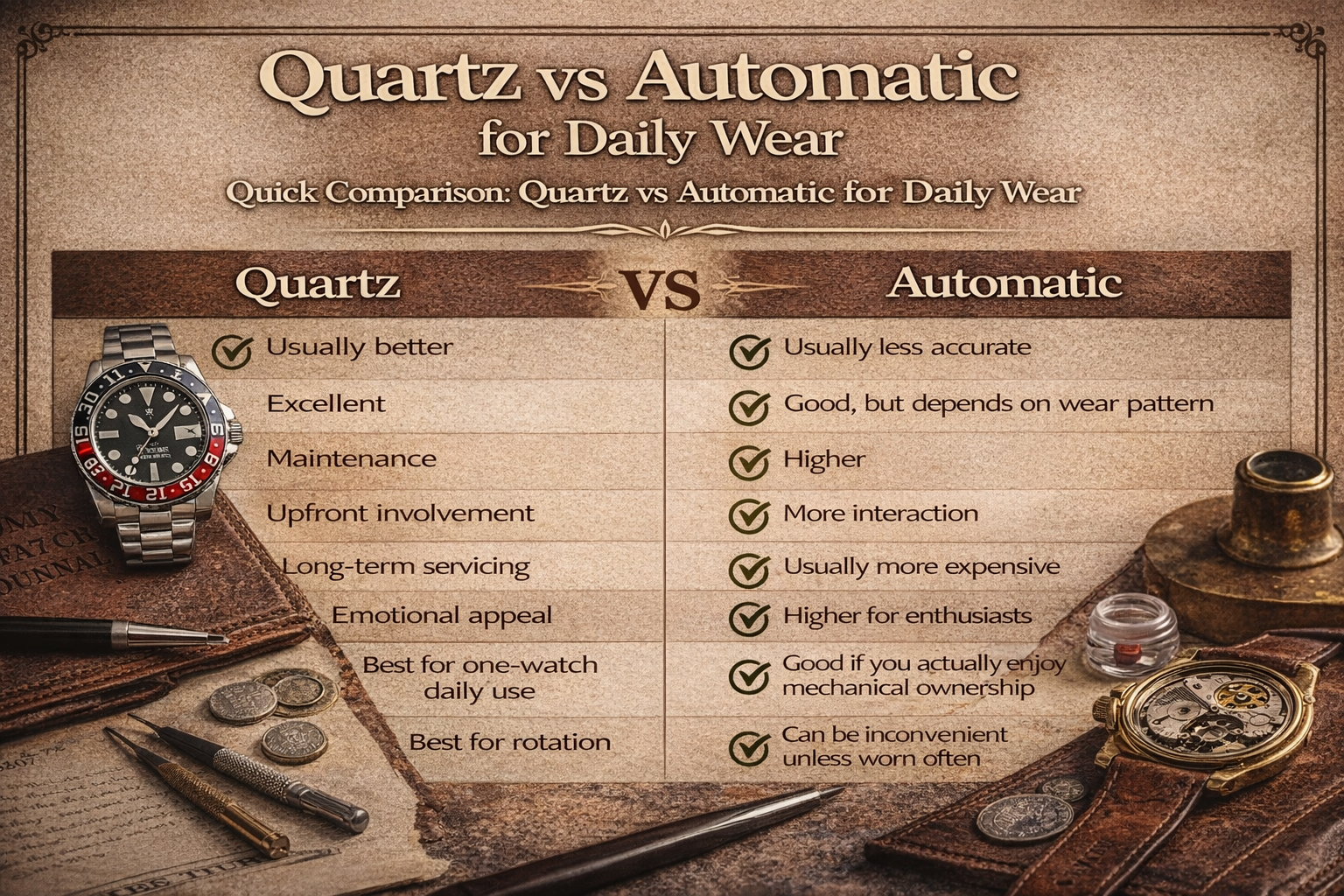 If you are buying a watch for daily wear, quartz is usually the smarter choice for most people. It is more accurate, easier to live with, lower-maintenance, and less likely to annoy you on a rushed Monday morning.
But that is not the whole story.
If you enjoy the mechanical side of watches, like the idea of wearing something powered by springs and gears, and do not mind a little interaction, an automatic can still be the more satisfying choice. It is just important to buy it for the right reasons.
That is where many people get this decision wrong.
They buy an automatic because it feels more “serious,” then get frustrated when it stops after a quiet weekend, needs resetting, or ends up costing more to maintain than expected. Or they buy quartz because it seems practical, then realize what they actually wanted was the emotional experience of a mechanical watch.
So the better question is not:
Which is better in general?
It is:
Which is better for the way you actually live?
The short answer
Choose quartz if you want:
- grab-and-go convenience,
- better day-to-day accuracy,
- lower ownership hassle,
- lower long-term maintenance cost,
- a watch you do not have to think about.
Choose automatic if you want:
- a more mechanical, traditional ownership experience,
- a smoother seconds-hand feel,
- no battery changes,
- a stronger emotional connection to the watch,
- and you are fine with more maintenance and occasional resetting.
For pure daily practicality, quartz wins.
For emotional enjoyment, automatic often wins.
Why this decision matters more than people think
A watch can look perfect in photos and still be the wrong daily wear choice.
This happens all the time.
A person buys an automatic because it feels more premium. For the first two weeks, they love it. Then real life starts showing up:
- they sit at a desk most of the day,
- they rotate watches during the week,
- the watch runs down if it sits too long,
- they have to reset the time on busy mornings,
- and the “romance” starts competing with convenience.
On the other side, someone buys a quartz watch because it is practical, accurate, and thin. Six months later, they realize they never bonded with it. It did everything right, but it never felt special.
Both outcomes are common.
That is why this is not just a spec-sheet comparison. It is a lifestyle decision.
Quick comparison: quartz vs automatic for daily wear
| Category | Quartz | Automatic |
|---|---|---|
| Accuracy | Usually better | Usually less accurate |
| Convenience | Excellent | Good, but depends on wear pattern |
| Maintenance | Lower | Higher |
| Upfront involvement | Almost none | More interaction |
| Long-term servicing | Usually simpler | Usually more expensive |
| Emotional appeal | Lower for enthusiasts | Higher for enthusiasts |
| Best for one-watch daily use | Excellent | Good if you actually enjoy mechanical ownership |
| Best for rotation | Excellent | Can be inconvenient unless worn often |
If you are reading this as a normal buyer rather than a hobbyist, the table already tells most of the story.
Accuracy in real life: this is where quartz pulls ahead fast
On paper, most people already know quartz is more accurate.
What matters more is how that feels in daily life.
A quartz watch usually stays close enough that you can ignore it for weeks or months. You pick it up, strap it on, and go.
An automatic is different. Even a perfectly healthy one may gain or lose noticeable time over days or weeks depending on movement quality, position, magnetism, and how it is worn. That does not mean something is wrong. That is simply part of mechanical ownership. If you want a deeper breakdown of what those accuracy numbers actually mean, Watch Accuracy Standards Explained: COSC vs METAS (What the Numbers Really Mean) is worth reading alongside this article.
Real-world example
Imagine two people leaving for work at 8:10 AM.
One wears a quartz watch. It has been sitting on the dresser since Friday. They put it on, and it is still correct enough to trust without a second thought.
The other wears an automatic. It stopped sometime Sunday night. Now they need to wind it, pull the crown, set the time, and possibly correct the date.
That difference is tiny when you are relaxed.
It feels huge when you are late.
If precise time-setting matters to you, Hacking Seconds Explained: How to Set Time Precisely (and When It Matters) explains why some mechanical owners care so much about that extra step.
Convenience: the category most buyers underestimate
This is where the decision becomes honest.
A lot of people say they are fine with “a little maintenance.” What they usually mean is that they are fine with it in theory.
In real life, convenience is not about whether something takes 45 seconds. It is about whether you want to do it repeatedly.
An automatic daily watch is most convenient when:
- you wear it almost every day,
- you enjoy interacting with it,
- you do not mind resetting it occasionally,
- and you understand how to wind and handle it properly.
If that sounds like you, great. An automatic can absolutely work as a daily watch.
If not, quartz is probably the more honest answer.
A common automatic-owner mistake
A lot of first-time automatic buyers assume wearing the watch casually is always enough to keep it running. That is not always true, especially for desk-heavy lifestyles. If you spend most of the day typing, driving, or sitting still, the watch may not build up as much reserve as you expect. That is why articles like How to Wind a Mechanical Watch Properly (Manual vs Automatic + Mistakes to Avoid) and Power Reserve Explained: Why Your Watch Stops Early (and How to Fix It) become essential once you move into mechanical ownership.
Quartz simply avoids most of that friction.
Total cost: the part people often think about too late
When people compare quartz and automatic, they often focus only on purchase price.
That is a mistake.
The more useful comparison is total ownership cost.
Quartz usually wins here too, especially for daily wear.
Why?
Because quartz ownership is usually cheaper and simpler over time. Battery changes, occasional seal checks, and basic upkeep are generally easier to budget for than full mechanical servicing.
Automatic watches may not cost you more every month, but they usually cost you more across the years.
That is especially true if you actually keep the watch long enough to maintain it properly.
A practical ownership example
Let’s imagine two buyers choose similarly styled daily watches.
Buyer A picks quartz.
They wear it to work, travel with it, and occasionally wear it in light rain or around sinks. Over the years, they may pay for battery changes, sealing checks, and maybe a pressure test depending on use.
Buyer B picks automatic.
They enjoy the watch more as an object, but they also deal with winding habits, accuracy drift, and eventually a more meaningful service bill when the movement needs attention.
Over a long enough timeline, the automatic usually becomes the more expensive watch to own.
That does not make it a bad choice. It just makes it a different kind of choice.
If you want a dedicated cost-focused breakdown after this article, your previous piece, How Much Does Watch Servicing Cost? Mechanical vs Quartz vs Chronograph vs GMT, should sit right next to this one in the content cluster.
Maintenance: quartz is easier, automatic is more demanding
This section is where the head and the heart start arguing.
Quartz maintenance is usually simple:
- battery changes,
- occasional gasket checks,
- basic exterior care,
- occasional pressure testing if water use is part of the routine.
Automatic maintenance usually involves more:
- keeping an eye on power reserve,
- monitoring timekeeping,
- proper winding habits,
- more expensive servicing over time,
- and better awareness of shocks, magnetism, and moisture.
That sounds intimidating, but it is manageable if you actually enjoy the process.
A real-life example
A quartz owner notices the watch has stopped. They assume the battery is dead, get it checked, and move on.
An automatic owner notices the watch is suddenly running fast. Now they wonder:
- Is it magnetized?
- Is it positional?
- Is it just normal mechanical variance?
- Does it need service?
That is not a bad experience if you enjoy watches. It can even be part of the fun. But it is definitely not lower-maintenance.
If you want to keep an automatic daily watch healthy, these articles naturally support that ownership path:
- Why Is My Watch Running Fast or Slow? 9 Common Causes (And Fixes)
- Magnetized Watch Symptoms: Why Your Watch Runs Fast & How to Fix It (Safely)
- How Often Should You Service a Mechanical Watch? A Practical Maintenance Timeline (2026)
Daily wear comfort: this part is more important than enthusiasts admit
Quartz vs automatic is not only about what is inside the watch. It also changes how the watch feels on the wrist.
Quartz watches are often:
- thinner,
- lighter,
- easier to make slim,
- easier to forget you are wearing.
Automatic watches are often:
- thicker,
- slightly heavier,
- more mechanically dense,
- and sometimes more “present” on the wrist.
That can be a good thing or a bad thing.
If you want a watch to disappear into your day, quartz often has the edge. If you want the watch to feel substantial and alive, automatic may feel more satisfying.
That is where fit becomes critical. If a watch is too big, too thick, or badly balanced, daily wear gets old fast. That is why Watch Size Guide: Case Diameter, Lug-to-Lug & Thickness (How to Choose the Perfect Fit) and Watch Bracelet Sizing Guide: How Tight Should It Be? (Comfort, Fit Tests & Fixes) are more connected to this decision than many buyers realize.
Travel, work, and real schedules: where quartz becomes the easy winner
This is one of the clearest separators.
Quartz is excellent for:
- frequent travelers,
- shift workers,
- busy parents,
- people with unpredictable schedules,
- and anyone who simply wants a watch that is ready when they are.
Automatic is still viable here, but only if you accept the trade-offs.
Real-world example
A consultant travels twice a month, changes outfits constantly, and rotates between a smartwatch, a dress watch, and a weekend sports watch. For this person, quartz makes life easier. It survives rotation better, needs less attention, and is almost always ready to go.
Now imagine a different owner: one watch, worn almost every day, mostly for enjoyment rather than pure utility. That person may be perfectly happy with an automatic.
Same category. Different daily life. Different best answer.
Emotional value: this is why automatic still wins so many hearts
If quartz is usually the smarter daily-wear choice, why do so many enthusiasts still choose automatic?
Because watches are not bought only with logic.
An automatic watch has a different emotional profile. You can feel the rotor, appreciate the movement, admire the engineering, and enjoy the idea that the watch is running because of mechanics rather than a battery.
For many owners, that matters.
It turns the watch from a tool into an object of attachment.
That is why automatic is often the better choice for people who want their daily watch to feel like part of a personal ritual.
You wind it. You notice it. You care about it.
Quartz can absolutely be loved too. But automatic usually creates a deeper sense of ownership.
Who should buy quartz for daily wear?
Quartz is the better daily-wear choice if you are:
- buying your first serious watch,
- often in a hurry,
- not interested in winding or resetting,
- bothered by visible time drift,
- cost-conscious over the long term,
- or simply honest that convenience matters most.
It is also a strong choice for gift buyers. If you are buying a watch for someone who is not already into watch mechanics, quartz is often the safer answer.
Who should buy automatic for daily wear?
Automatic is the better daily-wear choice if you are:
- already interested in watches,
- comfortable with a bit of interaction,
- okay with occasional resets,
- drawn to mechanical craftsmanship,
- and planning to enjoy the watch as more than just a timing tool.
Automatic also works better when you actually wear the same watch most days. That reduces one of its biggest annoyances: sitting unworn long enough to stop.
A 7-day test before you decide
If you are stuck between quartz and automatic, try this before buying.
For the next 7 days, ask yourself these questions:
1. How often do I rotate watches?
If the answer is “a lot,” quartz becomes more attractive.
2. Would resetting the time annoy me on a busy morning?
Be honest here. Not romantic. Honest.
3. Do I care if the watch gains or loses noticeable time over a week?
If yes, quartz is probably the better fit.
4. Do I enjoy the idea of winding, setting, and interacting with the watch?
If yes, automatic may be worth the trade-off.
5. Am I buying this as a tool, or as a hobby object I also wear daily?
That question usually reveals the answer fast.
The most common buying mistakes
Mistake 1: Buying automatic because it feels more “premium”
More mechanical does not automatically mean better for your lifestyle.
Mistake 2: Buying quartz when what you really want is emotional connection
If you already know you care about movement, a purely practical choice may leave you cold.
Mistake 3: Ignoring maintenance entirely
Whether you choose quartz or automatic, daily wear still means exposure to sweat, dust, moisture, knocks, and bad habits. That is why Everyday Watch Care Guide: How to Keep Your Watch Looking New (2026), Weekly Watch Care Routine: A Simple 10-Minute System to Extend Your Watch’s Life (2026), and How to Store Watches Properly When Not Wearing Them (2026) belong in every owner’s routine.
Mistake 4: Forgetting where the watch will actually be worn
If your watch spends time around sinks, rain, hand washing, or everyday splashes, you also need to think about use habits, not just movement type. Can You Wash Your Hands With a Watch On? What’s Safe & What’s Not and Is It OK to Wear a Watch in the Rain? What’s Safe & What to Check First are practical reads for either path.
Bottom line
For daily wear, quartz is usually the better real-life choice.
It is more accurate, easier to own, cheaper to maintain, and better suited to busy routines.
Automatic is the better choice when you want the experience of ownership, not just the convenience of telling time.
So if your goal is pure daily practicality, buy quartz.
If your goal is daily enjoyment with a mechanical soul, buy automatic.
The best choice is not the one that sounds more impressive.
It is the one you will still be happy wearing on an ordinary Tuesday.
FAQ
Is quartz better than automatic for everyday use?
For most people, yes. Quartz is usually more accurate, easier to live with, and less demanding.
Is automatic worth it for a daily watch?
Yes, if you enjoy mechanical watches and do not mind extra interaction and maintenance.
Which lasts longer, quartz or automatic?
Both can last a long time if cared for properly. The difference is usually not raw lifespan, but maintenance style and cost over time.
Is quartz cheaper to own than automatic?
Usually yes. Quartz tends to be simpler and less expensive to maintain over the long run.
Why do enthusiasts still prefer automatic?
Because automatic watches offer mechanical character, emotional value, and a more engaging ownership experience.
Should I buy quartz or automatic as my first watch?
If this is your first serious daily watch and you want the safest, least frustrating choice, quartz is usually the smarter first buy.