How to Wind a Mechanical Watch Properly (Manual vs Automatic + Mistakes to Avoid)
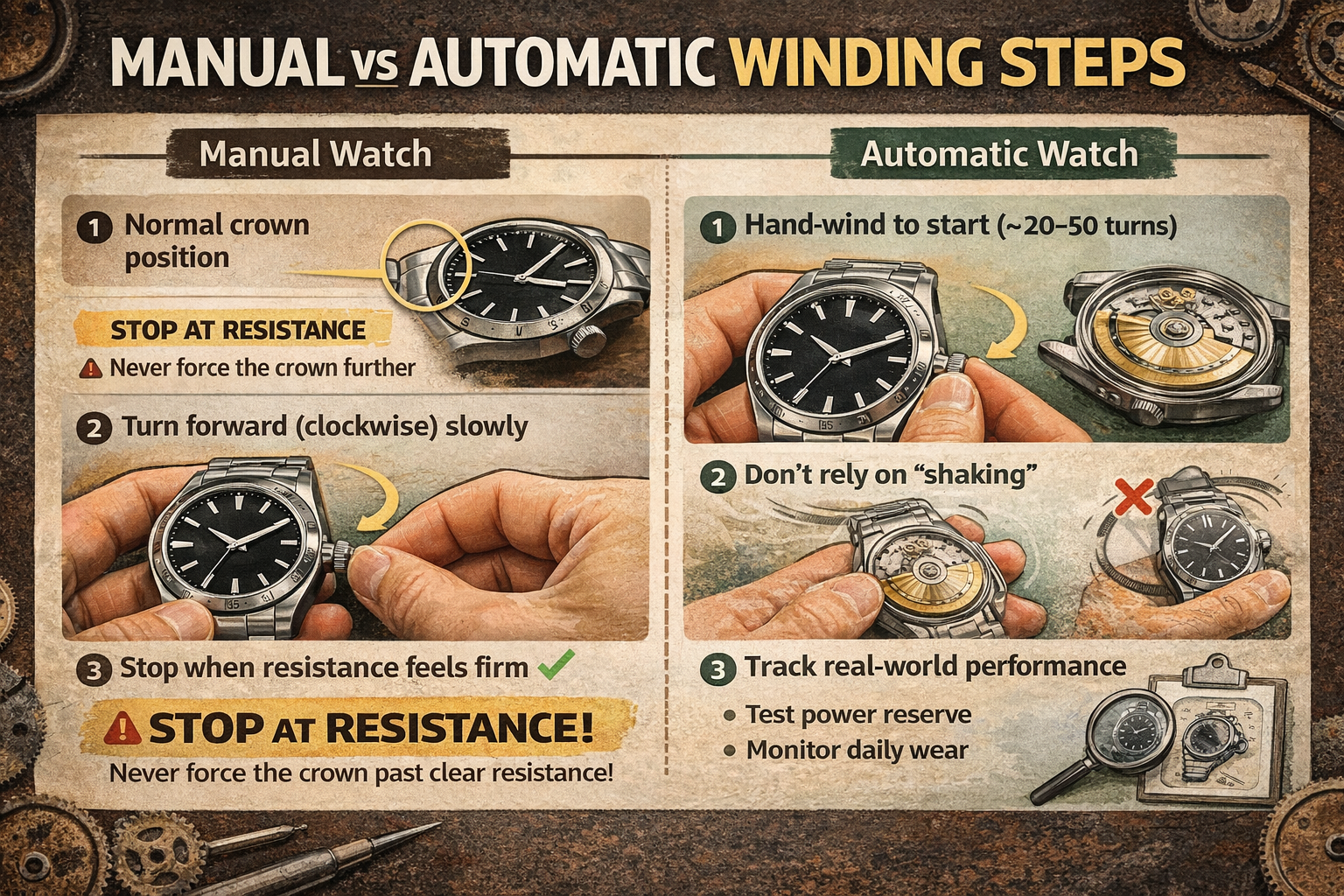 Quick Answer
-
Manual-wind watch: wind the crown until you feel firm resistance, then stop (do not force it).
-
Automatic watch: you can hand-wind to “start it” (often ~20–50 turns), then wear it normally to maintain power.
-
If your watch stops early, it may not be fully wound—or it may need service.
Power reserve guide (related):
→ Power Reserve Explained: Why Your Watch Stops Early (and How to Fix It)
1) Manual vs Automatic: what changes?
Manual-wind
You supply all the energy by winding the crown. When it’s full, you’ll feel clear resistance.
Automatic
A rotor winds the mainspring as you move. Many automatics also allow hand-winding, which helps after the watch has stopped.
Service timeline (for healthy winding performance):
→ How Often Should You Service a Mechanical Watch? A Practical Maintenance Timeline
2) Before you wind: 3 safe rules
-
Remove the watch from your wrist if the crown is hard to access (reduces stress on the stem).
-
Wind slowly and smoothly—no rapid spinning.
-
If anything feels gritty, stiff, or “skips,” stop and investigate.
General “don’t damage your watch” habits:
→ 10 Watch Care Mistakes That Ruin Your Watch Faster Than You Think (2026)
3) How to wind a manual-wind watch (step-by-step)
Step 1 — Make sure the crown is in the normal position
Do not pull it to the time-setting position.
Step 2 — Turn the crown forward (usually clockwise)
Use steady turns. You’ll feel the tension build.
Step 3 — Stop at firm resistance
A manual watch usually gives a clear “stop point.”
✅ Correct: stop when it feels firm.
❌ Wrong: forcing past resistance (can damage the mainspring or winding parts).
How often?
Many people wind once daily at a consistent time.
4) How to wind an automatic watch (step-by-step)
Step 1 — Hand-wind to get it started
If your automatic supports hand-winding, do:
-
~20–50 crown turns as a practical starting range
Then set the time and wear it. Normal wrist movement keeps it topped up.
Step 2 — Don’t rely on “shaking”
A gentle motion to start the seconds hand is okay, but repeated shaking is unnecessary and can be rough on the movement.
Step 3 — Track real-world performance
If your automatic stops early despite daily wear, run a simple reserve check:
→ Power Reserve Explained: Why Your Watch Stops Early (and How to Fix It)
5) “How many turns?” (practical guidance)
There’s no single universal number, but these guidelines work for most owners:
-
Manual watches: wind until firm resistance
-
Automatic watches (starting from stopped): ~20–50 turns as a base, then wear
If your watch consistently underperforms, it can be maintenance-related:
→ How Often Should You Service a Mechanical Watch? A Practical Maintenance Timeline
6) Common mistakes (and how to avoid them)
Mistake 1: Overwinding a manual watch
Stop at firm resistance. Forcing is the real risk.
Mistake 2: Fast “spinning” the crown
Smooth and controlled is better for the gears.
Mistake 3: Setting time and winding with the crown half-pulled
Always confirm crown position (normal position for winding).
Mistake 4: Wearing the watch too loose (automatic efficiency drops)
Loose fit can reduce rotor efficiency and reduce power build-up over the day.
Sizing + fit guides:
-
Watch sizing:Watch Size Guide: Case Diameter, Lug-to-Lug & Thickness (How to Choose the Perfect Fit)
-
Bracelet fit: Watch Bracelet Sizing Guide: How Tight Should It Be? (Comfort, Fit Tests & Fixes)
Mistake 5: Ignoring “warning feel”
Gritty crown, uneven resistance, slipping sensation—these are signals to stop.
Daily care reference:
→Everyday Watch Care Guide: How to Keep Your Watch Looking New
7) When winding won’t fix it (signs you need service)
Consider service if:
-
power reserve is far below spec (after proper winding)
-
timekeeping becomes unstable
-
winding feels rough or noisy
-
the watch stops randomly
Fast/slow diagnosis (related):
→ Why Is My Watch Running Fast or Slow? 9 Common Causes (And Fixes)
Service baseline:
→ How Often Should You Service a Mechanical Watch? A Practical Maintenance Timeline
8) Storage tip (for watch rotation)
If you rotate watches and they stop often:
-
store them clean and dry
-
avoid dusty environments
-
keep them in a stable place
Storage guide:
→ How to Store Watches Properly When Not Wearing Them
FAQ
1) Can I overwind an automatic watch?
Most automatics use a slipping bridle to prevent true overwinding via rotor, but forcing the crown aggressively is still not smart. Wind smoothly.
2) Should I wind my automatic every day?
Not necessarily. If you wear it daily and it stays running, you may not need daily hand-winding. Use hand-winding mainly to start it from stopped.
3) Why does my watch stop even after winding?
Either it wasn’t fully wound, or you have a low reserve issue. Start here:
→ Power Reserve Explained: Why Your Watch Stops Early (and How to Fix It)
4) Is it better to wind on the wrist or off the wrist?
Off-wrist is safer and more comfortable, especially if access is tight.
5) My crown feels gritty—what should I do?
Stop and consider service.
→ How Often Should You Service a Mechanical Watch? A Practical Maintenance Timeline
Recommended Reading
-
Power Reserve Explained: Why Your Watch Stops Early (and How to Fix It)
-
How Often Should You Service a Mechanical Watch? A Practical Maintenance Timeline
-
Why Is My Watch Running Fast or Slow? 9 Common Causes (And Fixes)
-
Watch Size Guide: Case Diameter, Lug-to-Lug & Thickness (How to Choose the Perfect Fit)
-
Watch Bracelet Sizing Guide: How Tight Should It Be? (Comfort, Fit Tests & Fixes)
-
Everyday Watch Care Guide: How to Keep Your Watch Looking New
-
10 Watch Care Mistakes That Ruin Your Watch Faster Than You Think