Watch Accuracy Standards Explained: COSC vs METAS (What the Numbers Really Mean)
 Quick Answer
-
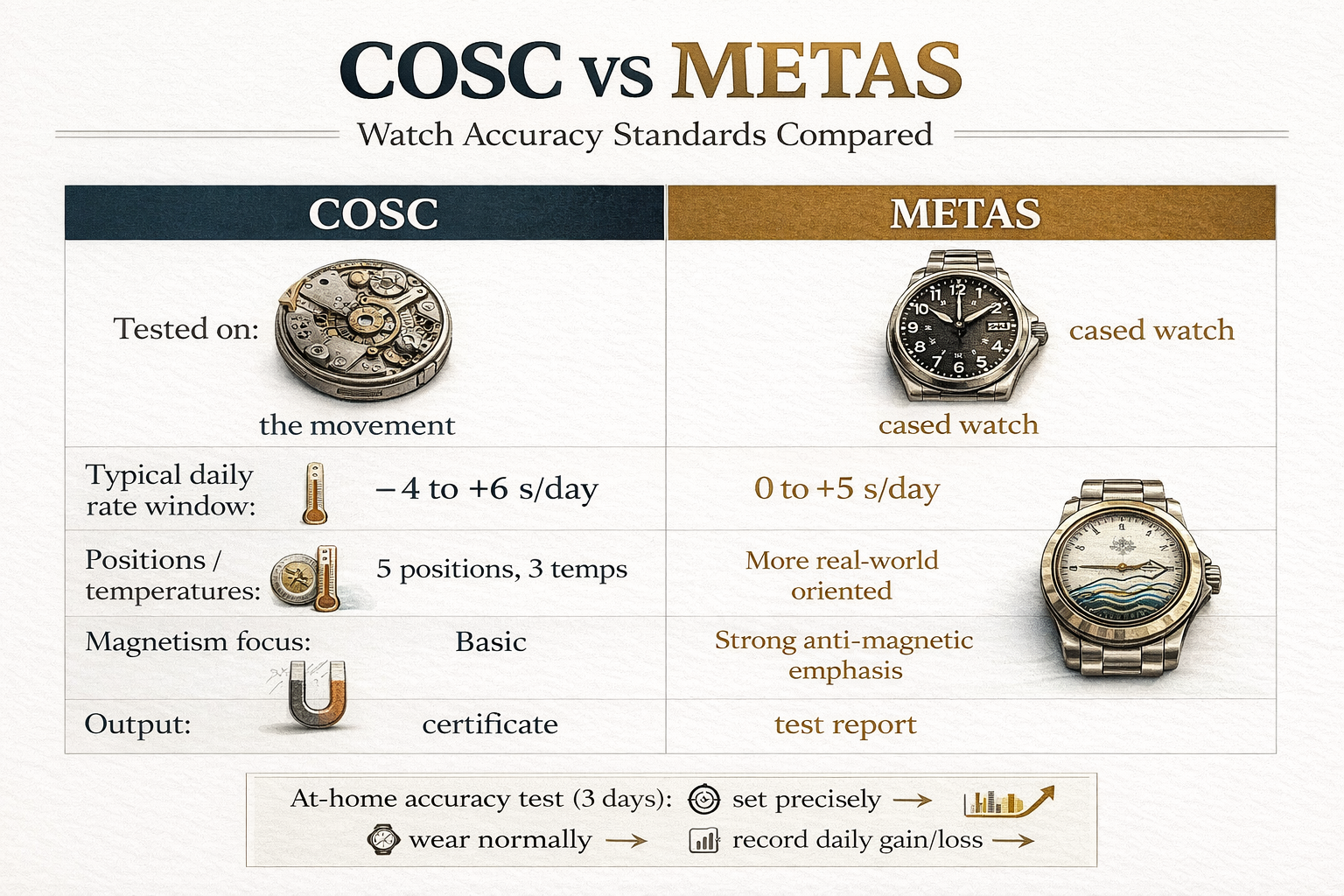
COSC certifies a movement as a chronometer based on the ISO 3159 standard. For mechanical watches, the well-known target is −4 to +6 seconds/day, tested over 15 days, in 5 positions and 3 temperatures.
-
METAS “Master Chronometer” is a tougher, more real-world style test on the fully cased watch, typically requiring daily precision around 0 to +5 seconds/day, plus strong anti-magnetic performance and other checks.
“Better” depends on what you care about: pure timekeeping consistency, real-world anti-magnetism, or simply a trusted baseline.
1) The only number most people misread: seconds per day
When you see something like +5 s/day, it means the watch gains 5 seconds in 24 hours.
A practical way to think about it:
-
+5 s/day ≈ +35 seconds/week
-
−4 s/day ≈ −28 seconds/week
This matters more than “chronometer” as a label.
If you want to set time precisely before measuring accuracy, use:
Hacking Seconds Explained: How to Set Time Precisely (and When It Matters)
2) COSC vs METAS (simple comparison)
| Standard | What’s being tested | Where it’s tested | Typical accuracy target | What it proves |
|---|---|---|---|---|
| COSC | the movement (chronometer test) | lab test, movement-based | −4/+6 s/day for mechanical; 15 days, 5 positions, 3 temps | the movement meets an accepted chronometer standard |
| METAS (Master Chronometer) | the fully assembled watch | cased watch tests (more real-world oriented) | often 0/+5 s/day (tighter window) | real-world performance checks including anti-magnetism and precision |
Key idea: COSC is a strong baseline. METAS tends to be more “real watch on your wrist” oriented.
3) What COSC actually does (why it’s respected)
COSC is a widely recognized Swiss chronometer certification. For mechanical watches, the standard is based on 15 days of testing, across positions and temperatures, with the well-known −4/+6 s/day average daily rate requirement.
What it’s good for:
-
a reliable “minimum bar” for regulated movements
-
consistency across conditions (position/temperature)
What it doesn’t guarantee:
-
your watch will always run in that range on your wrist (real life varies)
-
strong anti-magnetism (magnetism is a separate issue)
Magnetism guide:
Magnetized Watch Symptoms: Why Your Watch Runs Fast & How to Fix It (Safely)
4) What METAS adds (why it feels more “real-world”)
METAS Master Chronometer testing is known for:
-
tighter daily precision (often 0/+5)
-
strong anti-magnetic performance in the test regime
-
testing on the fully cased watch (more reflective of actual wear)
Why this matters:
-
magnetism is a very common real-life cause of sudden fast running
-
cased testing better matches “what you actually wear”
5) How accurate should a mechanical watch be in real life?
Even a great watch can vary depending on:
-
position (dial up, crown down, etc.)
-
how fully wound it is
-
magnetism exposure
-
whether it needs service
If your watch suddenly changes behavior, use these:
-
fast/slow causes:
Why Is My Watch Running Fast or Slow? 9 Common Causes (And Fixes) -
power reserve (stops early):
Power Reserve Explained: Why Your Watch Stops Early (and How to Fix It) -
how to wind properly:
How to Wind a Mechanical Watch Properly (Manual vs Automatic + Mistakes to Avoid)
6) Simple “at-home accuracy test” (no tools)
This is the most useful thing for readers.
Step 1 — Set the watch precisely
Use stop-seconds (hacking) if you have it:
Hacking Seconds Explained: How to Set Time Precisely (and When It Matters)
Step 2 — Wear normally for 3 days
Don’t change your routine. Record daily gain/loss at the same time each day.
Step 3 — Compare the average
-
If it’s stable (same direction, similar amount), that’s usually good.
-
If it swings wildly, suspect magnetism or service needs.
Magnetism:
Magnetized Watch Symptoms: Why Your Watch Runs Fast & How to Fix It (Safely)
7) When the “standard” matters for buying
COSC matters if you want:
-
a credible baseline of regulation
-
a widely recognized chronometer certificate concept
METAS matters if you want:
-
tighter daily rate window + real-life anti-magnetism emphasis
-
more reassurance under modern magnetic exposure conditions
8) When to service (the part people skip)
If your watch used to run fine but now:
-
drifts much more than before
-
becomes inconsistent day-to-day
-
has winding/crown issues
Service reference:
How Often Should You Service a Mechanical Watch? A Practical Maintenance Timeline
FAQ
1) Is METAS “better” than COSC?
Not always—METAS is typically stricter and more real-world oriented (cased watch + anti-magnetism emphasis), but COSC is still a respected baseline.
2) What does −4/+6 seconds/day mean?
It’s the allowed average daily rate range for COSC mechanical chronometers.
3) Why does my watch run fast suddenly?
A very common reason is magnetism:
Magnetized Watch Symptoms: Why Your Watch Runs Fast & How to Fix It (Safely)
4) My watch is accurate some days and not others—why?
Position, power reserve level, and magnetism are the big three. Start here:
https://www.globalwatchindustry.com/blogs/watch-running-fast-or-slow-causes-fixes
5) Does hacking seconds improve accuracy?
It improves setting precision, not the movement’s inherent accuracy.
Hacking Seconds Explained: How to Set Time Precisely (and When It Matters)
Recommended reading
-
Hacking Seconds Explained: How to Set Time Precisely (and When It Matters)
-
Why Is My Watch Running Fast or Slow? 9 Common Causes (And Fixes)
-
Magnetized Watch Symptoms: Why Your Watch Runs Fast & How to Fix It (Safely)
-
Power Reserve Explained: Why Your Watch Stops Early (and How to Fix It)
-
How to Wind a Mechanical Watch Properly (Manual vs Automatic + Mistakes to Avoid)
-
How Often Should You Service a Mechanical Watch? A Practical Maintenance Timeline
-
Everyday Watch Care Guide: How to Keep Your Watch Looking New
-
10 Watch Care Mistakes That Ruin Your Watch Faster Than You Think