Does a Watch Need a Pressure Test After Battery Change or Service?
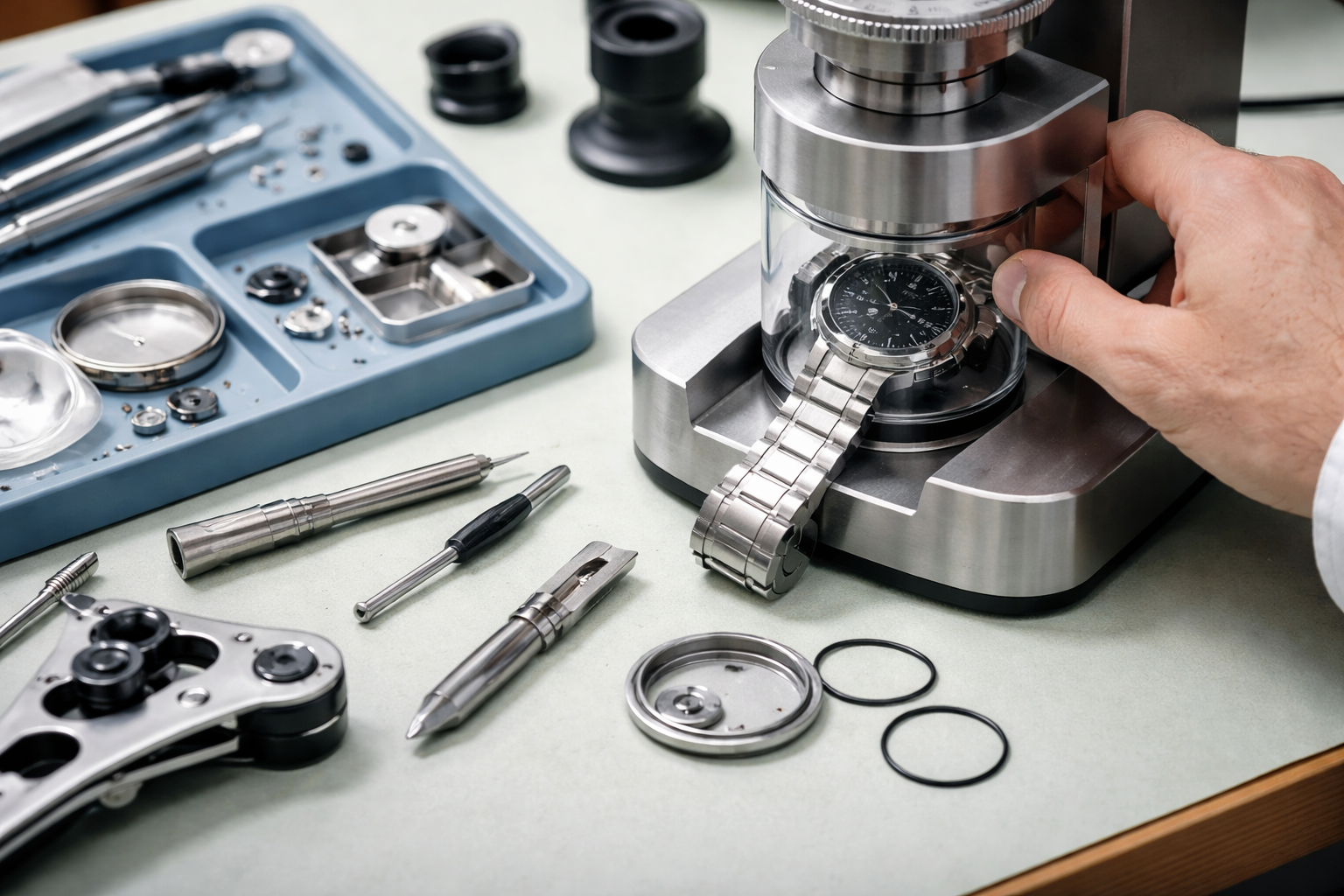
A lot of watch owners assume that once a battery is changed or a service is finished, the watch is automatically ready to go back into normal life.
That is not always true.
If the caseback has been opened, the seal has been disturbed, or the crown and gasket system has been handled, one question matters more than most people realize:
Has the watch been pressure-tested before going back near water?
Here is the honest short answer:
Yes—if a watch is expected to resist water after a battery change or service, a pressure test is usually the smart move.
It is not because every opened watch instantly becomes unsafe.
It is because water resistance is not something you should assume after the case has been opened.
That distinction matters.
A watch may look perfectly sealed.
It may even feel perfectly normal.
And it can still fail when exposed to water if the gaskets, caseback seal, crown seal, or assembly were not checked properly.
That is why pressure testing matters.
Who this guide is for
This article is for you if:
- your watch just had a battery change,
- your mechanical watch just came back from service,
- you are not sure whether a pressure test is necessary,
- or you wear your watch around sinks, rain, pools, showers, or everyday water exposure.
It is especially useful if you already understand the basics of water resistance but want the practical ownership answer. If you need the broader foundation first, Watch Water Resistance Test: What a Pressure Test Checks (and How Often to Do It) is the best companion read.
The short answer
A watch usually should be pressure-tested after:
- a battery change,
- a full service,
- any caseback opening,
- crown or gasket replacement,
- crystal replacement,
- or any repair that affects the sealed case.
A pressure test is especially important if:
- you plan to wear the watch in rain,
- wash your hands with it on,
- swim with it,
- or treat its original water-resistance rating as still usable.
A pressure test may feel less urgent if:
- the watch will only be worn dry,
- it is a dress watch you keep far from water,
- or it is an older/vintage piece where you do not rely on water resistance anyway.
But even then, the smart answer is still usually the same:
If the watch was opened and water resistance matters, test it.
Why this question matters so much
Many owners think of water damage as something dramatic.
They imagine:
- diving with the crown open,
- jumping into a pool with a damaged case,
- or leaving the watch underwater for too long.
But real-world water damage is often much more ordinary than that.
It often starts with:
- hand washing,
- warm rain,
- daily sink use,
- shower steam,
- summer humidity,
- or a quick swim that the owner assumed would be fine.
That is why a watch does not need to be abused to take on moisture. It only needs a weak point in the seal system.
And once the case has been opened for a battery change or service, that seal system should no longer be treated as automatically verified.
A real-world example
Let’s say someone owns a quartz sports watch rated to 100 meters.
The battery dies.
They get it changed quickly.
The watch comes back looking fine.
A week later, they wash their hands with it on, wear it in the rain, and later take it to the pool because “it’s a 100m watch.”
Then the crystal fogs.
What happened?
The battery change itself may have been perfectly routine. But if the caseback gasket was worn, misseated, dry, damaged, or simply not tested afterward, the watch was no longer the same as it was before opening.
That is the key point:
The rating printed on the watch is not a permanent guarantee.
It depends on the current condition of the seals.
That is why Water Resistance Explained: What Watch Depth Ratings Really Mean matters, but so does what happened after the case was last opened.
What a pressure test actually confirms
A pressure test is not just a formality.
It helps confirm whether the watch case is still sealing correctly under pressure conditions relevant to water resistance. Depending on the test method and the watch, it can help reveal whether the caseback, crystal, crown system, and gaskets are still doing their job.
In other words, it answers a more useful question than most owners ask:
Not:
“Was the battery changed?”
But:
“Is the watch still sealed after the battery change?”
That is a much better ownership question.
Why battery changes are a big deal for water resistance
A battery change sounds minor. And mechanically, it often is.
But from a water-resistance perspective, it is still important because the case is being opened.
That means:
- the caseback seal is disturbed,
- the gasket may need inspection or replacement,
- the seating surface matters,
- and the case must be closed correctly.
This is why two battery changes can produce very different results.
One technician may:
- inspect the gasket,
- lubricate or replace it if needed,
- close the case properly,
- and pressure-test the watch.
Another may simply:
- open the case,
- replace the battery,
- close it again,
- and send it out.
Both watches received a “battery change.”
Only one of them got its water resistance meaningfully checked.
Why service does not automatically equal water safety
A lot of owners assume that if a watch went in for service, water resistance is automatically taken care of.
Sometimes yes.
Sometimes not fully.
Sometimes only if requested.
Sometimes only if the watch passes.
That is why the word “service” can create false confidence.
A proper service may include:
- gasket work,
- case sealing,
- water-resistance restoration,
- and pressure testing.
But that depends on:
- the service type,
- the watch type,
- the repair scope,
- and the shop.
If the watch is coming back to a life that includes water exposure, the smart question is not “was it serviced?” The smart question is:
Was it pressure-tested after the service, and what was the result?
That is a more useful conversation.
After service, should every watch be pressure-tested?
Practically speaking, yes—if you care about water resistance at all.
That includes:
- dive watches,
- sports watches,
- daily quartz watches,
- everyday automatics,
- and really any watch you wear around normal real-life moisture.
Because “normal real-life moisture” includes more than people think.
If you wear the watch while:
- washing hands,
- getting caught in rain,
- walking in humidity,
- or spending time near water,
then pressure testing matters more than many owners assume.
That is why these related questions connect directly to this article:
- Can You Wash Your Hands With a Watch On? What’s Safe & What’s Not
- Is It OK to Wear a Watch in the Rain? What’s Safe & What to Check First
- Can You Swim With a Watch? Pool vs Ocean Water Risks Explained
If the watch is going back into any of those situations, a pressure test is not overkill. It is common sense.
When a pressure test is absolutely worth doing
There are situations where this is not really optional in practical terms.
1. After a battery change on a watch you wear around water
This is one of the clearest cases.
2. After a full service on a sports or dive watch
If the watch is meant to be used as such, testing should be part of responsible ownership.
3. After gasket replacement, crown work, or caseback work
Any repair that affects the sealing system deserves verification.
4. After crystal replacement
The crystal is part of the sealed case. If it has been touched, tested sealing matters.
5. Before swimming season or travel
If you are planning beach, pool, resort, or humid travel use, pressure testing before that exposure makes sense. That becomes even more practical once you read Does Chlorine Damage Watches? What Pool Water Really Does and Does Salt Water Damage Watches? Ocean Exposure Explained.
When owners wrongly assume they can skip it
These are the most common mistakes.
“It was only a quick battery change.”
Still opened. Still seal risk.
“It’s rated 100m, so I’m fine.”
The original rating is only meaningful if the current seals are still sound.
“The caseback was closed properly.”
Maybe. But “closed” is not the same as “tested.”
“I never swim with it.”
Many water problems begin far from swimming. Rain, sink water, steam, and accidental exposure are enough.
“It looks normal.”
Moisture problems often stay invisible until they do not.
That last one is especially dangerous.
A watch can look completely normal—until you see condensation. Then the problem is no longer theoretical.
What happens if you skip the pressure test?
Sometimes nothing.
And that is exactly why people get careless.
The watch seems fine.
Days go by.
Maybe weeks.
Confidence grows.
Then one day:
- the crystal fogs,
- moisture gets inside,
- or the owner notices condensation after water exposure that felt harmless.
At that point, you are no longer asking whether the pressure test was worth it. You are asking how much damage has already started.
If water gets inside, the right next step is not guesswork. It is immediate action. That is where What Happens If Water Gets Inside Your Watch? What To Do Immediately and Water Got Inside Your Watch? What to Do Immediately (First 30 Minutes) become essential.
And if what you notice first is misting or fogging, Why Is My Watch Fogging Under the Crystal? Causes & Fixes (What to Do Now) is the natural follow-up.
Does a dress watch need a pressure test too?
This is where people often hesitate.
If a dress watch is rarely worn near water and mostly stays in dry conditions, a pressure test may feel less urgent than it would on a sports watch.
That said, if the case was opened and the owner still expects normal daily resilience—like hand washing, light rain, or incidental splash exposure—testing is still the more responsible choice.
The real question is not:
“Is this a dress watch?”
It is:
“How will this watch actually be worn?”
If the answer includes any moisture at all, the value of testing goes up immediately.
What about vintage watches?
Vintage pieces are different.
With vintage watches, owners often accept that water resistance is no longer something to trust casually, even if the watch originally had a rating. In those cases, a pressure test may still be useful as information, but not always as permission to start wearing the watch around water again.
That is a different ownership mindset.
For many vintage owners, the practical rule is:
- keep it dry,
- enjoy it carefully,
- and do not treat original depth ratings like a current promise.
Should the gasket always be replaced during battery change or service?
Not always automatically, but it should always be inspected seriously.
A gasket can be:
- dry,
- flattened,
- cracked,
- worn,
- or no longer trustworthy even if it is technically still there.
That is why a good battery change or service is not just about reopening and reclosing the case. It is about evaluating whether the sealing components still deserve confidence.
And even a replaced gasket still leads back to the same final question:
Did the watch pass a pressure test afterward?
That is what matters most.
Battery change at a mall kiosk vs watchmaker vs authorized service
This is where ownership decisions become practical.
Not every battery change service is the same.
Quick battery counter
Convenient. Fast. Sometimes fine for very basic dry-use watches. But you should never assume water resistance was properly restored unless that was explicitly done and verified.
Independent watchmaker
Often a strong option if they inspect seals, handle the case properly, and can pressure-test.
Authorized service center
Usually the most confidence-inspiring route if maintaining factory-style standards matters to you, especially on higher-value watches.
This does not mean every quick battery service is bad. It means you should not treat all “battery changes” as equal.
A practical example: when testing saves money
Imagine two owners with similar quartz sports watches.
Owner A gets a battery change and immediately goes back to normal daily use. No test, no questions.
Owner B gets a battery change and asks for pressure testing.
If the watch passes, great. Confidence restored.
If it fails, the issue is discovered early, before water gets in.
That is the hidden value of a pressure test.
It does not only confirm good news.
It can catch bad news before it becomes expensive news.
That is why it is so often worth doing.
How soon after service or battery change should you test?
Ideally, immediately or as part of the same service process.
The best outcome is simple:
- watch is opened,
- battery or service work is completed,
- seals are checked,
- watch is pressure-tested,
- owner receives the watch knowing where things stand.
That is much better than reopening the question later, after the watch has already been back in daily use.
A simple decision framework
If you are unsure, use this.
Always test if:
- the watch was opened,
- and you plan to wear it around water, rain, sinks, or daily splash situations.
Strongly consider testing if:
- the watch is a sports or dive model,
- you travel with it,
- you wear it often,
- or you want confidence instead of guesswork.
You might skip testing only if:
- the watch will live a completely dry life,
- water resistance no longer matters to you,
- and you accept that you should not trust it around water afterward.
That last category is smaller than most people think.
Because many owners say “I won’t wear it near water,” then wear it in daily life exactly the way daily life happens.
What to ask the shop after battery change or service
Keep it simple.
Ask:
- Was the watch pressure-tested after opening?
- Were the gaskets inspected or replaced?
- Did it pass?
- If not, why not?
- Should I treat the watch as water-safe, splash-only, or dry-use only?
Those questions are not excessive.
They are normal.
In fact, they are much more useful than just asking, “All good?”
Bottom line
If a watch has been opened for a battery change or service and you still expect it to handle real-world moisture, a pressure test is usually worth doing.
Not because every opened watch is suddenly unsafe.
Because water resistance should be verified, not assumed.
That is the real lesson.
A battery change is not just a battery change if the case was opened.
A service is not automatically complete in practical terms if no one confirmed the seal afterward.
So if the watch is going back near:
- sinks,
- rain,
- showers,
- pools,
- or ordinary daily moisture,
do the smart thing:
Ask for the pressure test.
It is usually cheaper than finding out the hard way.
FAQ
Does a watch need a pressure test after a battery change?
Usually yes, if you expect to wear it around water or treat its water resistance as still usable.
Is a pressure test necessary after a full service?
In most practical cases, yes—especially for sports, dive, and daily-wear watches.
If the watch is rated 100m, do I still need the test after opening it?
Yes. The printed rating does not confirm the current seal condition after the case has been opened.
Can I skip the pressure test if I never swim with the watch?
You can, but only if you also accept that you should not trust it around daily water exposure either.
Does replacing the battery automatically restore water resistance?
No. Water resistance depends on the condition of the gaskets, sealing surfaces, assembly, and whether the watch passes testing afterward.
What if the watch fogs after battery change or service?
Treat it seriously and act quickly. Moisture inside the case can lead to bigger problems if ignored.