What Happens If Water Gets Inside Your Watch? What To Do Immediately
Whether it happened after swimming, showering, or sudden temperature change, water inside a watch is a serious issue that should never be ignored.
In this guide, we explain:
-
Why moisture enters
-
What damage it causes
-
What to do immediately
-
When professional service is necessary
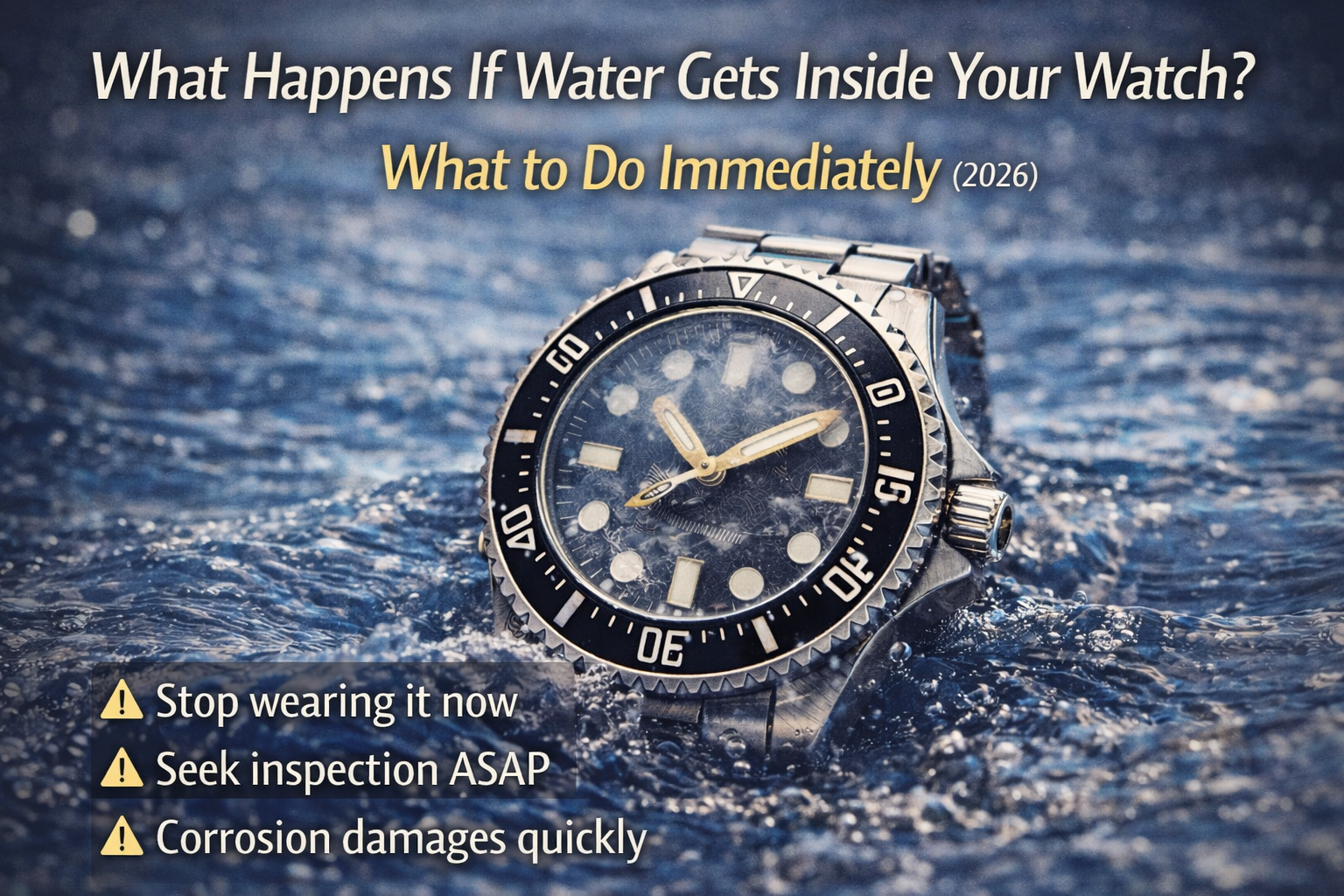 Short Answer: Act Immediately
If water enters your watch:
-
Stop wearing it
-
Do not adjust the crown
-
Keep it dry
-
Seek professional inspection
Delaying action increases the risk of corrosion and movement damage.
How Does Water Get Inside a Watch?
Water intrusion usually happens due to:
-
Worn gaskets
-
Unscrewed crown
-
Impact damage
-
Heat + steam exposure
-
Aging seals
Many cases occur after:
-
Swimming in pools or ocean
-
Sauna or hot tub exposure
-
Hot showers
If unsure about rating limits, review
👉 watch water resistance explained.
Why Fog Appears Under the Crystal
Fogging occurs when:
-
Moisture enters the case
-
Temperature changes cause condensation
-
Internal air cools and water vapor condenses
This is common after:
-
Hot showers
👉 Is It Safe to Wear a Watch in the Shower? -
Ocean swimming
👉 Does Salt Water Damage Watches?
Even small moisture amounts can create visible condensation.
What Damage Can Water Cause?
Water exposure can lead to:
-
Rust on steel components
-
Degraded lubrication
-
Dial staining
-
Corrosion of movement parts
-
Reduced accuracy
Mechanical watches are especially vulnerable because they rely on precise lubrication.
Learn more about service timing here:
👉 How Often Should You Service a Mechanical Watch?
Should You Try to Dry It Yourself?
Common DIY methods include:
-
Rice
-
Silica gel
-
Hair dryers
These are not reliable.
Heat can worsen damage, and rice does not remove internal moisture effectively.
If fog persists beyond a few hours, professional inspection is strongly recommended.
When Is It an Emergency?
Immediate servicing is needed if:
-
Heavy condensation remains
-
Water droplets are visible
-
Accuracy changes suddenly
-
Rust appears
Waiting allows corrosion to spread.
Ignoring moisture is one of the most common
👉 watch care mistakes.
Can a Water-Resistant Watch Still Get Moisture?
Yes.
Water resistance ratings assume:
-
Proper gasket condition
-
Correct crown position
-
No heat exposure
Even a 200m-rated watch can fail if seals degrade.
If comparing ratings, see:
👉 100m vs 200m Water Resistance
Maintenance matters more than numbers.
Preventing Future Water Intrusion
To reduce risk:
-
Test water resistance during servicing
-
Avoid heat + moisture combinations
-
Rinse after pool or ocean exposure
-
Inspect crown position
If you swim regularly, review
👉 Can You Swim With a Watch?
Conclusion
Water inside a watch is not something to monitor — it’s something to act on.
Prompt servicing can prevent permanent movement damage and extend your watch’s lifespan.
Water resistance protects — but only when seals are intact and properly maintained.
If moisture appears, treat it as urgent.