Timegrapher Settings Explained: Lift Angle & Beat Rate (VPH) — Get Accurate Readings
 Quick Answer
If your timegrapher numbers look “off,” the problem is often settings, not your watch.
- Wrong beat rate (VPH) can distort rate/trace behavior.
- Wrong lift angle can make amplitude look too low or too high, leading to bad decisions.
Readings guide (your previous post):
→ Timegrapher Readings Explained: Amplitude, Beat Error & What’s Normal
1) What is beat rate (VPH)?
VPH (Vibrations Per Hour) is how many times the balance oscillates per hour. Common mechanical beat rates:
- 18,000 vph (2.5 Hz)
- 21,600 vph (3 Hz)
- 28,800 vph (4 Hz) — very common
- 36,000 vph (5 Hz) — high-beat
Why VPH matters on a timegrapher
A timegrapher needs the correct beat rate to interpret the “tick” pattern properly. Wrong VPH can show unstable traces and misleading rate numbers.
2) What is lift angle?
Lift angle is a movement geometry value used to calculate amplitude on a timegrapher.
Important: Rate and beat error can still look “reasonable,” but amplitude can be wrong if lift angle is wrong.
Typical lift angle range
Many watches fall somewhere around 50°–55°, but the exact value depends on the movement.
3) The most common mistake: “My amplitude is low” (but lift angle is wrong)
If you set lift angle incorrectly, you might see:
- amplitude that looks “too low” (panic → unnecessary service)
- or “too high” (false reassurance)
Before you judge amplitude, make sure:
- VPH is correct
- Lift angle is as close as possible to your movement spec
- The watch is properly wound
Winding guide:
→ How to Wind a Mechanical Watch Properly (Manual vs Automatic + Mistakes to Avoid)
Power reserve check:
→ Power Reserve Explained: Why Your Watch Stops Early (and How to Fix It)
4) How to find your watch’s correct VPH and lift angle (safe methods)
Best sources (in order)
- Your watch manual / brand specs
- Movement caliber info (often listed in specs or service docs)
- If you can’t find it: use the most common VPH for your movement family (many modern watches are 28,800 vph), and use a reasonable lift angle as a temporary estimate.
If you can’t confirm lift angle, don’t overreact to amplitude alone—use it as a rough signal, not a verdict.
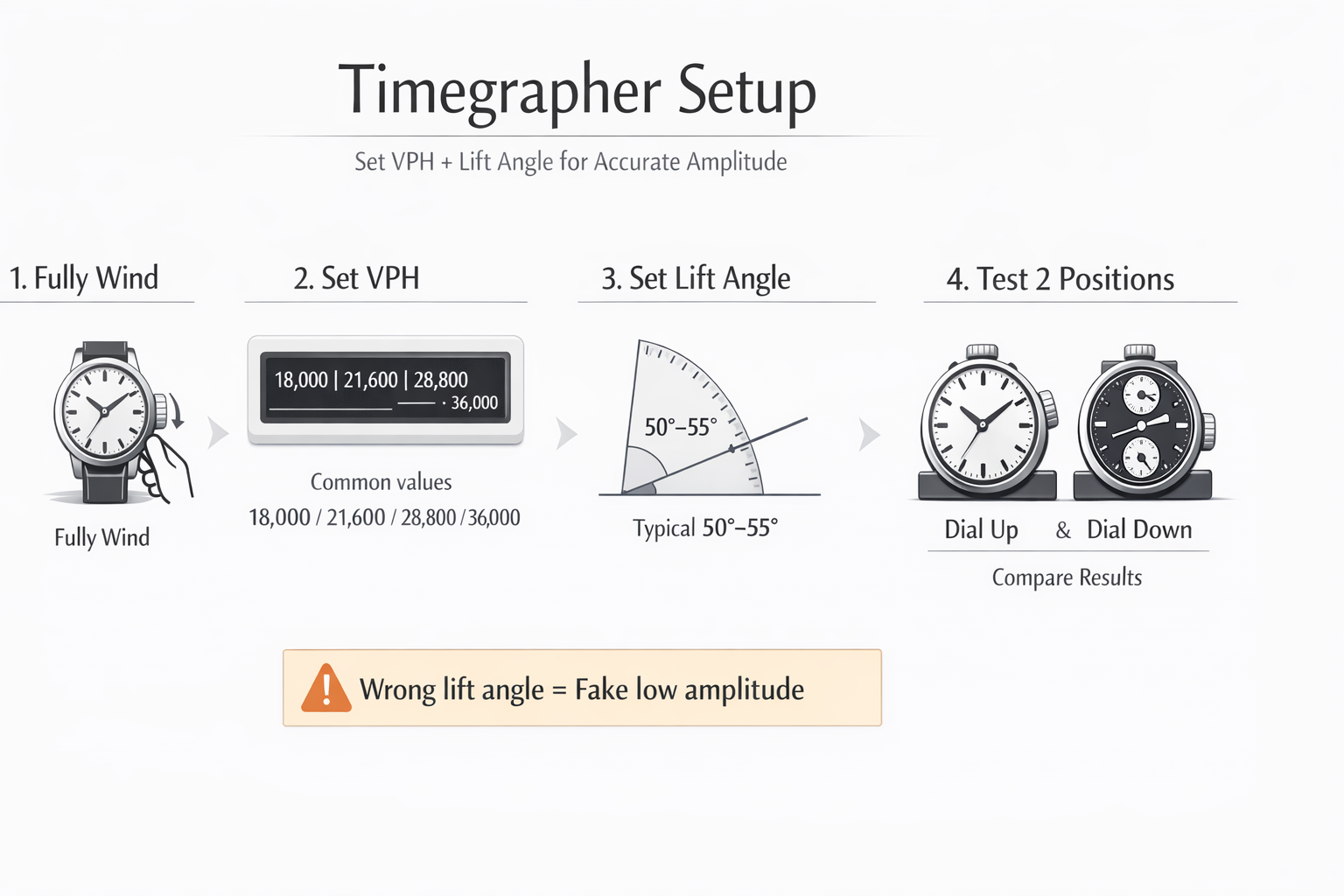
5) Setup checklist (the “good readings” routine)
Step 1 — Set time precisely (for later comparison)
→ Hacking Seconds Explained: How to Set Time Precisely (and When It Matters)
Step 2 — Fully wind before measuring
- Manual: wind to firm resistance (don’t force)
- Automatic: give it a solid start wind, then test
→ How to Wind a Mechanical Watch Properly (Manual vs Automatic + Mistakes to Avoid)
Step 3 — Set VPH correctly
Use your known movement beat rate.
Step 4 — Set lift angle as close as possible
If unknown, choose a reasonable placeholder and label your result as “estimate.”
Step 5 — Test multiple positions (fast sanity check)
Dial up and dial down are a good starting pair. Position affects results (normal):
→ Positional Variance Explained: Dial Up vs Crown Down (Improve Watch Accuracy Overnight)
6) What “good” looks like (practical interpretation)
If your settings are correct, then:
- Rate tells you daily drift direction/size
- Amplitude tells you power/efficiency signal (but depends on wind level + position)
- Beat error tells you symmetry (out-of-beat risk)
If your watch runs fast/slow in daily life:
→ Why Is My Watch Running Fast or Slow? 9 Common Causes (And Fixes)
If you suspect magnetism (fast running, instability):
- Symptoms: Magnetized Watch Symptoms: Why Your Watch Runs Fast & How to Fix It (Safely)
- DIY demagnetize: How to Demagnetize a Watch at Home (Tool, Steps & When to Stop)
7) When to stop DIY and consider service
If after correct settings + full wind + demagnetizing:
- amplitude remains consistently very low
- beat error remains consistently high
- rate is unstable across positions and days
Service reference:
→ How Often Should You Service a Mechanical Watch? A Practical Maintenance Timeline
Accuracy standards context (why a few seconds/day matters):
→ Watch Accuracy Standards Explained: COSC vs METAS (What the Numbers Really Mean)
FAQ
1) What happens if my timegrapher beat rate is wrong?
Your rate/trace behavior may be misleading, and you can’t trust the reading.
2) Does wrong lift angle change rate?
Lift angle mainly affects amplitude, not rate, but it can still lead you to wrong conclusions.
3) What lift angle should I use if I don’t know it?
Use brand/movement specs if possible. If unknown, treat amplitude as an estimate and focus on rate stability + real-world tracking.
4) Why is amplitude lower in some positions?
Positional variance is normal in mechanical watches:
→ Positional Variance Explained: Dial Up vs Crown Down (Improve Watch Accuracy Overnight)
5) My watch is still fast after correct settings—what next?
Check magnetism, winding habits, then service if needed:
→ Magnetized Watch Symptoms: Why Your Watch Runs Fast & How to Fix It (Safely)
→ How to Wind a Mechanical Watch Properly (Manual vs Automatic + Mistakes to Avoid)
→ How Often Should You Service a Mechanical Watch? A Practical Maintenance Timeline