After Swimming With a Watch: The 7-Step Rinse & Dry Routine (Pool vs Ocean)
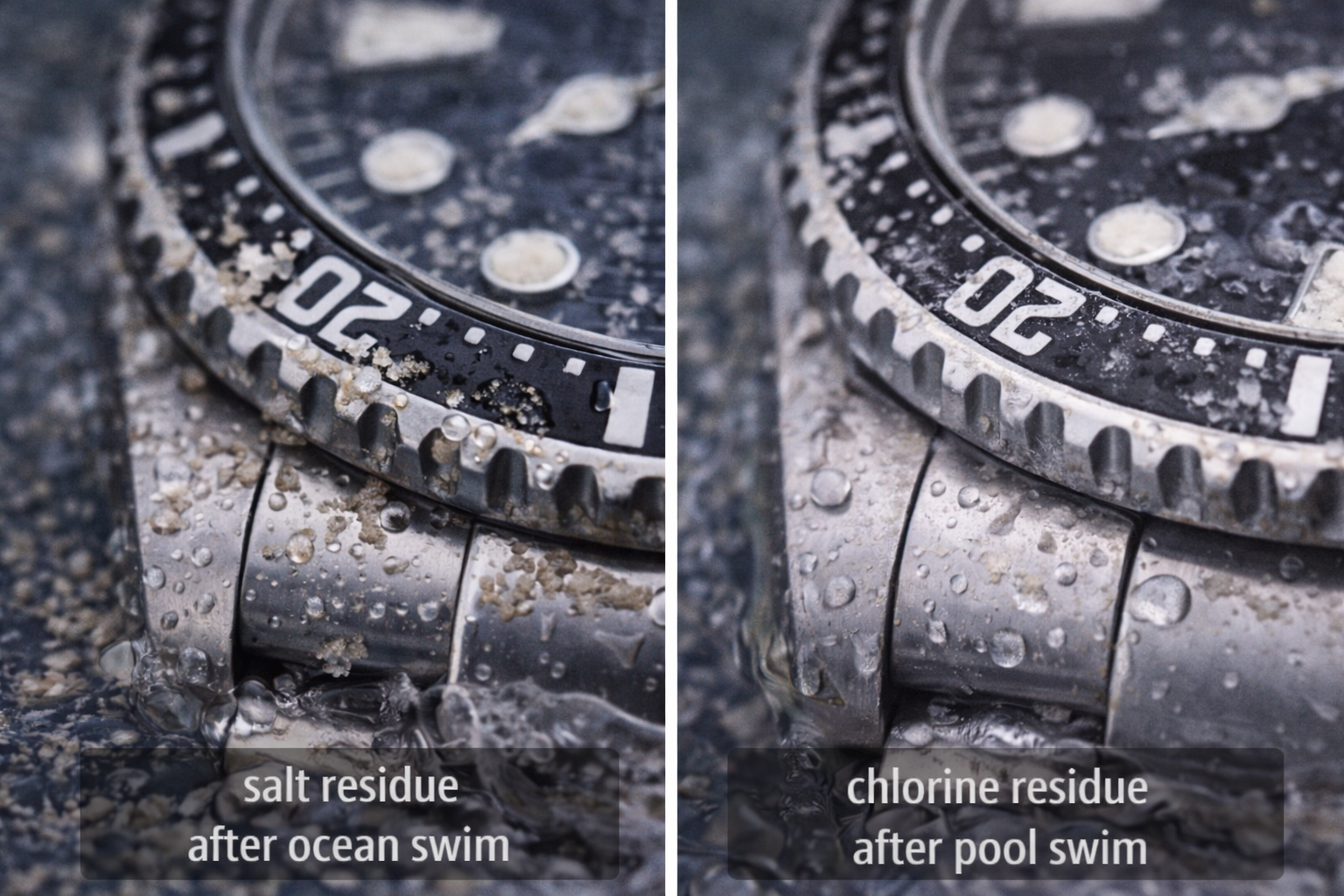 If you swam with your watch, the best way to prevent long-term damage is simple: rinse gently with fresh water (crown sealed), dry the crown area and bracelet gaps, and watch for fogging for 24 hours. Pool water (chlorine) and ocean water (salt) both leave residues that can accelerate corrosion and degrade seals—especially if you let the watch air-dry without rinsing.
First: Should you even swim with your watch?
If you’re not sure your watch is suitable for swimming, check this first:
→ Can You Swim With a Watch? Pool vs Ocean Water Risks Explained
And if you’re still confused by ratings like 50m/100m/200m, start here:
→Water Resistance Explained: What Watch Depth Ratings Really Mean
The 7-step routine (do this within 30 minutes of swimming)
Step 1) Confirm the crown is sealed (before any rinsing)
-
Push the crown fully in
-
If screw-down: screw it down fully (snug, not over-tight)
If your crown wasn’t sealed during swimming, treat this as higher risk and monitor closely for fogging.
Fogging guide:
→ mediately Why Is My Watch Fogging Under the Crystal? Causes & Fixes (What to Do Now)
Step 2) Rinse gently with cool fresh water (no strong jets)
Hold the watch under a gentle stream of fresh water for 20–30 seconds.
-
Focus on case, bezel edge, bracelet links
-
Avoid blasting the crown directly
Why no strong jets: high pressure can stress seals.Can a Pressure Washer or Car Wash Damage Your Watch? High-Pressure Water Risks Explained
Step 3) For ocean swims: soak briefly (3–5 minutes)
Salt crystals can form in tiny gaps.
A short soak in clean fresh water helps dissolve salt.
Saltwater details:
→ Does Salt Water Damage Watches? Ocean Exposure Explained
Step 4) For pool swims: rinse longer (30–60 seconds)
Chlorine residue can irritate materials over time, so rinse a bit longer.
Chlorine guide:
→ Does Chlorine Damage Watches? What Pool Water Really Does
Step 5) Clean the bracelet and bezel edge (optional but recommended)
Use:
-
a soft toothbrush / very soft brush
-
clean water
-
(optional) a tiny amount of mild soap only for metal bracelets
Do not scrub hard. The goal is to lift residue, not polish metal.
If you were at the beach and got sand in the bezel, use this guide (don’t force-rotate):
→Sand in Your Watch Bezel? How to Remove It Safely (Without Ruining Seals)
Step 6) Dry properly (especially the crown area)
-
Pat dry with microfiber
-
Pay attention to: crown, caseback seam, end-links
-
Let it air-dry at room temperature
Don’t use heat (hair dryer/radiator)—heat can stress seals and push moisture deeper.
If you suspect water actually got inside, follow the emergency plan:
→ Water Got Inside Your Watch? What to Do Immediately (First 30 Minutes)
Step 7) Monitor for fogging for 24 hours
Fogging is the early warning that moisture entered the case.
Fogging fix guide:
→ mediately Why Is My Watch Fogging Under the Crystal? Causes & Fixes (What to Do Now)
Pool vs Ocean: quick differences
Pool (chlorine)
-
Main risk: chemical residue + gasket aging
-
Rinse longer, don’t let it dry with chlorine on it
→ Does Chlorine Damage Watches? What Pool Water Really Does
Ocean (salt)
-
Main risk: salt crystals + corrosion
-
Short soak + gentle brushing helps a lot
→ Does Salt Water Damage Watches? Ocean Exposure Explained
What NOT to do after swimming (common mistakes)
-
❌ Don’t leave salt/chlorine to dry on the watch
-
❌ Don’t press pushers while wet
-
❌ Don’t “test” by putting it under a strong faucet jet
-
❌ Don’t use hot air to dry it
-
❌ Don’t rotate a gritty bezel (sand can scratch)
How often should you get water resistance tested?
If you swim with a watch regularly, periodic testing is smart—especially as seals age.
Service baseline:
→ How Often Should You Service a Mechanical Watch? A Practical Maintenance Timeline
FAQ
1) Should I rinse my watch after swimming in a pool?
Yes. Chlorine residue can build up and stress materials over time.
→ Does Chlorine Damage Watches? What Pool Water Really Does
2) Should I rinse after ocean swimming even if the watch is 200m?
Yes. Salt residue is the problem, not just “depth.”
→ Does Salt Water Damage Watches? Ocean Exposure Explained
3) Can I use soap to clean my watch after swimming?
A small amount of mild soap is okay for metal bracelets if the crown is sealed. Avoid harsh cleaners and don’t scrub aggressively.
4) My watch fogged after swimming—what now?
Start here:
→ mediately Why Is My Watch Fogging Under the Crystal? Causes & Fixes (What to Do Now)
If you suspect water inside:
→ Water Got Inside Your Watch? What to Do Immediately (First 30 Minutes)
5) Is 50m water resistance enough for swimming?
Sometimes, but it depends on the watch and seal condition.
→ Is 50m Water Resistance Enough? What You Can (and Can’t) Do
6) What’s the safest rating for regular swimming?
Many people choose 100m+ for regular swimming, but real-world sealing and maintenance still matter.
→ 100m vs 200m Water Resistance: Do You Really Need a Dive Watch?
→ Water Resistance Explained: What Watch Depth Ratings Really Mean
Related Guides
-
Can You Swim With a Watch? Pool vs Ocean Water Risks Explained
-
Water Resistance Explained: What Watch Depth Ratings Really Mean
-
Does Salt Water Damage Watches? Ocean Exposure Explained
mediately Why Is My Watch Fogging Under the Crystal? Causes & Fixes (What to Do Now)
-
Water Got Inside Your Watch? What to Do Immediately (First 30 Minutes)