Can a Pressure Washer or Car Wash Damage Your Watch? High-Pressure Water Risks Explained
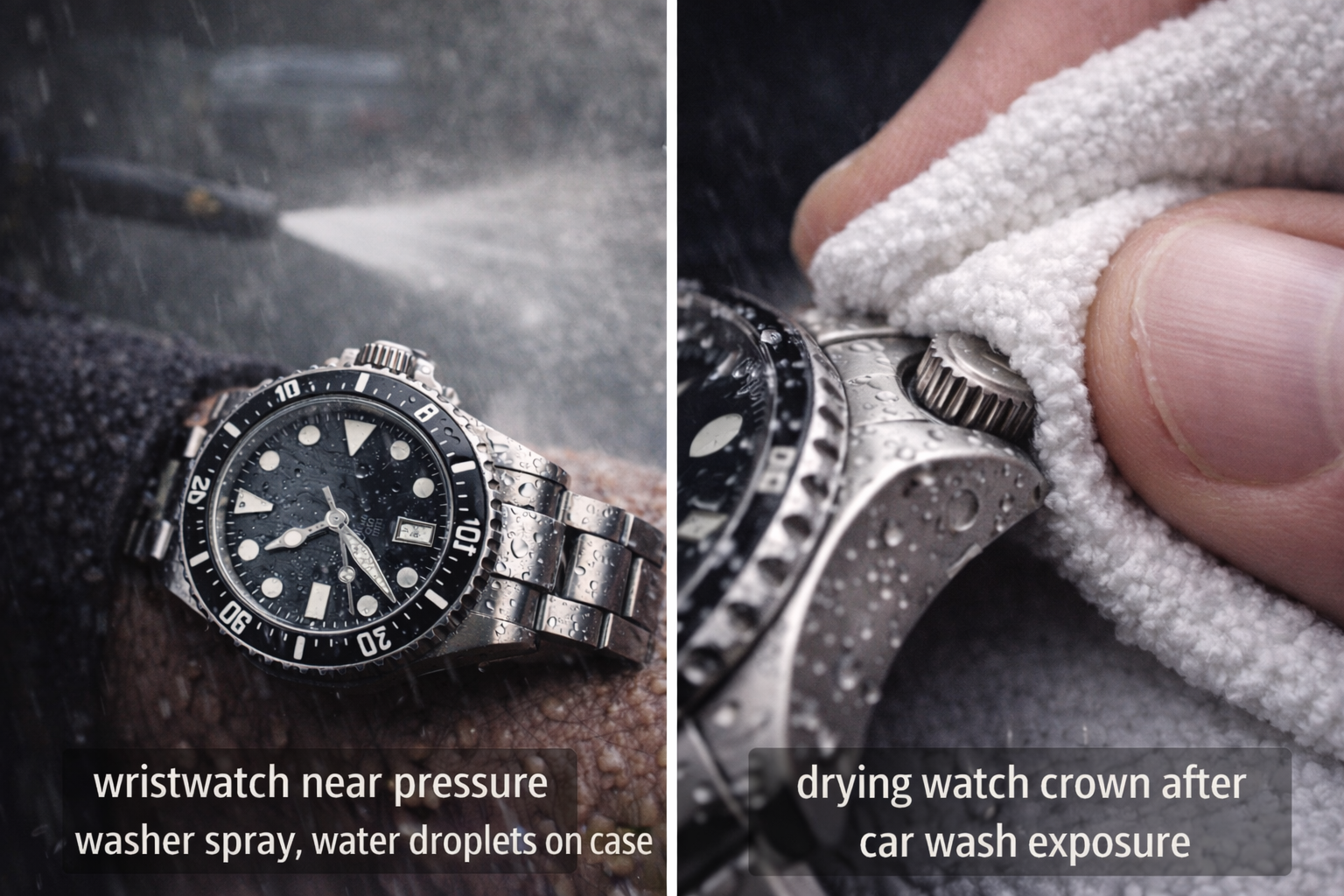 Yes—high-pressure water can damage a watch or force water past seals, even if the watch is “water resistant.” The risk is highest when the jet hits the crown, caseback seam, pushers, or bezel edge at close range. If you must wear a watch around pressure washing or automatic car washes, keep it out of the spray, make sure the crown is fully secured, and check for fogging afterward.
Why pressure water is different from rain or hand washing
Rain and hand washing are usually low pressure. A pressure washer or strong car-wash jet creates concentrated force that can:
-
momentarily deform gaskets
-
push water into tiny gaps
-
drive soapy/dirty water into bracelet links and bezel edges
For the baseline of what depth ratings actually mean (and why they don’t equal “spray-proof”), read:Water Resistance Explained:
→ What Watch Depth Ratings Really Mean (2026)
The highest-risk areas on a watch (where jets cause trouble)
1) The crown (most common entry point)
Even a slightly loose crown can let water in under pressure.
If your watch fogs later, follow:
→Why Is My Watch Fogging Under the Crystal? Causes & Fixes (What to Do Now)
2) Pushers (chronograph buttons)
Avoid pressing any pushers when wet. High-pressure spray near pushers is risky unless the model is built for it.
3) Caseback seam & crystal gasket
Older gaskets are more likely to fail under sudden pressure.
Service/seal aging reference:
→How Often Should You Service a Mechanical Watch? A Practical Maintenance Timeline
4) Bezel edge (grit + water intrusion risk)
Even if water doesn’t enter the case, pressure water can drive grit/soap into the bezel mechanism.
Automatic car wash vs pressure washer: which is worse?
Automatic car wash
-
Medium–High risk depending on jet strength and proximity
-
Soap chemicals + repeated jets increase risk
-
Wrist motion can expose crown directly
Pressure washer (home/industrial)
-
High risk if close range
-
Narrow jet can concentrate force on the crown area
“My watch is 100m/200m water resistant—am I safe?”
Not guaranteed. Ratings are tested under controlled conditions and don’t always reflect focused jets.
Helpful comparisons you already have:
-
50m rule-of-thumb:
→Is 50m Water Resistance Enough? What You Can (and Can’t) Do -
100m vs 200m reality:
→100m vs 200m Water Resistance: Do You Really Need a Dive Watch?
Also, if you ever wear it in the shower (steam + soap), that adds seal stress over time:
→Is It Safe to Wear a Watch in the Shower? The Truth About Water, Steam & Soap
What to do if you were sprayed (safe checklist)
Step 1: Dry correctly (don’t use heat)
-
Wipe the watch with a microfiber cloth
-
Dry crown area and bracelet gaps
-
Do not use hair dryer/heat (it can worsen seal issues)
If you need a “what to do immediately” emergency reference (suspected entry):
→ What Happens If Water Gets Inside Your Watch? What To Do Immediately
Step 2: Watch for fogging in the next 1–24 hours
Fogging is your early warning sign:
→ Why Is My Watch Fogging Under the Crystal? Causes & Fixes (What to Do Now)
Step 3: If you see droplets under the crystal, treat it as urgent
Follow the first-30-minutes plan:
→ Water Got Inside Your Watch? What to Do Immediately (First 30 Minutes
What NOT to do (common mistakes)
-
❌ Don’t “test it” by rinsing again under strong water
-
❌ Don’t press buttons while wet
-
❌ Don’t put it on a radiator or use hot air
-
❌ Don’t ignore light fogging that clears—moisture can still be inside
Prevention: how to wear a watch around car washing safely
-
Keep the watch under a sleeve or glove if you’re pressure washing
-
Don’t point jets at your wrist
-
Secure the crown before starting