- Home
- Rolex Datejust 36 vs 41: Which Size Is Actually Better for Real Daily Wear?
Rolex Datejust 36 vs 41: Which Size Is Actually Better for Real Daily Wear?
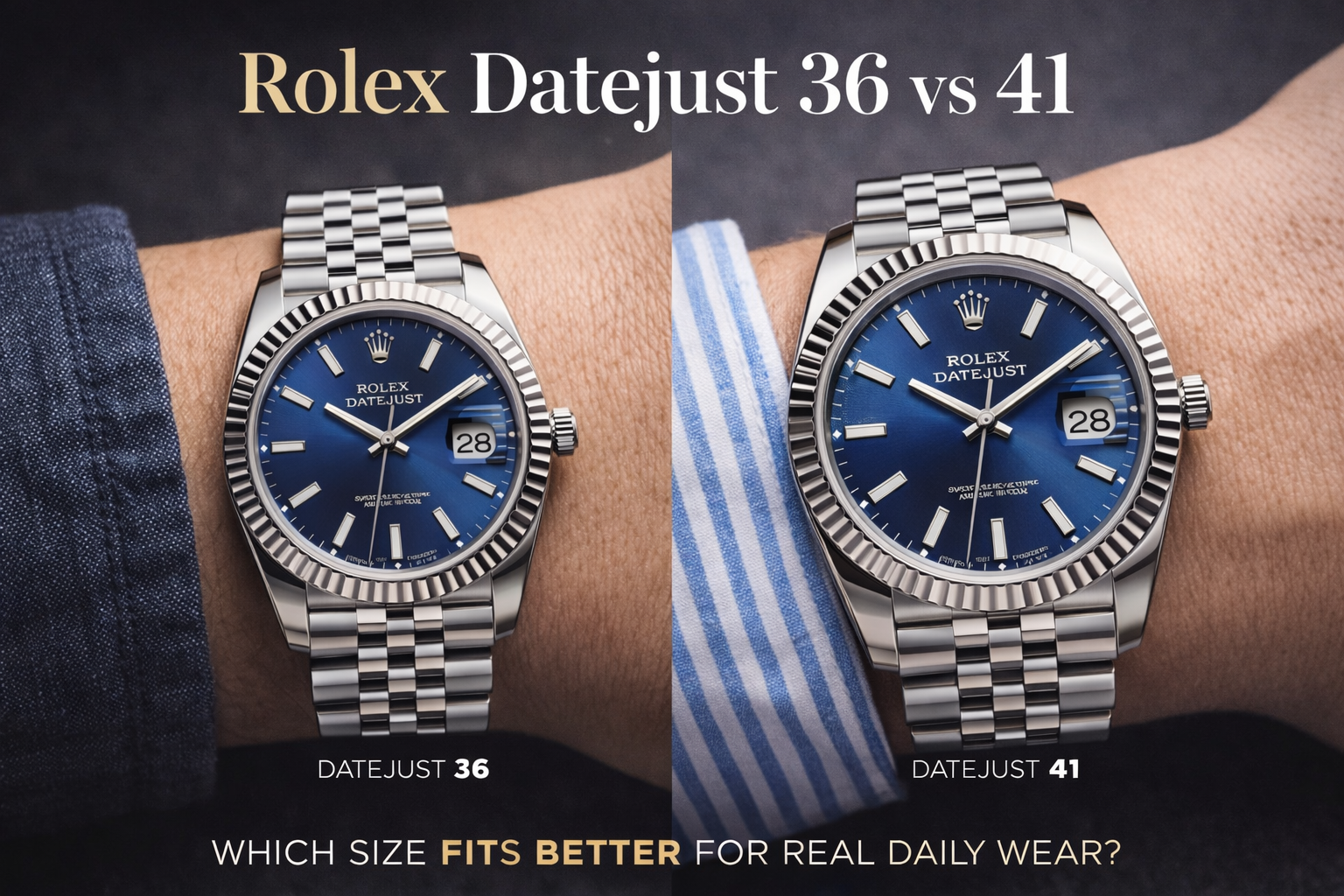
If you are thinking about buying a Rolex Datejust, there is a good chance you are not stuck on the brand.
You are stuck on the size.
More specifically, you are stuck between the Rolex Datejust 36 and the Rolex Datejust 41 — and that decision feels much harder than it looks on paper.
At first, it seems simple. One is smaller, one is bigger. Try both on, pick the one you like, done.
But anyone who has actually gone through this decision knows that is not how it works.
The Datejust 36 often looks more timeless, more elegant, and more “correct” in the traditional Rolex sense. The Datejust 41 often looks bolder, more modern, and more immediately impressive in a showroom or on social media.
The problem is that what looks better in a quick try-on is not always what wears better in real life.
And since the Datejust is supposed to be one of the best everyday luxury watches you can buy, size matters more here than it does in many other models.
So which size is actually better for real daily wear?
The honest answer is this: the Datejust 36 is usually the safer long-term choice, while the Datejust 41 is usually the stronger short-term visual choice.
That does not mean the 36 is always better or the 41 is a mistake. It means they satisfy two different kinds of buyers — and one of the easiest ways to regret a Datejust is to choose the size that flatters your ego more than your life.
The short answer
Buy the Datejust 36 if you want the more classic, versatile, and quietly luxurious version of the Datejust.
Buy the Datejust 41 if you want more wrist presence, a more contemporary feel, and a watch that makes a stronger immediate impression.
If you want the simplest version of the verdict, here it is:
- Datejust 36 is usually better for true long-term daily wear
- Datejust 41 is usually better for buyers who want a more modern luxury look
That is the quick answer. But there is a reason so many people keep going back and forth between the two.
Why this decision is harder than people expect
Most people do not choose between the 36 and 41 based on wrist size alone.
They choose based on identity.
The Datejust 36 tends to attract buyers who like proportion, elegance, and a watch that feels established rather than attention-seeking. The Datejust 41 attracts buyers who want a watch that feels more substantial, more current, and more visually obvious on the wrist.
That is why this is not just a measurement question. It is a personality question.
A lot of first-time buyers walk into a store thinking the 41 must be the better option because larger watches feel more “luxury” at first glance. More watch, more presence, more money-looking. But once they actually live with it, some of them realize they bought the louder option, not the better one.
Others do the opposite. They buy the 36 because the internet told them it was more tasteful, then later feel they should have gone bigger because they wanted more presence from the start.
That is why you need to separate what looks good in a mirror for 30 seconds from what makes sense for years of wear.
If you are still deciding whether the Datejust is the right Rolex at all, it helps to read Rolex Datejust vs Oyster Perpetual: Which One Is the Better One-Watch Luxury Choice? first, because some buyers who think they need a different Datejust size are actually better off with a different Rolex style altogether.
The Datejust 36: why so many experienced buyers end up here
The Rolex Datejust 36 has something the 41 cannot fully copy: natural balance.
There is a reason the 36 feels so “right” to so many people, even on wrists that could easily carry a larger watch. The proportions are cleaner. The watch feels more cohesive. The bezel, dial, bracelet, and overall silhouette often come together in a way that feels more refined and less forced.
This is especially true on fluted bezel and Jubilee bracelet combinations.
The Datejust 36 also tends to age better stylistically. Trends in watch size move up and down, but the 36 has a built-in timelessness that protects it from looking like a product of one specific era. It looks intentional. It looks old-money in the best sense. It looks like someone chose a Datejust because they understood what the Datejust is supposed to be.
That is why so many long-time collectors, even people with larger wrists, keep coming back to the 36.
Not because they cannot wear the 41.
Because they do not need it.
If you care about classic proportions in general, your readers will naturally connect this topic with Watch Size Guide: Case Diameter, Lug-to-Lug & Thickness (How to Choose the Perfect Fit), because the biggest mistake in watch sizing is assuming bigger automatically means better fit.
It does not.
The Datejust 41: why it wins so many first impressions
Now let’s be fair to the Datejust 41.
It exists for a reason.
For many buyers, especially first-time luxury buyers, the Datejust 41 simply feels more exciting when they first put it on. It has more dial presence, more visual substance, and more of that immediate “yes, this feels expensive” effect.
That reaction is real.
The Datejust 41 often works especially well for buyers coming from modern sports watches, larger daily watches, or smartwatches. If you are used to seeing more watch on your wrist, the 36 can initially feel a bit smaller than expected, even if it is technically the better proportion.
The 41 also makes sense for buyers who want their Datejust to sit closer to the modern luxury-sport side of the spectrum rather than the classic dress-sport middle ground.
In other words, the 41 is not wrong. It is simply less forgiving.
It asks you to genuinely want that larger, more assertive Rolex look. If you do, it can be great. If you do not, it can start feeling like a slightly oversized version of a watch that was always more elegant in smaller form.
A real buyer example: how people often choose the wrong one
A buyer I know went into a Rolex dealer fully convinced he wanted the Datejust 41.
He was in his early thirties, wore mostly business casual, and liked the idea of having one Rolex that looked substantial enough to justify the price. On first try-on, the 41 felt perfect. The 36 felt almost too restrained.
But instead of buying immediately, he did something smart: he went home and looked at wrist shots from normal daily angles, not showroom angles.
That changed everything.
From normal viewing distance — typing at a desk, walking outside, reaching for coffee, checking the time naturally — the 41 felt noticeably more dominant. Not ridiculous. Not oversized. Just more watch than he actually wanted for everyday use.
The 36, meanwhile, looked less dramatic in the mirror but more elegant in life.
A week later, he bought the 36.
Six months after that, he told me the same thing a lot of Datejust 36 owners eventually say: “At first I was afraid it was too small. Now I think the 41 would have been too much.”
That is a very common outcome.
The reverse can happen too, of course. Some buyers try to convince themselves they “should” buy the 36 because it is the connoisseur choice, then later realize they miss the stronger presence of the 41.
That is why the goal is not choosing the more respected size. The goal is choosing the size you will actually enjoy wearing most days.
What actually matters for real daily wear
A luxury watch can look incredible in a boutique and still be slightly wrong for everyday life.
That is why daily-wear sizing is really about friction, not just looks.
Ask yourself:
- Which one feels more natural under a cuff?
- Which one feels more comfortable during a full workday?
- Which one matches your actual wardrobe, not your fantasy wardrobe?
- Which one still looks right when you glance down casually, instead of posing for a photo?
For many people, the Datejust 36 wins these tests.
It slips more easily into everyday life. It works better across formal and casual situations. It feels less like you are “wearing a Rolex” and more like you are simply wearing your watch.
The Datejust 41, by contrast, is often more deliberate. It wants a bit more space, a bit more presence, and a bit more confidence from the wearer.
That can be great if that is exactly what you want.
It is less great if you are buying the Datejust specifically because you want one of the most versatile luxury watches ever made.
Bracelet fit matters a lot here too. A slightly loose or slightly tight Datejust changes the whole wearing experience, which is why Watch Bracelet Sizing Guide: How Tight Should It Be? (Comfort, Fit Tests & Fixes) is directly relevant to this decision, not just a post-purchase concern.
The hidden truth: your wrist size is only half the story
A lot of people ask, “What wrist size is best for Datejust 36 vs 41?”
That sounds like the right question, but it is incomplete.
Wrist size matters. Wrist shape matters too. So does how you like a watch to sit. So does your height, your style, your sleeve habits, and even what kind of watches you are used to wearing.
Two people with the same wrist size can make opposite decisions for good reasons.
One may want the elegance and restraint of the 36.
The other may want the presence and modernity of the 41.
That is why rigid internet rules like “under 7 inches buy 36” or “over 7 inches buy 41” are too simplistic to be useful.
A better question is this:
Do you want your Datejust to wear like a refined classic, or like a modern luxury daily watch?
That question usually leads to a better answer than wrist measurement alone.
Which one looks more expensive?
This is a surprisingly common buyer question, even if people rarely say it out loud.
In quick visual terms, the Datejust 41 often looks more expensive because it has more surface area, more dial impact, and more presence from a distance. It reads more obviously as a luxury watch, especially to people who are not deep into watches.
But the Datejust 36 often looks more expensive in a more subtle way.
Why?
Because it looks more proportionate. More composed. More intentional. The kind of watch choice associated with confidence rather than trying to prove a point.
This is one of those rare cases where the bigger watch may win the “impressive” test, while the smaller watch wins the “tasteful” one.
Which matters more is entirely up to you.
Which one is better if you only want one Rolex?
If the Datejust will be your only Rolex — or even your only nice watch — the decision becomes more important.
For most people, the Datejust 36 is the stronger one-watch choice.
It does more with less. It is easier to wear in different settings. It stays elegant. It does not ask too much from your wrist, your wardrobe, or your mood. It simply fits into life better.
The Datejust 41 becomes stronger if your personal style already leans larger, sportier, or more contemporary. If you know you dislike smaller-feeling watches, forcing yourself into the 36 because it is “more correct” is not smart either.
This is why there is no universal winner.
But if someone asked me which size is less likely to become annoying after the honeymoon period, I would usually say the 36.
The used market: size changes what is worth buying
This is another practical point buyers overlook.
The size you choose changes not just how the watch wears, but how you shop for it.
If you are buying pre-owned, the Datejust 36 often gives you more flexibility because there are so many references, dial options, and older examples in circulation. That can be a huge advantage if you know what you are doing.
It can also be a huge trap if you do not.
That is why anyone shopping the used market should already have How to Spot a Fake Rolex Before You Buy: 13 Red Flags That Actually Matter, Fake vs Aftermarket vs Franken Watch: The Difference That Can Cost You Thousands, and How to Tell If a Watch Is Overpolished Before You Buy open in separate tabs before sending money.
And if you are meeting a seller in person, you should review How to Check a Used Watch in Person: 15 Things to Inspect Before You Buy first. That is especially true with Datejust models, because so many buyers focus on dial color and bracelet style while missing condition details that matter much more in the long run.
A simple 5-minute try-on test that works better than mirror selfies
If you are stuck between the 36 and 41, here is a better way to decide.
Do not rely on one mirror glance.
Try this instead:
Put on the Datejust 36 and leave it there for five minutes. Move naturally. Sit down. Stand up. Use your phone. Reach forward. Check it the way you would in daily life.
Then do the same with the Datejust 41.
Now ask five questions:
- Which one looks better from your normal wrist-checking angle?
- Which one feels less “on display”?
- Which one works better under your most common shirt or jacket cuff?
- Which one would you still want after the novelty wears off?
- Which one fits your life more honestly?
That final question matters most.
Because a Datejust is not supposed to be a temporary thrill watch. It is supposed to be a watch you keep reaching for.
So which size should most people buy?
Here is my honest view.
If you are unsure, buy the Datejust 36.
Not because the 41 is bad.
Because when people are genuinely on the fence, the 36 is more often the size they grow to appreciate more over time.
It feels truer to the Datejust idea. More balanced. More elegant. More versatile. More timeless.
The 41 works best when you already know you want more presence and you are not just reacting to first-impression showroom energy.
If you are trying to talk yourself into the 41 because the 36 feels “too small for the money,” that is usually a warning sign.
If you are trying to talk yourself into the 36 because collectors online say it is the smarter choice, that can be a warning sign too.
The right choice is the one that still feels right once the opinions, hype, and mirror drama fade away.
Final verdict
Choose the Rolex Datejust 36 if you want the more timeless, balanced, and versatile Datejust for real daily wear.
Choose the Rolex Datejust 41 if you want a more modern, more noticeable, and more wrist-present version of the Datejust.
If your goal is long-term satisfaction, understated luxury, and everyday ease, the 36 usually makes more sense.
If your goal is stronger visual impact and a more contemporary feel, the 41 may be the better fit.
The 41 often wins the first impression.
The 36 often wins the long relationship.
And with a watch like the Datejust, the long relationship is the one that matters.
FAQ
Is Datejust 36 too small for modern daily wear?
No. For many buyers, it is actually the better-proportioned and more timeless daily-wear size.
Is Datejust 41 too big?
Not necessarily. But it is easier to buy for the wrong reasons, especially if you are chasing wrist presence more than actual versatility.
Which size holds up better over time stylistically?
Usually the Datejust 36. It is less trend-sensitive and tends to feel more natural across changing tastes.
Which size is better as a first Rolex?
For most buyers, the Datejust 36. It is the more flexible, classic, and lower-risk choice if you are uncertain.
Which size should I buy used?
Either can be great, but condition and authenticity matter more than size. If you go pre-owned, make sure you understand fake, aftermarket, franken, and overpolishing risks before buying.