AR Coating Explained: Why Your Watch Crystal Looks Scratched (But Isn’t)
 Quick Answer
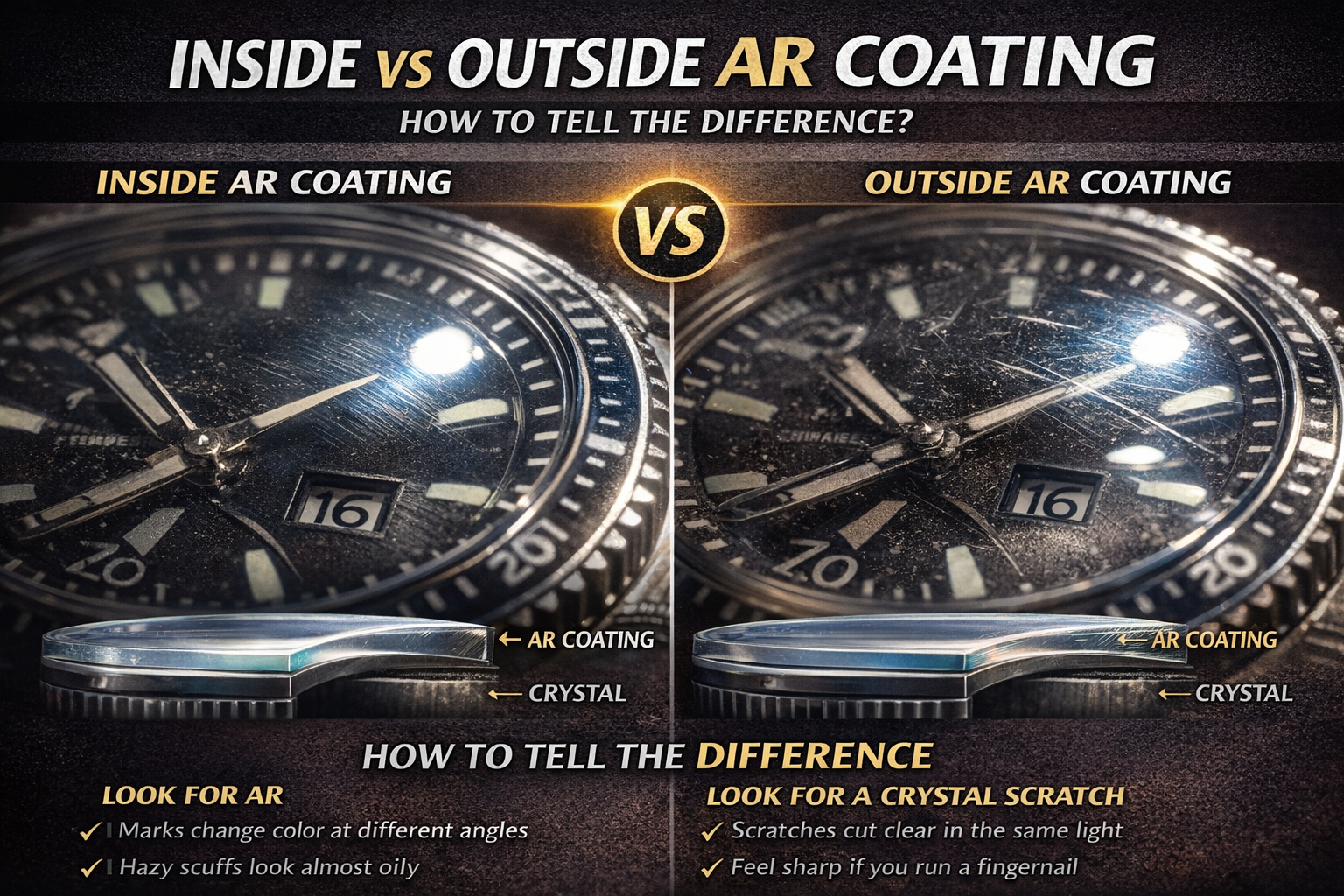
Anti-reflective (AR) coating reduces glare and improves dial clarity. But AR coating can scratch easier than sapphire, especially if the coating is on the outside of the crystal. That’s why a watch can look “scratched” even when the crystal itself is fine.
What is AR coating (simple explanation)?
AR coating is a thin layer applied to the watch crystal to reduce reflections. Less glare means:
-
the dial looks clearer in bright light
-
the watch is easier to read at angles
-
lume can appear more vivid because reflections are reduced
If you want the crystal material basics first (sapphire vs mineral vs acrylic):
→ Sapphire vs Mineral vs Acrylic Watch Crystal: Pros, Cons & Scratch Reality
Inside AR vs Outside AR (this is the key)
Inside AR (most common, more durable)
-
Coating is on the inner side of the crystal
-
Much harder to scratch because it’s protected
-
Usually the best “low drama” option
Outside AR (looks amazing, scratches easier)
-
Coating is on the outer surface
-
Gives that “no crystal” look (very clear)
-
But can pick up micro-scratches and scuffs more easily
Some watches use double AR (inside + outside) for maximum clarity.
Why does AR coating look like scratches?
AR marks can appear as:
-
hazy patches
-
rainbow/blue-ish scuffs
-
“wipe marks” that seem to move under light
-
fine hairline scratches that look worse at certain angles
This often happens because AR coating is so thin that even small abrasions show up strongly.
Quick diagnosis: Is it the AR coating or the crystal?
Use this 60-second check:
Step 1: Change the angle
-
If the “scratch” disappears or changes color dramatically when you tilt the watch, it’s often AR.
Step 2: Look for color shift
-
AR often shows a blue/purple/green tint under light.
-
Marks that only show with that tint are frequently AR-related.
Step 3: Check with a bright phone flashlight
-
Crystal scratches tend to look like “real lines” from most angles.
-
AR scuffs can look like cloudy streaks under harsh light.
If your crystal is acrylic, scratches behave differently and are often polishable:
→ Sapphire vs Mineral vs Acrylic Watch Crystal: Pros, Cons & Scratch Reality
Can you polish AR coating scratches out?
Most of the time: no
AR is a coating, not the crystal. Polishing often:
-
removes coating unevenly
-
creates “patchy” clarity
-
makes the watch look worse
What you can do safely
-
Clean properly (see below)
-
Accept light AR scuffs as normal wear
-
If it’s truly bothering you: a watchmaker can remove outside AR or replace the crystal/coating depending on the watch
Safe cleaning (what to do)
Best method (simple and safe)
-
Use a clean microfiber cloth
-
Breathe lightly on the crystal (fog it)
-
Wipe gently in straight strokes
-
If needed, use a tiny amount of water on the cloth (not dripping)
Avoid these (common causes of AR damage)
-
paper towels
-
rough fabrics
-
abrasive “polishing” cloths
-
harsh chemicals
More daily care habits:
→ Everyday Watch Care Guide: How to Keep Your Watch Looking New
Common mistakes that shorten watch life:
→ 10 Watch Care Mistakes That Ruin Your Watch Faster Than You Think
Should you remove outside AR coating?
It depends on your priorities.
Keep outside AR if you want:
-
maximum dial clarity
-
best “premium” look
-
better readability under strong light
Remove outside AR if you:
-
hate visible micro-scratches
-
work in environments where the crystal is constantly rubbed
-
prefer a “set and forget” surface
There is no universal “right answer”—it’s a trade-off.
Does AR affect lume visibility?
Often yes. Less reflection can make lume appear cleaner and stronger at night.
Related lume guide:
→ Watch Lume Guide: Super-LumiNova vs Tritium (Brightness, Lifespan & Safety)
When to replace the crystal (or take it to a watchmaker)
Consider professional help if:
-
the crystal has a deep real scratch you can feel with a fingernail
-
AR damage is heavy and you want uniform clarity again
-
the crystal has chips on the edge
-
the watch has multiple layers/coatings and looks patchy
Service reference:
→ How Often Should You Service a Mechanical Watch? A Practical Maintenance Timeline
Storage can also reduce accidental rubbing/scraping:
→ How to Store Watches Properly When Not Wearing Them
FAQ
1) Why does my sapphire look scratched so easily?
Often it’s not the sapphire—it’s the outside AR coating showing scuffs.
2) Can AR coating be reapplied?
Usually this is handled by crystal replacement or manufacturer-level refinishing, depending on the brand.
3) Is inside AR better than outside AR?
Inside AR is typically more durable. Outside AR looks clearer but scratches easier.
4) Can I remove AR coating at home?
Not recommended. DIY removal is easy to mess up and can leave uneven patches.
5) Does AR coating make the watch more fragile?
Not structurally. It’s mainly a surface layer affecting reflection and appearance.
6) How do I prevent AR marks?
Use microfiber only, avoid abrasive cloths, and store the watch safely.
→ How to Store Watches Properly When Not Wearing Them
Recommended Reading
-
Sapphire vs Mineral vs Acrylic Watch Crystal: Pros, Cons & Scratch Reality
-
Watch Lume Guide: Super-LumiNova vs Tritium (Brightness, Lifespan & Safety)
-
Everyday Watch Care Guide: How to Keep Your Watch Looking New
-
10 Watch Care Mistakes That Ruin Your Watch Faster Than You Think
-
How Often Should You Service a Mechanical Watch? A Practical Maintenance Timeline