Fake vs Aftermarket vs Franken Watch: The Difference That Can Cost You Thousands
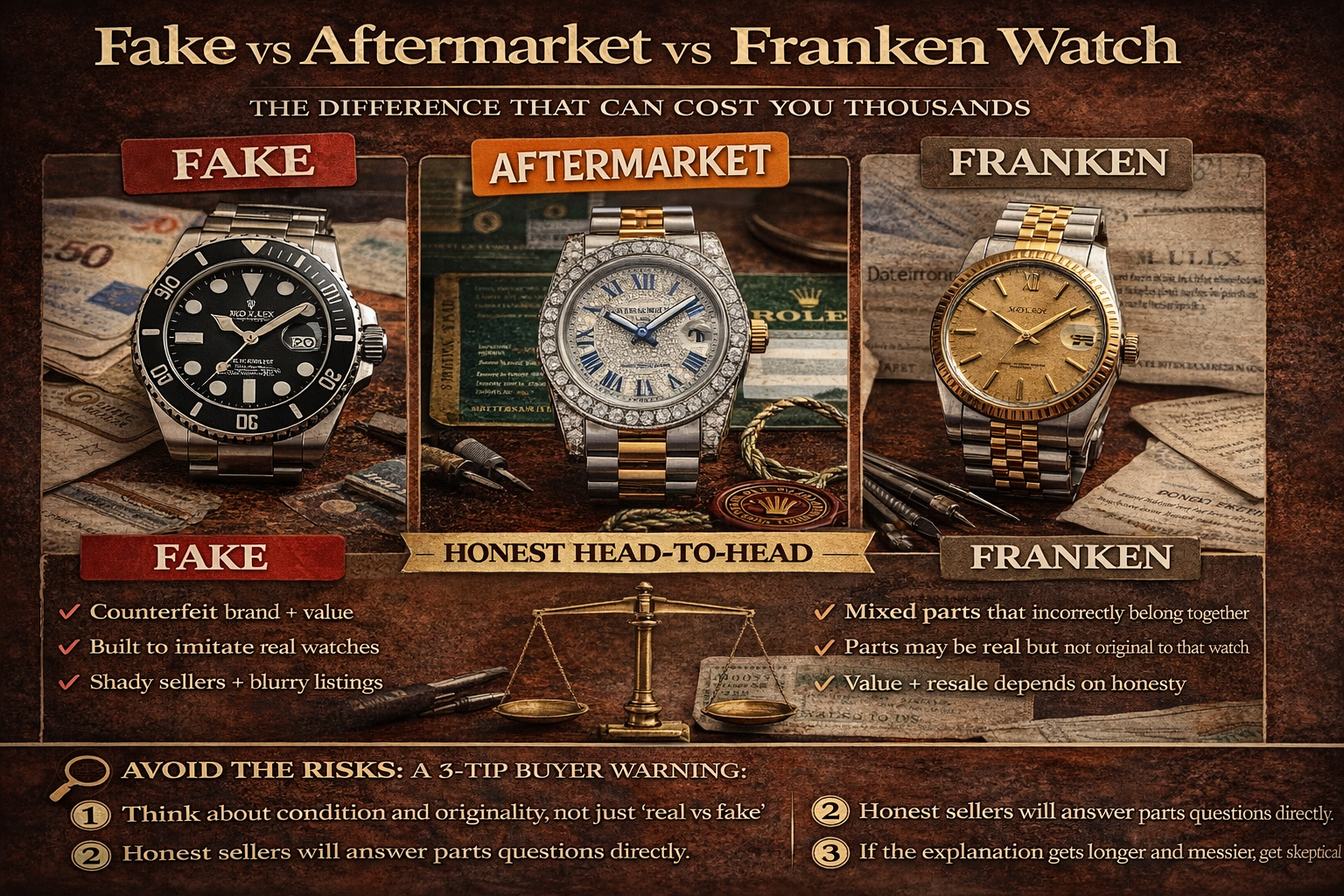
Fake vs Aftermarket vs Franken Watch: The Difference That Can Cost You Thousands
A lot of buyers use the word fake for everything that feels suspicious.
That is understandable.
It is also how people overpay.
Because in the real watch market, not every risky watch is fake in the same way.
Some watches are straight-up counterfeits.
Some are genuine watches with non-original parts.
Some are mixed together from parts that were never meant to live in the same watch.
To an inexperienced buyer, all three can look “close enough.”
To your wallet, they are very different problems.
And that is why this distinction matters:
A fake watch, an aftermarket watch, and a franken watch can all disappoint you—but they do not damage value, trust, and resale in the same way.
If you are buying used, especially online, this is one of the most important vocabulary lessons you can learn before sending money.
The short answer
Here is the clean version:
A fake watch is a counterfeit pretending to be a branded watch it is not.
An aftermarket watch usually starts as a genuine watch, but some visible or functional parts have been replaced with non-original parts not supplied by the original brand.
A franken watch is a watch assembled from mixed parts that do not correctly belong together, even if some or many of those parts are genuine.
That is the simple answer.
The real-world answer is more useful, because these categories overlap, and sellers do not always describe them honestly.
Why this matters more than buyers think
Because price in the watch market depends on story, not just steel.
Two watches can look nearly identical in photos and still have very different real value depending on:
- originality
- parts correctness
- service history
- disclosure
- brand expectations
- resale trust
A buyer sees a Rolex, Omega, Cartier, or Tudor listing and thinks the main risk is whether the watch is “real.”
But the smarter question is:
Real in what sense?
- Real brand?
- Real dial?
- Real bracelet?
- Real for that reference?
- Real for that year?
- Real enough to justify the asking price?
Those are not the same question.
And once you start thinking that way, your buying decisions get much safer.
What is a fake watch?
A fake watch is the easiest category to explain and sometimes the hardest to detect.
It is a counterfeit watch that pretends to be another brand.
That usually means:
- fake branding on the dial
- fake logo
- fake model identity
- fake serial or paperwork claims
- a general attempt to pass as Rolex, Omega, Cartier, Patek Philippe, Tudor, or another real brand
Sometimes the fake is obvious.
Sometimes it is much better than casual buyers expect.
That is why someone shopping for crown-logo watches should never rely on one “magic tell.” The safer mindset is the same one behind any smart used-watch purchase: check the seller, the story, the parts, and the condition together. That is also why our broader guide on buying a used luxury watch online matters before you even get into model-specific authentication.
In simple terms
A fake watch is not trying to be itself.
It is trying to borrow value from a name it did not earn.
What is an aftermarket watch?
This is where buyers get confused.
An aftermarket watch is often not fully fake. In many cases, it begins with a genuine branded watch. But one or more parts have been replaced with non-original parts.
That might include:
- an aftermarket bezel
- aftermarket dial
- aftermarket hands
- aftermarket bracelet
- aftermarket crystal
- aftermarket diamond setting
- non-original crown or insert
- custom parts added for style
This is why “aftermarket” is not always a yes-or-no morality label.
It is a disclosure and value issue.
A genuine watch with an aftermarket bezel is not the same thing as a counterfeit watch.
But it is also not the same thing as a fully original watch.
And if the seller prices it like a fully original watch, that is where the damage begins.
The key question
Is the watch being sold honestly for what it is?
Or is the aftermarket work being hidden, softened, or used to inflate value?
That is the real line.
What is a franken watch?
A franken watch is usually the most misunderstood category.
A franken watch is assembled from mixed parts that do not correctly belong together. Some may be genuine. Some may not. The problem is that the watch as a whole is not correct.
That can mean:
- a dial from one era
- hands from another
- a bracelet from a different reference
- a case that does not match the movement period
- service parts that changed the watch’s identity
- mixed genuine parts used to create a more desirable-looking model
This is especially common in vintage and heavily traded watch segments.
A franken watch can be much more dangerous than an obvious fake because it may pass the casual “looks real” test.
The parts may indeed be real.
They just are not right together.
That is a very expensive distinction.
The easiest way to remember the difference
Use this:
- Fake = pretending to be a brand it is not
- Aftermarket = real watch, non-original added or replaced parts
- Franken = mixed parts that do not correctly belong together
That framework is not perfect for every edge case, but it is the most useful buyer-level filter.
Real-world case 1: the fake Rolex that looked “good enough”
A buyer sees a pre-owned Submariner listed privately. The photos are decent, the seller sounds normal, and the watch comes with a box and card.
At first glance, the watch feels convincing.
But then the buyer notices a few things:
- the date sits slightly low
- the dial printing looks just a little soft
- the bezel pearl feels off
- the bracelet finishing does not match the rest of the case
- the seller avoids clear close-up photos
That turned out to be the simplest category: a fake.
This is the kind of deal that traps buyers who over-trust packaging. And that is exactly why full set vs watch only matters. Box and papers can support a watch, but they do not rescue a bad watch.
Real-world case 2: the genuine watch with expensive-looking aftermarket parts
Now a different scenario.
A buyer sees a used Cartier Santos with a diamond bezel and eye-catching custom dial. The seller describes it as “upgraded,” “luxury customized,” and “better than stock.”
Here, the base watch may be genuine.
But the visible parts that create the emotional wow factor are not factory original.
That makes it aftermarket.
Could someone still buy it and enjoy it?
Yes, if the disclosure is clear and the price reflects reality.
The problem is that many buyers treat aftermarket work as if it adds factory-level value. Usually it does not. In many cases, it narrows the future buyer pool and makes resale harder.
That is why the word “custom” should not automatically excite you. Sometimes it means more style. Sometimes it means less market trust.
Real-world case 3: the vintage Datejust that was “real,” but not right
A buyer finds a vintage Rolex Datejust that seems attractive because the price is lower than cleaner comparables.
The seller says:
“All genuine parts. Great vintage character.”
That sounds reassuring.
But under closer inspection:
- the dial belongs to a different production period
- the hands look like later service replacements
- the bracelet is from another generation
- the clasp code does not line up with the rest of the watch
- the case appears more worn than the dial condition suggests
This is classic franken territory.
Nothing in that description may be fully invented.
The parts may indeed be genuine.
But the watch is no longer a clean, correct example.
That matters because buyers do not pay top money for “technically real pieces mixed into one convenient story.”
Which is the most dangerous for buyers?
A fake is the most obvious betrayal.
A franken watch is often the most financially tricky.
An aftermarket watch sits in the middle and depends heavily on disclosure.
That is the honest ranking.
Fake
Big trust problem. Usually easiest to reject once proven.
Aftermarket
Not automatically evil, but frequently overmarketed and underexplained.
Franken
Often the hardest for normal buyers to detect and the easiest place to overpay while telling yourself the watch is “basically real.”
That is why so many expensive mistakes happen with watches that are not obviously counterfeit, but are still not worth the asking price.
Why brands like Rolex, Omega, Cartier, and Tudor show up in these conversations so often
Because brand heat creates incentive.
The stronger the brand name, the more money there is in:
- copying it
- upgrading it
- mixing parts to mimic rarer variants
- attaching prestige to unclear originality
Rolex is the obvious magnet because the market is so deep and the pricing gap between “ordinary example” and “great example” can be large.
Omega and Cartier also attract this problem because model familiarity is uneven. Many buyers know the name, but not the subtle details. That creates room for weak disclosure.
Tudor usually brings less counterfeit drama than Rolex, but the same basic buying logic still applies: if you are paying for originality, the watch needs to be original enough to justify the premium.
How each category affects value
This is the part that really matters when money enters the chat.
Fake watch value
In clean buying terms, a fake has no legitimate collectible value as the branded watch it imitates.
The more important issue is not whether someone, somewhere might still pay something for it. The real point is this:
You cannot honestly value it as the brand it claims to be.
Aftermarket watch value
An aftermarket watch may still hold some value because the base watch can be genuine.
But value often drops if:
- original parts are missing
- the customization is not reversible
- the work is unattractive to future buyers
- the seller is pricing it as factory original
The key rule is simple:
Aftermarket parts usually change value. They do not automatically add value.
Franken watch value
Franken watches are the hardest to price because so much depends on the mix.
Sometimes they are sold fairly as parts-based or imperfect examples.
More often, buyers get hurt when a franken watch is priced as though it were a clean original example.
That gap is where thousands disappear.
A watch can be genuine and still be a bad buy
This is worth saying clearly.
A lot of buyers relax the moment they hear “genuine.”
But genuine does not mean:
- correct
- original
- unpolished
- well-priced
- investment-worthy
- easy to resell
That is why how to tell if a watch is overpolished before you buy matters too. Condition problems, originality problems, and pricing problems often stack together.
A genuine watch can still be the wrong watch at the wrong price from the wrong seller.
The 9-step check I would use before paying
Here is a practical routine you can actually use.
1) Ask the seller one direct question
Send this:
Is the watch fully original to the best of your knowledge? If not, please list any aftermarket, replaced, service, or mixed parts.
That question does two things:
- it gives you information
- it reveals how the seller handles clarity
A clean seller will answer clearly.
A risky seller will hide inside vague language.
2) Start with the dial, not the box
The dial, hands, date window, and printing tell you more than packaging does.
If you are evaluating a used piece in person, the mindset in how to check a used watch in person is still the right one: inspect the watch first, the accessories later.
3) Compare the aging across parts
Do the dial, hands, bezel, bracelet, and case seem to have aged together?
If the dial looks older than the hands, or the case wear feels inconsistent with the rest, there may be part-swapping involved.
4) Ask what has been serviced or replaced
This is where many sellers reveal more than they intended.
Ask:
- Has the crystal been replaced?
- Are the hands original?
- Is the bracelet original to the watch?
- Has the bezel insert ever been changed?
- Has the dial been refinished or swapped?
- Is any part aftermarket?
These are not rude questions. They are buyer questions.
5) Check whether the price assumes originality
A seller may fully disclose changes and still overprice the watch.
That is where many buyers get trapped. They hear “genuine watch” and stop negotiating.
Do not do that.
If originality is weaker, your negotiating stance should change too. And if you need help keeping the deal calm while still protecting your side, our article on how to negotiate the price of a used watch without losing the deal is built exactly for that situation.
6) Treat “full set” as supporting evidence, not decisive evidence
Again, box and papers matter less than many people think.
A fake can come with packaging.
A franken watch can come with real accessories.
An aftermarket watch can still come with the original card.
The paperwork story and the watch story must match.
7) Be extra careful with vintage
Vintage is where people get seduced by phrases like:
- tropical
- service dial
- period correct
- rare configuration
- desirable variation
Sometimes those phrases are valid.
Sometimes they are elegant camouflage.
If you do not know the reference deeply, slow down.
8) If the case was opened or the watch was modified, think about water resistance too
This is especially important on dive-style watches and sports watches.
A genuine watch with changed parts or recent service may still need a proper pressure test before you trust it near water. That is why it helps to understand what a watch water resistance test actually checks and whether a watch needs a pressure test after battery change or service.
This does not prove authenticity by itself.
It proves whether the watch is ready for the real world.
9) For expensive deals, get a third-party inspection
The more money involved, the less ego should be involved.
If the seller resists reasonable inspection, that resistance is part of the evidence.
A message you can send any suspicious seller
Use this before you pay:
Hi, I’m interested, but I need clarity before moving forward. Please confirm whether the watch is fully original to the best of your knowledge, and list any aftermarket, replaced, service, or mixed parts. I’d also like clear close-up photos of the dial, hands, date, bracelet, clasp, case sides, and any paperwork. If we proceed, I’d want the sale to be subject to inspection/authentication.
That message is polite.
It is specific.
And it is very hard for a slippery seller to answer well.
The emotional mistake buyers make most
They think the only bad outcome is buying a fake.
It is not.
A very common expensive mistake is buying a watch that is:
- technically genuine
- visually attractive
- poorly disclosed
- wrongly configured
- priced as something better than it is
That is why the market punishes buyers who think in only two categories: real or fake.
The smarter buyer uses three:
- fake
- aftermarket
- franken
Once you do that, the watch market starts making a lot more sense.
What I would personally avoid
I would walk away fastest from:
- any watch with vague language about originality
- any seller who avoids direct parts questions
- any “custom luxury” piece priced like factory original
- any vintage watch whose components do not seem to have lived the same life
- any deal where the explanation gets longer as the evidence gets weaker
That does not mean every imperfect watch is a trap.
It means perfect confidence should never be built on imperfect clarity.
FAQ
Is a franken watch the same as a fake watch?
No. A fake is a counterfeit pretending to be a branded watch. A franken watch may use genuine parts, but those parts do not correctly belong together.
Is aftermarket always bad?
No. Some buyers knowingly enjoy aftermarket or customized watches. The problem starts when the work is hidden or when the price assumes factory originality.
Can a watch be genuine and still overpriced?
Absolutely. Genuine does not mean correct, original, or fairly valued.
Why are franken watches so dangerous?
Because they can pass the casual “looks real” test while still being worth much less than a correct example.
Do box and papers solve these problems?
No. They can support a watch, but they do not override issues with the watch itself.
Should I buy a watch with replaced service parts?
It depends. Service parts are not automatically a deal-breaker, but they should be disclosed and reflected in the price.
Final thoughts
The watch market does not only punish obvious mistakes.
It punishes blurry thinking.
If you call everything “fake,” you miss the real danger.
Because sometimes the costliest watch is not the obvious counterfeit.
It is the watch that is just real enough, just original enough, and just attractive enough to make you stop asking questions too early.
That is why fake vs aftermarket vs franken is not just watch-nerd vocabulary.
It is buying survival vocabulary.
So before you pay, ask yourself:
- Is this watch genuine?
- Is it original?
- Is it correct?
- Is it honestly described?
- Is the price based on reality?
If you cannot answer all five cleanly, you are not ready to send money.