Rolex Datejust Blue Dial vs Wimbledon: Which One Should You Actually Buy?
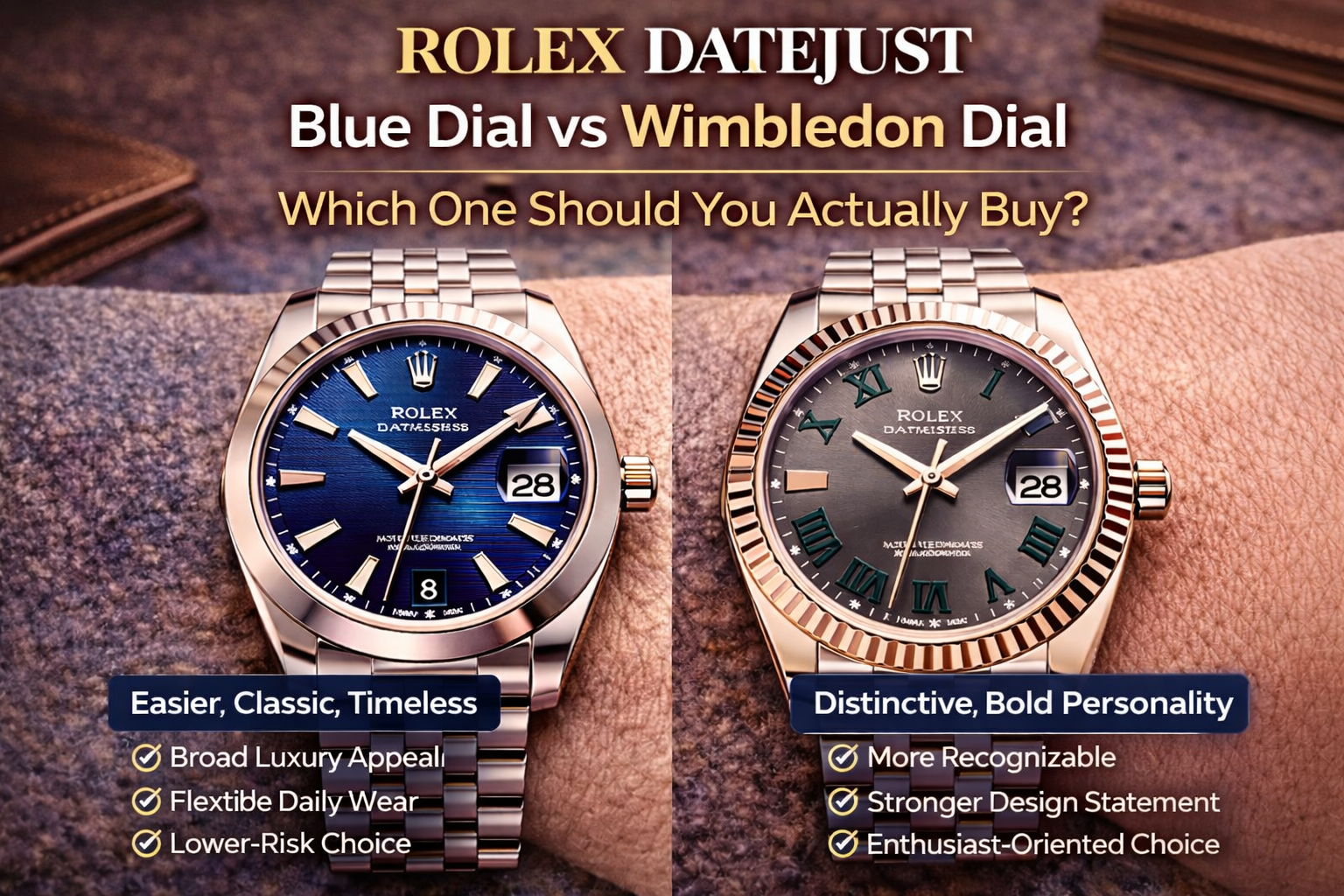
If you are buying a Rolex Datejust, there is a good chance you are not stuck on the case size anymore.
You are stuck on the dial.
And once the choice becomes blue dial vs Wimbledon dial, the decision gets a lot more personal than many buyers expect.
On paper, both are strong Datejust options. Both look premium. Both are popular. Both can work as a daily luxury watch. But in real life, they do not create the same feeling at all.
The blue dial usually feels cleaner, more classic, and easier to live with long term.
The Wimbledon dial usually feels more distinctive, more recognizable, and more like a deliberate Rolex choice instead of a safe one.
That is why buyers get stuck here.
This is not really about color alone.
It is about whether you want your Datejust to feel timeless and universally easy, or slightly more expressive and more identity-driven.
So which one should you actually buy?
The short answer is this: buy the blue dial if you want the safer long-term Datejust choice, and buy the Wimbledon if you want the more distinctive, more personality-heavy version that feels less generic every time you wear it.
That is the simple version.
But the real answer depends on what kind of satisfaction you are trying to buy.
The short answer
Buy the blue dial Datejust if you want:
- the more classic and versatile choice
- a dial that feels easy to wear across almost any situation
- a lower-risk first Rolex configuration
- a watch that tends to age well visually and emotionally
Buy the Wimbledon dial Datejust if you want:
- a more distinctive and recognizable Datejust look
- stronger personality on the wrist
- a dial that feels more “Rolex enthusiast” than “safe luxury buyer”
- something less common-feeling than the usual blue or black setup
If you are deeply unsure, the blue dial is usually the safer buy.
If you already know you get bored by safe choices, the Wimbledon may be the one you actually want.
Why this decision is harder than it looks
A lot of buyers assume dial color is just a styling preference.
It is not.
On a Datejust, the dial affects the entire tone of the watch. It changes how formal the watch feels, how casual it feels, how much personality it shows, how quickly you notice it on the wrist, and whether the watch feels like a classic choice or a deliberate one.
That is why blue vs Wimbledon is such a real decision point.
The blue dial Datejust usually appeals to buyers who want the watch to feel elegant, flexible, and obviously good-looking without needing explanation.
The Wimbledon dial usually appeals to buyers who want something with more character. It feels more specific. More intentional. More like a configuration chosen by someone who already had the obvious options in front of them and deliberately went another way.
That is why these two dials attract different kinds of buyers.
They are both Datejusts.
But they are not trying to satisfy the same part of your brain.
If you are still working out the bigger Datejust formula before worrying about dial choice, it helps to read Rolex Datejust 36 vs 41: Which Size Is Actually Better for Real Daily Wear?, Rolex Datejust Smooth Bezel vs Fluted Bezel: Which One Should You Actually Buy?, and Rolex Datejust Jubilee vs Oyster Bracelet: Comfort, Style, and Resale Differences, because the right dial often becomes much clearer once you know what kind of Datejust you are building overall.
The blue dial: why it is the safer choice for most buyers
Let’s start with the dial that almost nobody regrets for the wrong reasons.
The blue dial Datejust is the safer choice because it does almost everything well.
It looks rich without being loud. It looks sporty without becoming casual. It looks elegant without becoming fragile or overly dressy. In good light, it has enough visual life to keep the watch interesting. In ordinary light, it still feels balanced and premium.
That is exactly why so many first-time buyers end up here.
The blue dial is easy to understand.
It does not need context.
It does not depend on taste as heavily as some more specific dial choices do.
You can wear it with tailoring, office clothes, knitwear, denim, and weekend outfits without feeling like the watch is pulling too hard in one direction. It just works.
That matters more than people think.
A lot of expensive watch purchases go wrong not because the watch is bad, but because the buyer chooses something more “interesting” than they actually want to live with.
The blue dial usually avoids that problem.
It is not boring.
It is just easier to stay happy with.
The Wimbledon dial: why people either love it or hesitate forever
Now let’s talk about the Datejust dial that creates much stronger opinions.
The Wimbledon dial is not subtle in the same way the blue dial is. It carries more identity. It feels more specific. It looks like something chosen, not something defaulted into.
That is exactly why some buyers love it.
They do not want the safest beautiful Datejust.
They want the one that has more personality from across the room.
The Wimbledon dial gives them that.
It feels a little more playful, a little more distinctive, and a little more recognizable to people who know the model. It can also make the Datejust feel less like a generic luxury watch and more like a configuration with its own point of view.
But that extra personality comes with a real question:
Do you genuinely love it, or do you just find it more interesting right now?
That distinction matters.
Because the Wimbledon is not the kind of dial most people feel neutral about. It tends to create stronger first reactions, which can be good or dangerous depending on the buyer.
A watch that feels more distinctive in week one can sometimes feel more limiting in year two.
That does not mean the Wimbledon is a bad choice.
It means you need to want it for the right reasons.
A real buyer example: the watch that felt more exciting was not the one he bought
A buyer I know spent weeks going back and forth between a blue Datejust and a Wimbledon Datejust.
At first, the Wimbledon seemed like the clear winner. It felt more interesting. More specific. More like the kind of watch choice that had personality instead of just broad appeal.
The blue dial looked great too, but in comparison it almost felt too safe.
Then he tried both on twice.
That changed everything.
On the first try-on, the Wimbledon won the excitement test.
On the second try-on, the blue dial won the real-life test.
Why?
Because once the first emotional surge settled down, he started asking better questions. Which one worked better with his actual clothes? Which one would still look right five days a week instead of just in ideal conditions? Which one would feel easier after the novelty wore off?
That is when the blue dial started making more sense.
He bought the blue dial in the end, and months later he said something that sums this decision up very well: “The Wimbledon impressed me more. The blue dial fit me better.”
That does not mean blue is always the winner.
It means the watch that creates the stronger first reaction is not always the watch you want to grow old with.
Which one looks better?
That depends completely on what kind of “better” you mean.
If you mean cleaner, richer, more timeless, and easier to like immediately, the blue dial usually looks better.
If you mean more distinctive, more personality-driven, and more likely to stand out among other Datejusts, the Wimbledon usually looks better.
That is the real split.
The blue dial wins the classic beauty contest.
The Wimbledon wins the identity contest.
A lot of buyers get stuck because they think they are asking one question when they are actually asking another.
They ask, “Which dial looks better?” when what they really mean is, “Which dial will still feel right after the first excitement wears off?”
That is the more useful question.
Which one is better for real daily wear?
For most people, the blue dial.
Not because the Wimbledon cannot be worn daily. It absolutely can.
But daily wear rewards flexibility.
It rewards the choice that feels natural on ordinary days, not just appealing in ideal moments. It rewards the watch that slips into different outfits, different moods, and different seasons without asking too much from the wearer.
That is where the blue dial usually wins.
It is easier to pair. Easier to explain. Easier to forget about in the best possible way. It feels like a natural part of the watch rather than the thing you are constantly aware of choosing.
The Wimbledon can still be a great daily dial if you love what makes it specific. In fact, that is exactly when it works best. But it asks for a little more from the buyer. More certainty. More commitment. More confidence that this is the dial you truly want, not just the one that seemed more interesting in a boutique or on Instagram.
If you are choosing your Datejust specifically as a one-watch luxury purchase, Rolex Datejust vs Omega Aqua Terra: Which Everyday Luxury Watch Makes More Sense? also helps frame the bigger question of whether you want classic Rolex energy or a more understated everyday luxury watch overall.
Which one feels more “Rolex”?
This is one of those questions buyers often ask without saying it directly.
And the honest answer is: both do, but in different ways.
The blue dial feels Rolex in a broad, elegant, and easy-to-understand way. It looks expensive, balanced, and familiar without depending on one very specific visual identity.
The Wimbledon feels Rolex in a more insider way. It signals that this was not just a generic dial choice. It has more character and more instant identity to people who recognize it.
So if by “more Rolex” you mean more universally classic, the blue dial has a strong case.
If by “more Rolex” you mean more specific and more instantly identifiable as a known Datejust configuration, the Wimbledon has a strong case too.
That is why this is not a simple winner-loser decision.
It is a choice between broad classic appeal and more pointed brand personality.
Which dial is more timeless?
For most buyers, the blue dial.
That is not an insult to the Wimbledon.
It is just a reflection of how timelessness usually works in watches. The more visually universal a dial is, the more naturally it survives changing moods, wardrobes, and trends. The blue dial tends to feel timeless because it asks less of the buyer and depends less on specific taste.
The Wimbledon, by contrast, tends to feel more era-specific and more personality-specific. That can be part of the charm. It makes the watch feel more memorable. But it can also make the watch feel less neutral over very long ownership periods.
This is not a reason to avoid the Wimbledon.
It is a reason to buy it only if you really want that more defined character.
Which one resells better?
This is where buyer psychology matters more than many people expect.
The blue dial often has broader resale appeal because it is easy to like. It attracts first-time buyers, traditional buyers, and people who simply want a beautiful Datejust without overthinking the configuration.
That broad appeal matters.
The Wimbledon, on the other hand, can have strong demand from the buyers who specifically want it. But it is a more taste-dependent dial. That can work in your favor if the next buyer already loves the look. It can work against you if they do not.
So in general terms:
- the blue dial usually has the safer, wider resale pool
- the Wimbledon often has the stronger niche appeal for the right buyer
That means resale is not only about which one is “worth more.” It is also about how many people can easily say yes to the watch later.
If you are shopping pre-owned with resale in mind, do not stop at dial preference. You should already have How to Spot a Fake Rolex Before You Buy: 13 Red Flags That Actually Matter, How to Tell If a Watch Is Overpolished Before You Buy, Fake vs Aftermarket vs Franken Watch: The Difference That Can Cost You Thousands, and Used Watch Full Set vs Watch Only: How Much Do Box and Papers Really Matter? open before you send money. The wrong condition can hurt resale more than the wrong dial.
Which one is better as a first Rolex?
For most people, the blue dial.
That is the honest answer.
A first Rolex purchase usually comes with enough emotion already. Most buyers benefit from choosing the dial that is easiest to live with, easiest to style, and least likely to create long-term second thoughts. The blue dial does that very well.
But there is one big exception.
If the Wimbledon is the configuration you keep coming back to, and you know the blue dial would feel like the “safer” compromise rather than the watch you actually want, then the Wimbledon may be the right first Rolex for you.
That is the part too many buyers ignore.
They buy the one that makes the most sense on paper, then spend the next year admiring the one they really wanted.
That is not rational buying.
That is delayed regret.
Which one should you buy if you only want one Datejust?
If this is your one and only Datejust, and you want the lowest-risk answer, buy the blue dial.
It is easier. More flexible. More universal. More forgiving across changes in wardrobe, mood, and taste.
If this is your one and only Datejust, and you specifically want a configuration with more built-in identity, buy the Wimbledon.
Just be honest about why.
If you want the Wimbledon because it genuinely feels more like you, that is a strong reason.
If you want it because it seems more interesting in photos, that is a weaker one.
A practical 5-minute try-on test
If you are looking at both dials in person and still cannot decide, do this.
Put on the blue dial and leave it there for five minutes. Do not just stare in the mirror. Move normally. Step near natural light. Check the time casually. Think about your actual daily clothes.
Then do the same with the Wimbledon.
Now ask yourself:
- Which one still feels right when the first excitement settles down?
- Which one works better with your real wardrobe?
- Which one would you wear more often, not just admire more?
- Which one feels more natural on an ordinary day?
- If you bought the other one, which would you keep thinking about later?
That last question matters most.
Because the dial you keep thinking about is usually the dial you should have bought.
So which one should you actually buy?
Here is my honest view.
If you are uncertain, buy the blue dial.
It is the safer long-term choice, the easier first Rolex choice, and the one more buyers stay happy with over time.
If you are not uncertain — if you already know the Wimbledon is the one that keeps pulling you back — then buy the Wimbledon and stop trying to talk yourself out of it.
The blue dial is usually the calmer decision.
The Wimbledon is usually the more personal one.
And with a watch like the Datejust, personal truth matters.
Final verdict
Choose the blue dial Datejust if you want the more timeless, flexible, and lower-risk choice for real long-term ownership.
Choose the Wimbledon Datejust if you want the more distinctive, more identity-driven, and more specific Datejust configuration that feels less like a default luxury pick.
If your priority is versatility and long-term ease, blue makes more sense.
If your priority is personality and a stronger sense of individual choice, Wimbledon makes more sense.
The blue dial is often easier to live with.
The Wimbledon is often harder to forget.
And when you are spending this kind of money, that difference matters.
FAQ
Is the blue dial Datejust the safer choice?
Yes. For most buyers, it is the easier and more versatile long-term option.
Is the Wimbledon dial too specific for daily wear?
Not necessarily. But it is a more taste-driven choice, so you should buy it because you genuinely love it, not just because it feels more interesting in the moment.
Which Datejust dial is better for a first Rolex?
Usually the blue dial, because it is easier to wear and less likely to create second thoughts later.
Which one is better for resale?
The blue dial usually has broader overall resale appeal, while the Wimbledon often appeals more strongly to buyers who specifically want that exact look.
Which dial should I buy if I only want one Datejust?
For most people, blue. Buy Wimbledon only if that is clearly the version you actually want and not just the version that feels more novel right now.