Used Watch Full Set vs Watch Only: How Much Do Box and Papers Really Matter?
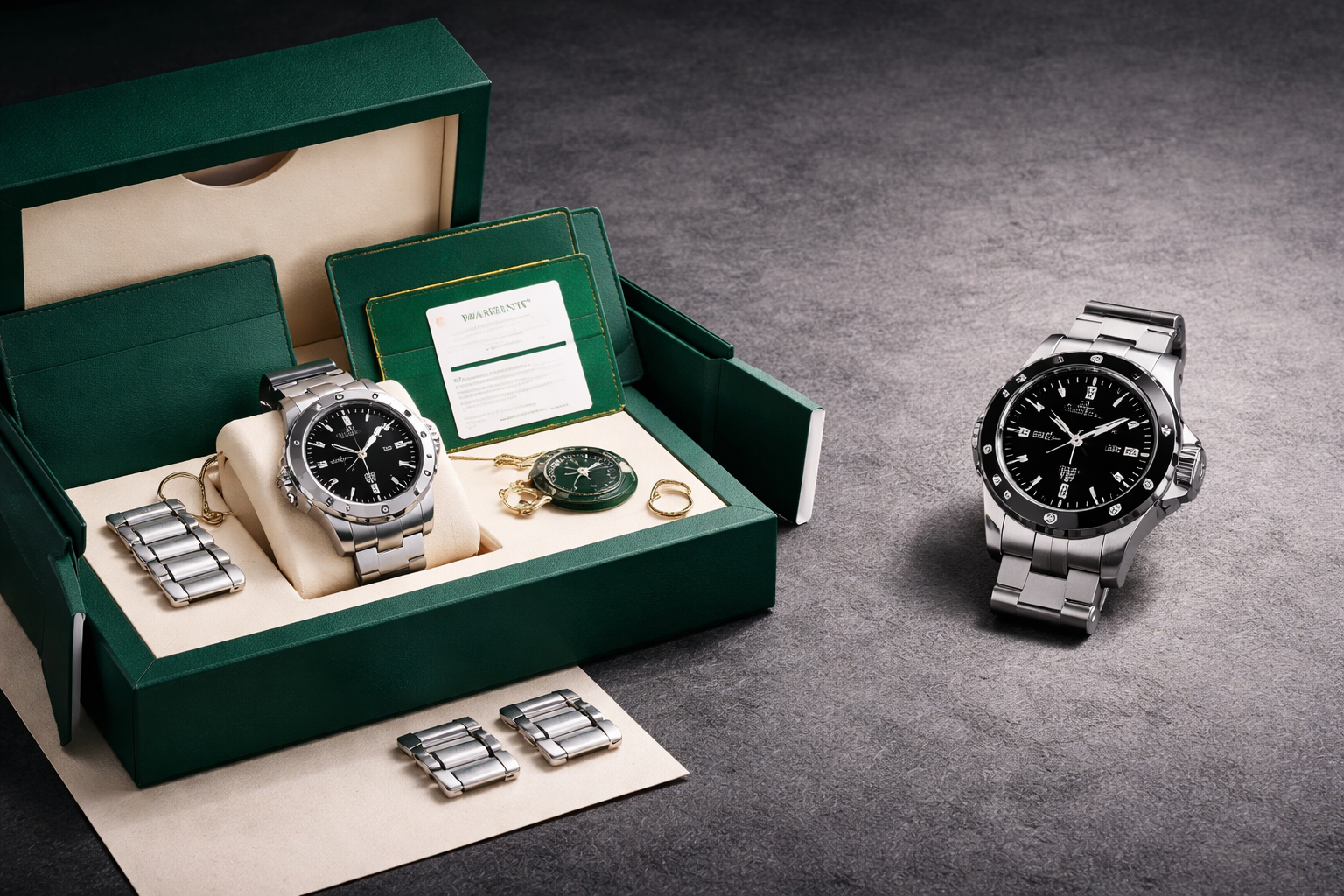
When people start shopping for a used watch, they usually focus on the watch itself.
That makes sense. The dial, bezel, case shape, bracelet, and price are what pull you in first.
Then you start seeing the listing language:
- full set
- box and papers
- watch only
- missing card
- no outer box
- open papers
- service papers only
And suddenly the question becomes bigger than just the watch.
How much do box and papers actually matter?
Here is the honest short answer:
They matter—but not always in the way people think.
A full set can absolutely help resale, buyer confidence, and overall appeal. But a used watch is not automatically a bad buy just because it is watch-only. In many cases, condition, originality, service history, and price matter more than cardboard and packaging.
That is the real decision.
Who this guide is for
This article is for you if:
- you are comparing a full set listing with a cheaper watch-only listing,
- you want to know whether box and papers are worth paying extra for,
- you are buying a used luxury watch for the first time,
- or you are trying to think more clearly about resale and long-term ownership.
If you are still deciding whether a used watch itself is worth buying, it also helps to think through fit, condition, and ownership practicality. That is where articles like Watch Size Guide: Case Diameter, Lug-to-Lug & Thickness (How to Choose the Perfect Fit), Watch Bracelet Sizing Guide: How Tight Should It Be? (Comfort, Fit Tests & Fixes), and Watch Case Materials Explained: Steel vs Titanium vs Ceramic vs Bronze (Pros & Cons) all become more useful than many buyers expect.
The short answer
Choose a full set when:
- you care about future resale,
- the watch is modern and expensive enough that documentation meaningfully affects buyer confidence,
- the price premium is reasonable,
- or you simply want the most complete ownership package.
Choose watch only when:
- the condition is stronger,
- the price is better,
- the seller is credible,
- the watch itself is right,
- and you understand that missing accessories should reduce the price.
In simple terms:
A full set is a nice advantage. It is not a substitute for a good watch.
And watch-only is not a problem if the watch itself still makes sense.
What “full set” usually means
This sounds obvious, but it is worth clarifying because sellers use the phrase loosely.
A true full set usually means the watch comes with the original retail package and its relevant accessories, which may include:
- inner box,
- outer box,
- warranty card or papers,
- booklets,
- hang tags,
- extra links,
- extra strap or clasp pieces if originally supplied,
- and sometimes receipts or service records.
Not every brand or era includes exactly the same things, so “full set” is not a universal formula. But the idea is the same: the watch comes with the key original extras that were part of its first sale.
That can feel more reassuring. Sometimes it should.
But it can also distract buyers from the more important question:
Is the watch itself actually the better buy?
What “watch only” really means
“Watch only” means the watch is being sold without some or all of its original extras.
That could mean:
- no box,
- no warranty card,
- no booklets,
- no spare links,
- or some incomplete version of the original package.
Sometimes that sounds worse than it really is.
A watch-only listing is not automatically suspicious. Watches lose packaging all the time over years of ownership, moving houses, traveling, divorces, estate clear-outs, drawer clean-outs, and casual real-life ownership. Plenty of perfectly legitimate watches are now separated from their original accessories.
The important part is that missing items should affect how you think about price and confidence, not automatically how you think about authenticity.
A full set does not guarantee a good watch.
A watch-only listing does not guarantee a bad one.
Why box and papers matter to buyers
There are four main reasons buyers care.
1. Confidence
A full set often feels safer. The buyer sees more supporting material, which can make the deal feel more complete and easier to trust.
2. Resale
When it is your turn to sell, a full set is usually easier to market and often attracts stronger offers.
3. Collectibility
For some models, especially modern luxury sports pieces and more collectible references, completeness matters more because buyers are chasing the whole package, not just the watch head.
4. Psychology
This one matters more than people admit. Opening the box, seeing the card, handling the booklets—these things create a stronger sense of “ownership event.” It feels cleaner and more satisfying.
That is real value. Just not always financial value.
Where buyers get this wrong
The biggest mistake is paying too much for a worse watch because the accessories feel reassuring.
A sharp, honest, well-priced watch-only example is often a better buy than a softer, overpolished, overpriced full set.
That sounds obvious on paper. But in real life, buyers often drift toward completeness because it feels safer emotionally.
Real-world example
Imagine two used watches of the same model.
Watch A is a full set. It comes with the box, warranty card, booklet, and all links. But the case has been polished more than you would like, the bracelet shows heavier wear, and the asking price is strong.
Watch B is watch-only. No card, no box, but the case is sharper, the bracelet is tighter, the crystal is cleaner, and the seller’s condition description is honest. It is also priced more sensibly.
A lot of buyers still choose Watch A because “full set feels safer.”
Experienced buyers often choose Watch B.
Why?
Because you wear the watch.
You do not wear the box.
That does not mean accessories are irrelevant. It means they should not overpower the condition conversation.
When full set matters a lot
There are definitely times when completeness matters more.
1. Modern luxury watches
On newer luxury watches, missing card and missing accessories often matter more because buyers expect a more complete package.
2. Hot resale references
If the model is the kind of watch buyers compare very closely, full set can make the watch easier to move later.
3. First-time buyers who value reassurance
A full set can reduce anxiety, especially for people who are new to used watches.
4. Gifting
If the watch is being bought as a gift, presentation matters more. Box and papers can make the purchase feel more finished and premium.
5. Collectors who care about completeness as part of ownership
For some buyers, completeness is not just resale strategy. It is part of the pleasure of the object.
In those cases, paying a bit more can make perfect sense.
When full set matters less than people think
There are also many times when box and papers matter less.
1. Older watches
As watches age, missing packaging becomes less surprising and often less important than the condition of the watch itself.
2. Daily wear purchases
If you are buying the watch to wear hard and keep long term, box and papers may matter much less than fit, condition, and ownership cost.
3. Lower price brackets
On less expensive used watches, the premium for completeness may not be worth it unless the price gap is very small.
4. Strong watch-only examples
A watch-only piece with excellent case shape, better bracelet condition, and a fair price can easily be the smarter buy.
5. Service-documented watches
If a watch does not have original papers but does have credible service records, that can sometimes matter more in practical ownership terms.
That is especially true once you start thinking like a wearer instead of a collector. Articles like How Much Does Watch Servicing Cost? Mechanical vs Quartz vs Chronograph vs GMT become relevant here because real ownership costs often matter more than packaging nostalgia.
Full set does not mean original, untouched, or better condition
This is a crucial point.
A full set can still include:
- an overpolished case,
- replaced parts,
- stretched bracelet,
- worn crown threads,
- tired gaskets,
- or vague service history.
Do not let the presence of a warranty card hypnotize you into ignoring the watch.
This is especially important if you are looking at case-heavy or detail-sensitive models where condition can be changed by refinishing. A polished case does not become more attractive just because it is sitting beside a box.
If you are still improving your eye for surfaces, Sapphire vs Mineral vs Acrylic Watch Crystal: Pros, Cons & Scratch Reality and AR Coating Explained: Why Your Watch Crystal Looks Scratched (But Isn’t) are also useful, because many buyers misread wear and then overvalue packaging instead.
Watch only does not mean fake
This is another place buyers get too simplistic.
A missing box or missing card is not proof of anything on its own.
It may increase caution.
It should lower confidence slightly.
It should affect price.
But it does not automatically mean the watch is suspect.
The right response is not panic.
It is better inspection.
When a watch is watch-only, you should care more about:
- the seller,
- the condition,
- the functions,
- the fit,
- the movement behavior,
- and the story behind the watch.
That is the intelligent way to handle missing accessories.
How much extra is a full set worth?
There is no universal number, because the premium depends on:
- the watch model,
- age,
- demand,
- condition,
- and how much buyers in that segment care about completeness.
That said, the key principle is simple:
The premium should make sense relative to the watch itself.
If the full-set premium is modest and the watch is equally strong, paying extra can be rational.
If the premium is large and the watch itself is weaker, watch-only may be the better buy.
A simple way to think about it
Ask yourself:
- Am I paying extra for stronger resale later?
- Or am I paying extra mostly for the emotional comfort of seeing the extras?
Both answers are valid. But they are not the same answer.
A practical buying example
Let’s say you are choosing between two pre-owned dive watches.
Option 1: Full set
- better presentation,
- original card and box,
- slightly more expensive,
- more clasp wear,
- softer lugs,
- no recent pressure test.
Option 2: Watch only
- cleaner case shape,
- tighter bracelet,
- stronger overall condition,
- lower price,
- but no original accessories.
If you are buying for daily wear and long-term ownership, Option 2 may easily be the smarter purchase.
If you are buying in a highly resale-sensitive segment and the condition gap is small, Option 1 may make more sense.
The point is not “always choose watch only” or “always choose full set.”
The point is:
Do not let the accessories make the decision for you.
Box and papers vs service records: which is more useful?
This is one of the most underrated questions in used-watch buying.
Original papers are nice.
Service records can be more useful.
Why?
Because a service document may tell you something practical about:
- timing,
- gasket work,
- crown replacement,
- movement condition,
- or recent maintenance.
An original warranty card tells you something about the watch’s original sale context. That matters too, especially for confidence and resale. But for actual next-owner ownership, service history can sometimes be the more meaningful piece of paper.
If the choice is between:
- a full set with unknown practical history, and
- a watch-only piece with credible recent service documentation,
the answer is not automatically obvious.
For a real wearer, the second option may be stronger than it first appears.
Do box and papers matter more for resale than for buying?
Usually yes.
When you buy, they affect:
- confidence,
- price,
- and emotional appeal.
When you sell, they often affect:
- how easy the watch is to list,
- how many buyers are interested,
- and how firm your asking price can be.
That is why some buyers willingly pay a little more now—not because they are obsessed with packaging, but because they know the next buyer may care.
That can be sensible.
But it still only makes sense if the actual watch is strong enough to deserve the strategy.
What to check if you are paying up for a full set
If you are paying extra for completeness, make sure the extra is actually real.
Check:
- is the warranty card present and believable for the watch,
- do the links and accessories match,
- is the box correct for the model and era,
- are booklets and tags consistent,
- and does the full-set premium still make sense after you evaluate condition?
This matters because some sellers casually use “full set” to create pricing power even when the package is incomplete, mismatched, or not especially valuable.
The safest mindset is:
full set should support value, not replace inspection.
Who should choose full set?
Full set is usually the better choice if you are:
- buying a modern luxury watch,
- likely to sell or trade later,
- sensitive to buyer confidence,
- giving the watch as a gift,
- or simply the kind of owner who values completeness.
There is nothing shallow about that. Ownership experience matters.
Some people enjoy the ritual of a complete package. That is a valid part of watch buying.
Who should choose watch only?
Watch-only is often the better choice if you are:
- buying to wear, not to curate packaging,
- getting a significantly better condition example,
- prioritizing value,
- comfortable with a little less resale strength,
- or buying an older watch where completeness is less critical than condition.
This is especially true when the missing accessories let you buy a better actual watch for the same total budget.
That is often the smarter move.
The 5 biggest mistakes buyers make here
1. Paying full-set money for a weaker watch
This is by far the most common mistake.
2. Treating watch-only like a red flag by default
Sometimes it is just normal life.
3. Ignoring missing links
A “full set” with poor bracelet fit is less useful than it sounds. Fit still matters. Watch Bracelet Sizing Guide: How Tight Should It Be? (Comfort, Fit Tests & Fixes) is relevant here for a reason.
4. Forgetting that water resistance is unrelated to papers
A card does not prove current water safety. If the watch will be used around water, Watch Water Resistance Test: What a Pressure Test Checks (and How Often to Do It) matters much more.
5. Letting packaging decide the deal
This is not a box purchase. It is a watch purchase.
A simple decision framework
If you are stuck, use this:
Choose full set if:
- the price gap is reasonable,
- the watch condition is also strong,
- resale matters to you,
- and the package feels complete and correct.
Choose watch only if:
- the watch itself is clearly better,
- the price is meaningfully better,
- the seller is credible,
- and you are buying primarily for wear.
Walk away if:
- the seller is asking a heavy full-set premium for a weak watch,
- the completeness claims feel vague,
- or the accessories are being used to distract from real condition issues.
Bottom line
Box and papers matter.
They just do not matter more than the watch.
A full set can improve buyer confidence, resale strength, and ownership satisfaction. That is real value. But a watch-only example can still be the smarter buy if the condition is stronger, the price is better, and the actual watch makes more sense on the wrist and in your budget.
So the real answer is simple:
- Buy the full set when the premium is fair and the watch is still strong.
- Buy watch only when the watch itself is clearly the better value.
Just do not confuse packaging with quality.
Because in the end, the part you live with is not the box on the shelf.
It is the watch on your wrist.
FAQ
Is a used watch without papers a bad buy?
No. It can still be a very good buy if the watch is strong, the seller is credible, and the price reflects the missing accessories.
Do box and papers increase resale value?
Usually yes. A full set often sells more easily and can support a stronger asking price.
Should I always pay more for a full set?
Not always. Only when the premium is reasonable and the watch itself is still worth buying.
Is service history more important than original papers?
Sometimes yes, especially for practical ownership. Service records can tell you more about recent real-world condition.
Does watch only mean fake?
No. Missing box and papers increase caution, but they do not prove anything by themselves.
What matters more: condition or full set?
In most cases, condition matters more.