Is Grand Seiko a Luxury Watch? What You Really Get for the Money
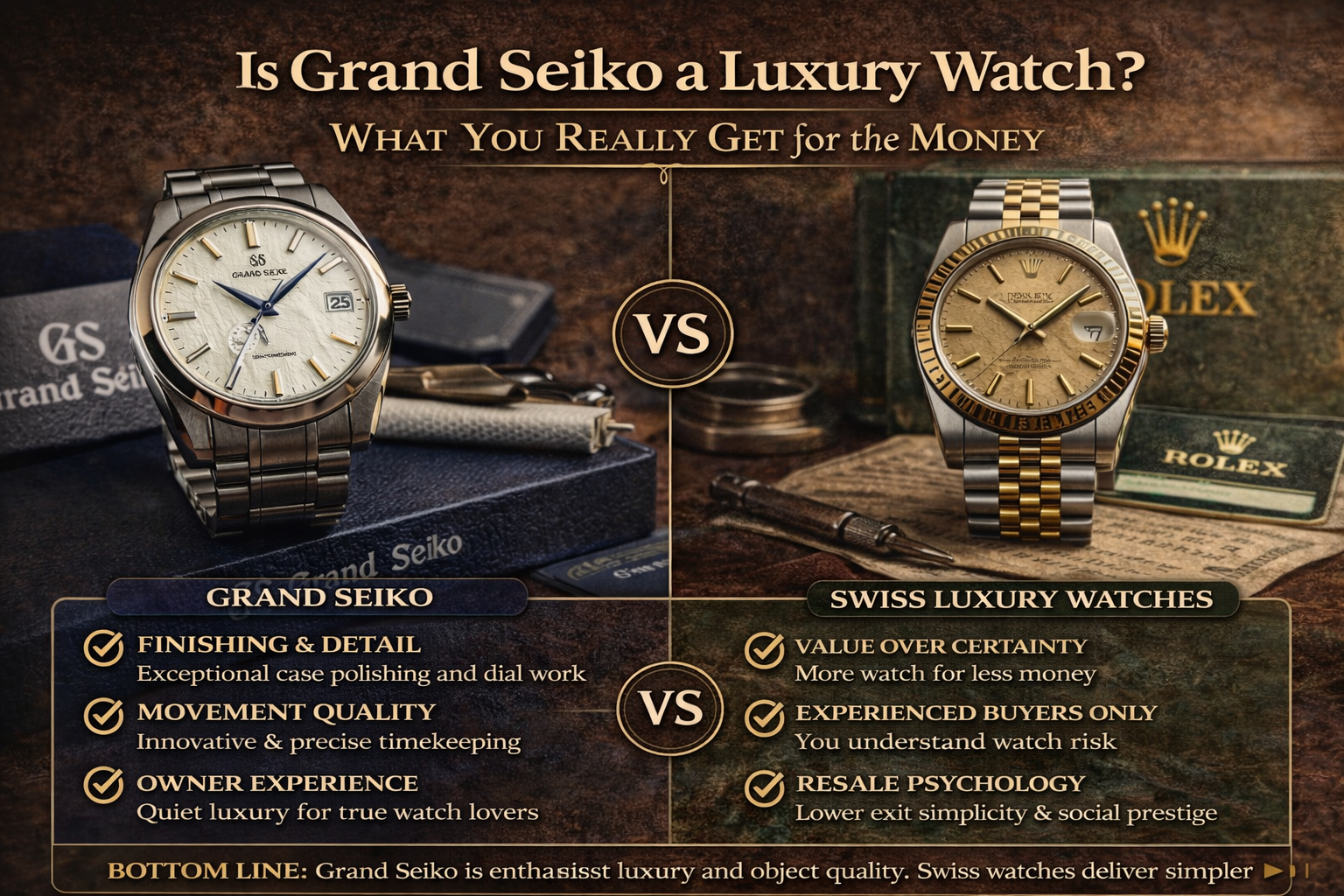
Is Grand Seiko a Luxury Watch? What You Really Get for the Money
This question comes up for one reason more than any other:
People know Seiko.
They do not always know what to do with Grand Seiko.
They look at the watch, see strong finishing, sharp hands, a beautifully textured dial, and a price that clearly sits above ordinary Seiko territory. Then they pause and ask the obvious question:
Is Grand Seiko actually a luxury watch?
That is a fair question.
Because Grand Seiko does not behave like luxury in the loud, obvious way some Swiss brands do. It usually does not scream for attention across the room. It does not always give you the same instant recognition that Rolex, Cartier, or Omega give you. And that creates a strange buying tension.
Some people try one on and think, “This is ridiculously good.”
Others look at the dial and think, “Yes, but will anyone else understand it?”
That tension is the whole story.
So let us start with the clean answer:
Yes, Grand Seiko is absolutely a luxury watch brand.
But it is a very particular kind of luxury watch brand.
It offers a lot of what serious buyers say they want:
- finishing
- craftsmanship
- dial work
- movement interest
- precision
- quiet individuality
What it does not always offer in the same way is:
- mass-market prestige
- instant social recognition
- the easiest resale story
- the emotional shorthand of a crown logo or a famous Swiss name
That does not make it less luxurious.
It makes it a different kind of luxury purchase.
The short answer
If by “luxury watch” you mean:
- high-end finishing
- serious craftsmanship
- refined case work
- premium materials
- strong movement identity
- brand philosophy beyond basic timekeeping
then Grand Seiko is clearly a luxury watch.
If by “luxury watch” you mean:
- universal public recognition
- obvious status signaling
- easy social validation
- brand power that non-watch people instantly understand
then Grand Seiko feels more complicated.
That is why so many buyers ask the question in the first place.
They are not really asking whether the watch is luxurious.
They are asking what kind of luxury it delivers.
Why Grand Seiko confuses buyers more than Rolex or Cartier
Because Grand Seiko sits at an unusual intersection:
- it is highly respected by watch people
- it is less understood by non-watch people
- it often looks restrained rather than dramatic
- it delivers quality in ways that show up more in ownership than in brand flexing
That means the value is not always obvious in the first five seconds.
A Rolex often communicates itself instantly.
A Cartier Santos often communicates itself instantly.
Even something like a recognizable Omega sports model can explain itself pretty quickly.
Grand Seiko often needs a second look.
Sometimes a third.
And that is exactly why it becomes such a personal purchase.
It tends to attract buyers who care about what the watch actually is, not only what the logo does in public.
What Grand Seiko really gives you for the money
This is the part that matters.
Because buyers do not actually purchase the phrase “quiet luxury.” They purchase a watch. And a watch has to justify itself on the wrist.
Here is what people are usually paying for with Grand Seiko.
1) Case finishing that feels much more expensive than many buyers expect
This is often the first real surprise.
A lot of people know Grand Seiko by reputation before they ever handle one. Then they see one in person and realize the surfaces, edges, reflections, and transitions are not just “nice for the money.” They are simply very, very good.
This is especially important if you have already read our guide on watch case materials explained. Materials matter, but finishing matters just as much. A watch can use excellent material and still feel ordinary if the execution is lazy. Grand Seiko usually wins because the execution feels intentional.
That is luxury.
Not marketing luxury.
Object luxury.
2) Dial quality that changes how you experience the watch
A lot of brands give you a pretty dial.
Grand Seiko often gives you a dial you keep noticing months later.
That matters more than spec sheets suggest.
The dial is the part you actually look at every day.
And Grand Seiko has built a reputation on making that everyday interaction feel richer than expected.
Some buyers discover that the real hook is not the name at all.
It is the moment they look down in natural light and realize the watch still feels interesting.
That is one reason Grand Seiko tends to age well emotionally for the right owner.
3) A strong identity around accuracy and movement seriousness
Grand Seiko also attracts buyers who actually care how a watch runs, not just how it photographs.
That is where your existing content can help set expectations. Someone comparing brands at this level often also cares about watch accuracy standards, daily use, and whether they should live with quartz, mechanical, or something in between. That is why Quartz vs Automatic for Daily Wear is a very natural supporting read for this article.
Grand Seiko appeals strongly to buyers who appreciate precision as part of luxury, not as an afterthought.
4) A luxury watch that does not feel too obvious
This is either a huge advantage or a deal-breaker depending on the buyer.
Some people are tired of buying watches that announce themselves before they even sit down. They want something refined, expensive, and rewarding without inviting constant outside interpretation.
Grand Seiko is very strong there.
It can feel luxurious to the wearer without turning into a performance for everyone else.
Case study 1: the buyer who wanted Rolex status and bought Grand Seiko instead
A buyer starts by looking at Rolex.
That makes sense.
Most people do.
He likes the idea of buying one “serious” watch, but as he goes deeper, he notices two things:
- he cares more about the object than the reputation
- he does not actually enjoy the attention and baggage that come with obvious status watches
Then he tries on a Grand Seiko.
What happens?
He notices the dial first.
Then the case finishing.
Then the strange feeling that the watch is somehow more satisfying up close than many louder luxury options.
He buys it.
Six months later, he is still happy because he bought for himself, not for the room.
That is a classic Grand Seiko success story.
Case study 2: the buyer who should not have bought Grand Seiko
Now the harder truth.
Another buyer says he wants craftsmanship, value, and originality. On paper, that sounds like the ideal Grand Seiko customer.
But what he actually wants, emotionally, is a watch people instantly recognize as expensive.
He buys Grand Seiko because the internet told him it was the “smart choice.”
A few months later, he is still browsing Rolex and Cartier.
That is not because Grand Seiko failed.
It is because he did not buy honestly.
He wanted validation more than craft, but tried to reason himself into a quieter brand.
That almost never works.
This is the same emotional trap we have already seen in pieces like Rolex vs Tudor and Omega Seamaster vs Rolex Submariner. Buyers do not regret the wrong specs nearly as much as they regret buying against their own real motivation.
So what kind of luxury is Grand Seiko?
The cleanest answer is this:
Grand Seiko is enthusiast luxury, object-first luxury, and owner-focused luxury.
It is usually strongest when the buyer cares about:
- finishing over hype
- nuance over brand shorthand
- personal enjoyment over public recognition
- quality of execution over pure logo power
That makes it feel extremely luxurious to some people and strangely invisible to others.
Both reactions are understandable.
Is Grand Seiko better made than Swiss luxury watches?
That is the wrong question in its blunt form.
The better question is:
Does Grand Seiko give you a level of finishing, detail, and ownership satisfaction that clearly belongs in the luxury category?
Yes.
Absolutely.
Will every buyer prefer it to Rolex, Omega, Cartier, or other Swiss brands?
No.
Because “better made” and “better for you” are not the same thing.
Some buyers want the cleaner global prestige story of Rolex.
Some want the icon status and elegance of Cartier.
Some want the broader mainstream familiarity of Omega.
Grand Seiko wins most decisively when the buyer responds to the watch itself first.
Daily wear: is Grand Seiko a good real-life luxury watch?
For a lot of people, yes.
In fact, this is one of its strongest advantages.
Grand Seiko often works very well for buyers who want:
- refined daily wear
- comfort without flashy weight
- enough personality to stay interesting
- enough restraint to fit normal life
If you are the kind of person who already thinks about case diameter, thickness, and proportion rather than buying purely by hype, this article naturally connects with your watch size guide. Grand Seiko tends to reward buyers who care about how a watch really sits and wears, not just how famous it is.
This is also where some people unexpectedly prefer Grand Seiko to louder luxury options. The watch often feels easier to integrate into real life.
Not because it is less special.
Because it is less performative.
What Grand Seiko does better than many buyers expect
There are four things buyers often underestimate before owning one.
1) Long-term visual interest
Some watches impress immediately and become visually ordinary later.
Grand Seiko often does the opposite.
It may not dominate your attention in the first five minutes.
But it keeps rewarding closer viewing over time.
2) Calm ownership
A lot of luxury-watch stress comes from:
- worrying about social signaling
- worrying about theft attention
- worrying about brand-based assumptions
- worrying that every mark hurts a semi-financial object
Grand Seiko often brings less of that weight.
That can make ownership feel healthier.
3) Conversation with people who actually care
This is underrated.
A Rolex gets broader recognition.
A Grand Seiko often gets more meaningful recognition from the people who notice it.
Whether that matters depends entirely on you.
4) A real sense of buying the watch, not just the story
This may be the biggest one.
With Grand Seiko, buyers often feel they paid for:
- the dial
- the hands
- the polishing
- the movement character
- the physical experience
That is a very satisfying way to buy a watch.
What Grand Seiko does not always give you
This part matters just as much.
A serious buying guide should say where the brand does not dominate.
1) Instant non-watch-person prestige
This is obvious but important.
If you want a watch that immediately reads as “luxury” to the general public, Grand Seiko usually does not hit in the same way as Rolex or Cartier.
2) The easiest resale psychology
This is not about whether Grand Seiko has value.
It is about how easy the next buyer conversation feels.
Some brands are easier for the market to explain to itself. Grand Seiko can require more context, more taste alignment, and more buyer understanding.
3) The simplest purchase for brand-driven buyers
If your heart really wants a famous Swiss luxury symbol, Grand Seiko may become the “rational alternative” that never fully satisfies you.
That is not a flaw in the watch.
It is a mismatch in buyer motive.
Is Grand Seiko worth it?
For the right buyer, absolutely.
But “worth it” depends on what you want your money to buy.
Grand Seiko is usually worth it when you value:
- craftsmanship you can actually see
- restrained but serious luxury
- real dial and case excellence
- movement interest
- long-term owner satisfaction
- lower reliance on public approval
It is less likely to feel worth it when you mainly want:
- instant recognition
- obvious status signaling
- the safest logo-driven luxury choice
- the emotional finish line of a Swiss icon brand
That is the honest divide.
Case study 3: the buyer choosing between Omega and Grand Seiko
A buyer narrows it down to Omega and Grand Seiko.
Omega feels safer in the mainstream luxury sense. It is easier to explain, easier to contextualize, and easier to compare against well-known Swiss benchmarks.
Grand Seiko feels more personal and more object-driven.
He spends time with both and notices something surprising: the Omega makes immediate sense, but the Grand Seiko keeps pulling him back.
That is often how this brand works.
It wins less by first-punch brand force and more by repeated close-contact appeal.
He ends up buying Grand Seiko because he realizes he wants the watch that feels richer in private, not louder in public.
Again, that is the exact buyer profile where Grand Seiko becomes a fantastic purchase.
A practical 8-step test before buying Grand Seiko
If you are trying to decide whether Grand Seiko is the right kind of luxury watch for you, use this.
Step 1: Ask what “luxury” means to you
Do you mean craftsmanship, public recognition, or both?
Step 2: Be honest about whether brand prestige matters
Not theoretically. Personally.
If it matters a lot, admit it now.
Step 3: Look at the watch in real light
Grand Seiko often makes much more sense in person than in flat online photos.
Step 4: Focus on the dial and case, not only the logo
This is where the value tends to reveal itself.
Step 5: Think about how you actually dress and live
Do you want a watch that quietly integrates, or one that clearly signals?
Step 6: Decide whether you enjoy subtlety
Some buyers say they do. Fewer really do.
Step 7: Think about servicing and ownership like an adult
Luxury is not only purchase price. Long-term care matters too. That is why How Much Does Watch Servicing Cost? remains a useful supporting read for anyone stepping into serious watch ownership.
Step 8: Ask whether you want admiration or attachment
Grand Seiko usually excels at attachment.
That distinction decides a lot.
Buying Grand Seiko new vs used
This article is about brand position, but the buying format still matters.
A new Grand Seiko often makes sense for buyers who want:
- clean provenance
- untouched condition
- the full ownership story from day one
A used Grand Seiko can make sense for buyers who care more about value than ceremony, especially if they are comfortable inspecting condition and disclosure.
The same used-watch discipline still applies:
- start with the watch, not the box
- check condition honestly
- ask about polishing
- ask about service
- compare multiple examples
That is where articles like How to Check a Used Watch in Person and Should You Buy a Used Luxury Watch Online? still matter, even outside the fake-Rolex world.
Because a real luxury watch can still be a bad buy if the transaction is sloppy.
My honest take
Yes, Grand Seiko is a luxury watch.
Not in the defensive sense.
Not in the “for the money” loophole sense.
In the real sense.
It belongs in the luxury conversation because of what it delivers on the wrist:
- finishing
- craft
- depth
- design discipline
- owner reward
But it is not a universal-answer luxury brand.
It is a more selective one.
It is perfect for the buyer who wants substance, detail, and quiet confidence.
It is less perfect for the buyer who wants maximum recognition and the simplest public luxury signal.
That is why Grand Seiko inspires such strong loyalty: when it matches the buyer, it matches deeply.
Who should buy Grand Seiko?
Buy Grand Seiko if:
- you care about object quality more than logo volume
- you enjoy subtle but serious luxury
- you want a watch people notice less often but respect more deeply when they do notice
- you want something different from the standard Swiss path
- you actually look at your dial and enjoy your watch daily
Do not buy Grand Seiko if:
- you really want Rolex, Cartier, or another Swiss icon but are trying to be “rational”
- you need broad recognition to feel satisfied
- you want the easiest possible resale psychology
- you mainly want a luxury symbol, not a deeply rewarding object
That is the cleanest buying advice I can give.
FAQ
Is Grand Seiko considered a luxury watch?
Yes. Grand Seiko clearly belongs in the luxury-watch category based on finishing, craftsmanship, movement seriousness, and overall execution.
Why do people still question whether Grand Seiko is luxury?
Mostly because the brand is quieter in public recognition than some Swiss luxury names, and because many people know Seiko but do not yet understand where Grand Seiko sits.
Is Grand Seiko worth the money?
For the right buyer, yes. Especially if you care about finishing, dials, precision, and understated ownership satisfaction.
Is Grand Seiko better than Rolex?
Not universally. Rolex usually wins on recognition and simpler prestige. Grand Seiko often wins for buyers who care more about object quality and quieter individuality.
Is Grand Seiko a status watch?
It can be, but it is usually a subtler one. It tends to signal taste more than obvious public status.
Should I buy Grand Seiko new or used?
That depends on whether you value certainty or price flexibility more. Either way, the quality of the watch and the quality of the seller still matter.
Final thoughts
The question “Is Grand Seiko a luxury watch?” sounds simple.
But what people usually mean is:
What kind of luxury am I really buying here?
And that is the right question.
Grand Seiko gives you a form of luxury that is less about instant recognition and more about repeated private satisfaction. Less about shouting, more about discovering. Less about the room, more about the wrist.
For some buyers, that makes it one of the most compelling luxury brands in watches.
For others, it will always feel like an intelligent answer to a different emotional question.
The smart move is not to force one answer.
The smart move is to know which kind of buyer you are before you spend the money.