Is a Timegrapher Worth Buying? What It Can Tell You—And What It Can’t
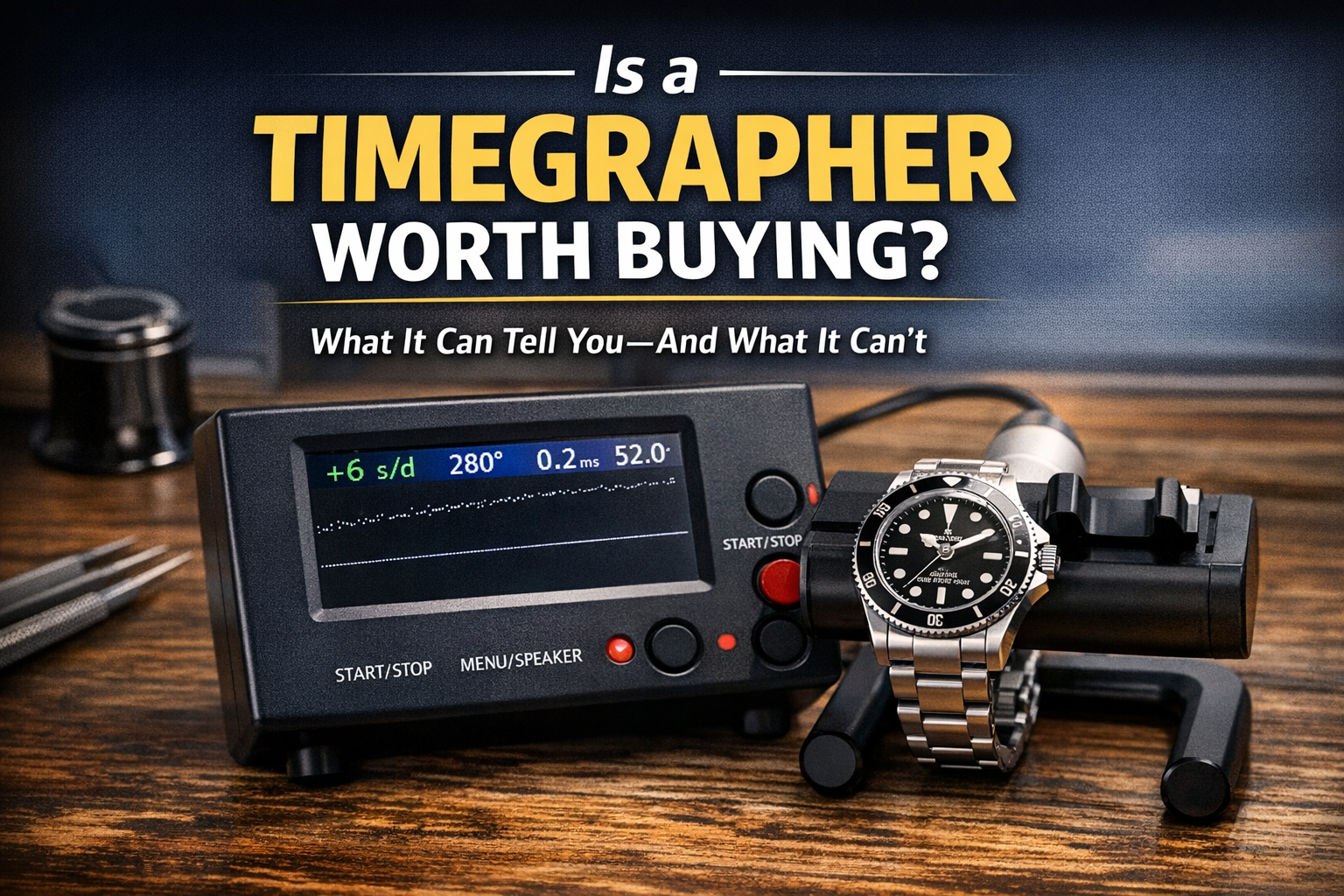
A timegrapher is one of those watch tools that looks far more magical than it really is.
For some owners, that is a good thing. A timegrapher can give quick, useful information about how a mechanical watch is running. It can help you spot obvious problems, compare positions, and understand whether a watch is behaving roughly as expected.
But for many people, buying a timegrapher is like buying a stethoscope after reading one health article online. You may hear something. You may even learn something. But that does not automatically mean you know what to do next.
So here is the honest short answer:
A timegrapher is worth buying if you own multiple mechanical watches, enjoy monitoring performance, and understand that it is a measuring tool—not a repair solution.
If you own one mechanical watch, rarely adjust anything, and mostly want to know whether the watch “seems fine,” a timegrapher is usually more curiosity purchase than necessity.
That is the core decision.
Who this guide is for
This article is for you if:
- you are thinking about buying your first timegrapher,
- you own several mechanical watches,
- you want to understand your watch’s condition better,
- or you keep seeing amplitude and beat error numbers online and want to know whether the tool is actually useful.
It is especially relevant if you have already read Timegrapher Readings Explained: Amplitude, Beat Error & What’s Normal, Timegrapher Settings Explained: Lift Angle & Beat Rate (VPH) — Get Accurate Readings, and Positional Variance Explained: Dial Up vs Crown Down (Improve Watch Accuracy Overnight). Those articles explain the details. This one answers the more important buying question:
Do you actually need the tool?
The short answer
A timegrapher is usually worth buying if:
- you own several mechanical watches,
- you enjoy tracking performance over time,
- you like diagnosing obvious issues before service,
- or you want to compare positions and monitor changes after regulation or demagnetizing.
A timegrapher is usually not worth buying if:
- you only own one watch,
- you do not enjoy technical watch data,
- you are expecting it to tell you everything about movement health,
- or you think buying one will replace proper service or professional diagnosis.
In simple terms:
A timegrapher is excellent for observation. It is limited for diagnosis.
What a timegrapher actually does
A timegrapher listens to the beat of a mechanical watch and translates that sound into useful running data.
Depending on the tool and settings, it can help show things like:
- rate,
- amplitude,
- beat error,
- beat noise pattern,
- and how the watch behaves in different positions.
That is useful. Sometimes very useful.
But it is important to stay realistic here.
A timegrapher does not look inside the movement.
It does not test water resistance.
It does not confirm long-term reliability.
It does not tell you whether a watch is fully healthy in every practical sense.
It gives you a snapshot of one part of the picture.
That is why people either overvalue timegraphers or dismiss them too quickly. The truth sits in the middle.
A real-world example
Let’s say you own three automatic watches.
One seems to be running a little fast.
One feels normal.
One stops earlier than expected after sitting overnight.
Without a timegrapher, you are mostly guessing.
With a timegrapher, you can learn whether:
- the fast watch may be showing obvious signs of magnetism or abnormal rate behavior,
- the normal-feeling watch is actually healthy across positions,
- and the weak-reserve watch is showing low amplitude or unstable behavior that deserves closer attention.
That does not mean the timegrapher will solve the problem.
But it may help you stop making blind assumptions.
That alone is why many enthusiasts find the tool worthwhile.
What a timegrapher is genuinely good at
This is where the tool earns its place.
1. Checking whether a watch is behaving roughly as expected
If a mechanical watch feels off, a timegrapher can often tell you whether the watch is obviously outside the kind of behavior you would normally expect.
That is a useful first filter.
2. Comparing positions
A watch that looks decent dial-up may behave differently crown-down or crown-left. Position testing is one of the most practical things a timegrapher helps with, especially if you are trying to understand daily wear behavior more realistically.
That is exactly why Positional Variance Explained: Dial Up vs Crown Down (Improve Watch Accuracy Overnight) matters so much once you own the tool.
3. Tracking performance over time
One reading alone is interesting. A series of readings over weeks or months is much more useful.
That is where a timegrapher starts becoming more than a toy.
If the same watch shows meaningful drift in amplitude, beat error, or stability over time, that may tell you more than a single “good” or “bad” result ever could.
4. Checking results after demagnetizing or regulation
A timegrapher can be helpful after a specific action.
For example, if a watch suddenly starts running fast and you suspect magnetism, Magnetized Watch Symptoms: Why Your Watch Runs Fast & How to Fix It (Safely) and How to Demagnetize a Watch at Home (Tool, Steps & When to Stop) become much more useful if you can check the watch before and after with actual readings.
5. Learning how mechanical watches really behave
This is underrated.
A timegrapher teaches owners that mechanical watches are not static machines. They behave differently based on power state, position, lift angle setting, movement type, and general condition.
For people who enjoy that side of watch ownership, the tool has real educational value.
What a timegrapher cannot tell you
This is the part that saves people from misusing the tool.
1. It cannot fully diagnose a movement
A timegrapher can suggest that something is wrong. It cannot always tell you exactly what the underlying problem is.
Low amplitude might point to several possible causes. So might unstable rate behavior.
2. It cannot replace real-world wear testing
A watch can look decent on a timegrapher and still disappoint on the wrist. Daily wear involves movement, winding efficiency, reserve use, temperature, and position changes that a static bench reading cannot fully reproduce.
That is why Power Reserve Explained: Why Your Watch Stops Early (and How to Fix It) still matters even if you own a timegrapher.
3. It cannot tell you whether the watch is water-safe
This sounds obvious, but some people treat a “healthy-sounding” watch as a generally healthy watch. Water resistance is a different issue entirely. If that matters, Watch Water Resistance Test: What a Pressure Test Checks (and How Often to Do It) is the relevant tool path, not a timegrapher.
4. It cannot fix bad assumptions
This is where people waste money.
A timegrapher gives numbers. But numbers are only as useful as the interpretation behind them. If you do not know what the tool is showing, it is easy to overreact to normal variation or miss something that actually matters.
5. It cannot make service decisions automatic
A weak reading does not always mean immediate service. A decent reading does not always mean “no service needed.”
The service decision still requires judgment, history, and real-world symptoms. That is why How Often Should You Service a Mechanical Watch? A Practical Maintenance Timeline still sits above the tool in the bigger ownership picture.
Who should absolutely consider buying one
A timegrapher makes the most sense for certain types of owners.
1. The multi-watch owner
If you own several mechanical watches, the value of the tool rises quickly because you can use it repeatedly across the collection.
2. The curious enthusiast
If you actually enjoy understanding how watches run, the tool gives meaningful insight and makes ownership more interactive.
3. The home tinkerer
If you already demagnetize watches, swap straps, monitor reserve behavior, and generally like learning by doing, a timegrapher fits naturally into that toolkit.
4. The pre-owned buyer or evaluator
If you regularly buy, sell, or inspect used mechanical watches, a timegrapher can be a useful first-check tool. Not a full truth machine, but still a valuable filter.
This is especially relevant if you are active in the pre-owned market and already think in the language of Should You Buy a Used Luxury Watch Online? 12 Checks Before You Pay.
Who probably should not buy one
There is no shame in skipping the tool.
1. The one-watch owner
If you own one mechanical watch and mostly want to wear it, enjoy it, and service it when needed, a timegrapher is rarely essential.
2. The owner who dislikes technical troubleshooting
If numbers make ownership less enjoyable rather than more, this tool can become a source of anxiety instead of value.
3. The buyer who expects certainty
If you want one device that can tell you exactly whether a watch is healthy, this is not that device.
4. The owner who is really avoiding service
Sometimes people buy tools because they hope to outsmart maintenance. A timegrapher is not a shortcut around normal service reality.
The biggest mistake people make with timegraphers
They confuse measurement with understanding.
This is the trap.
A person buys a timegrapher, places a watch on it once, sees one strange-looking number, and concludes the watch is in serious trouble. Or they get one neat-looking reading and assume everything is perfect.
Both reactions are too simple.
A timegrapher is best used like this:
- take multiple readings,
- use the correct settings,
- compare positions,
- consider power state,
- and combine what you see with real-world wear behavior.
Without that, the tool becomes a confidence machine for bad conclusions.
What you should learn before buying one
If you are seriously considering a timegrapher, learn these basics first:
1. Rate
How fast or slow the watch is running in the measured position.
2. Amplitude
A clue about movement energy and general running condition.
3. Beat error
How evenly the watch is ticking relative to its beat cycle.
4. Lift angle
Critical for correct readings on many watches.
5. Beat rate / VPH
Needed to make sure the tool is interpreting the movement correctly.
That is why these articles should be read before or immediately after buying:
- Timegrapher Readings Explained: Amplitude, Beat Error & What’s Normal
- Timegrapher Settings Explained: Lift Angle & Beat Rate (VPH) — Get Accurate Readings
- Positional Variance Explained: Dial Up vs Crown Down (Improve Watch Accuracy Overnight)
Without those basics, the tool is much easier to misuse.
A practical scenario: when a timegrapher saves you time
Let’s say your watch suddenly starts running fast.
Without a timegrapher, you may assume:
- it needs service,
- something major is wrong,
- or the movement is worn out.
With a timegrapher, you may notice behavior that strongly suggests magnetism instead of full mechanical decline.
That does not guarantee the answer.
But it may point you toward the right next step faster.
Now compare that with a different case:
Your watch keeps stopping early. You put it on the timegrapher, get one decent reading, and assume all is well. But the real issue is low winding efficiency from your desk-heavy routine, inconsistent wear, or reserve misunderstanding.
That is why tools never replace context. How to Wind a Mechanical Watch Properly (Manual vs Automatic + Mistakes to Avoid) and Power Reserve Explained: Why Your Watch Stops Early (and How to Fix It) still matter.
Is it worth buying just for one watch?
Usually not.
That is probably the cleanest answer in this whole article.
If you own one mechanical watch, and you are not actively learning regulation, diagnosing issues, or tracking behavior over time, a timegrapher often becomes a “used twice, then forgotten” purchase.
There are exceptions:
- you are deeply curious,
- you enjoy tools,
- or the watch is important enough that monitoring gives you real satisfaction.
But for the average one-watch owner, the tool is more interesting than necessary.
Is a cheap timegrapher good enough?
For many owners, yes.
If your goal is:
- basic observation,
- comparing positions,
- spotting obvious changes,
- and learning how readings behave,
then a simple entry-level unit can be enough.
The main thing is not buying the fanciest machine.
It is learning to use the tool correctly and interpret the results with restraint.
A good reading taken thoughtfully is more useful than a premium machine used badly.
A 6-step decision framework
If you are undecided, use this.
Step 1: Count your mechanical watches
One or two? The tool may be optional.
Several? It starts making more sense.
Step 2: Ask whether you enjoy technical ownership
Do you like measurements, comparison, and tracking? Or do you just want the watch to work?
Step 3: Be honest about your goal
Are you trying to learn, monitor, or diagnose obvious changes? Good reason.
Are you hoping the tool will replace watchmaking? Bad reason.
Step 4: Consider how often you would actually use it
Not theoretically. Realistically.
Step 5: Read the basics first
If you do not want to learn lift angle, VPH, and basic interpretation, do not buy the tool yet.
Step 6: Decide whether you want information or reassurance
A timegrapher gives information. It does not always give reassurance.
That distinction matters.
When borrowing or using a shop timegrapher is smarter
Sometimes the best answer is not buying one at all.
If you only need occasional readings, it may make more sense to:
- ask a trusted watchmaker,
- use a shop reading,
- or borrow one before deciding whether the tool deserves a place in your setup.
This is especially true if your interest is temporary rather than ongoing.
Bottom line
A timegrapher is worth buying for the right kind of watch owner.
If you own several mechanical watches, enjoy learning how they behave, and understand the limits of what the tool can tell you, it is a useful and satisfying piece of kit.
If you own one watch, want simple certainty, or expect the tool to answer every question, it is usually not worth the money or mental space.
That is the real answer:
A timegrapher is not a must-have for watch ownership.
It is a useful niche tool for owners who genuinely want data, context, and comparison.
Used well, it teaches you a lot.
Used badly, it mostly teaches you anxiety.
FAQ
Is a timegrapher necessary for watch owners?
No. Most owners do not need one. It becomes useful mainly for enthusiasts, multi-watch owners, and people who enjoy tracking performance.
Can a timegrapher tell if a watch needs service?
Not by itself. It can suggest that something may be wrong, but it cannot fully diagnose the movement or replace professional judgment.
Is a timegrapher worth buying for one watch?
Usually not, unless you are especially curious or like monitoring performance in detail.
Can a timegrapher detect magnetism?
It can show behavior that may suggest magnetism, but it does not directly prove every cause. It is a clue tool, not a final-answer machine.
Will a timegrapher improve my watch’s accuracy?
No. It measures behavior. It does not improve the watch by itself.
What should I learn before buying a timegrapher?
At minimum, learn rate, amplitude, beat error, lift angle, and beat rate/VPH. Without those, the tool is much easier to misuse.