- Home
- How to Spot a Fake Omega Seamaster Before You Buy
How to Spot a Fake Omega Seamaster Before You Buy
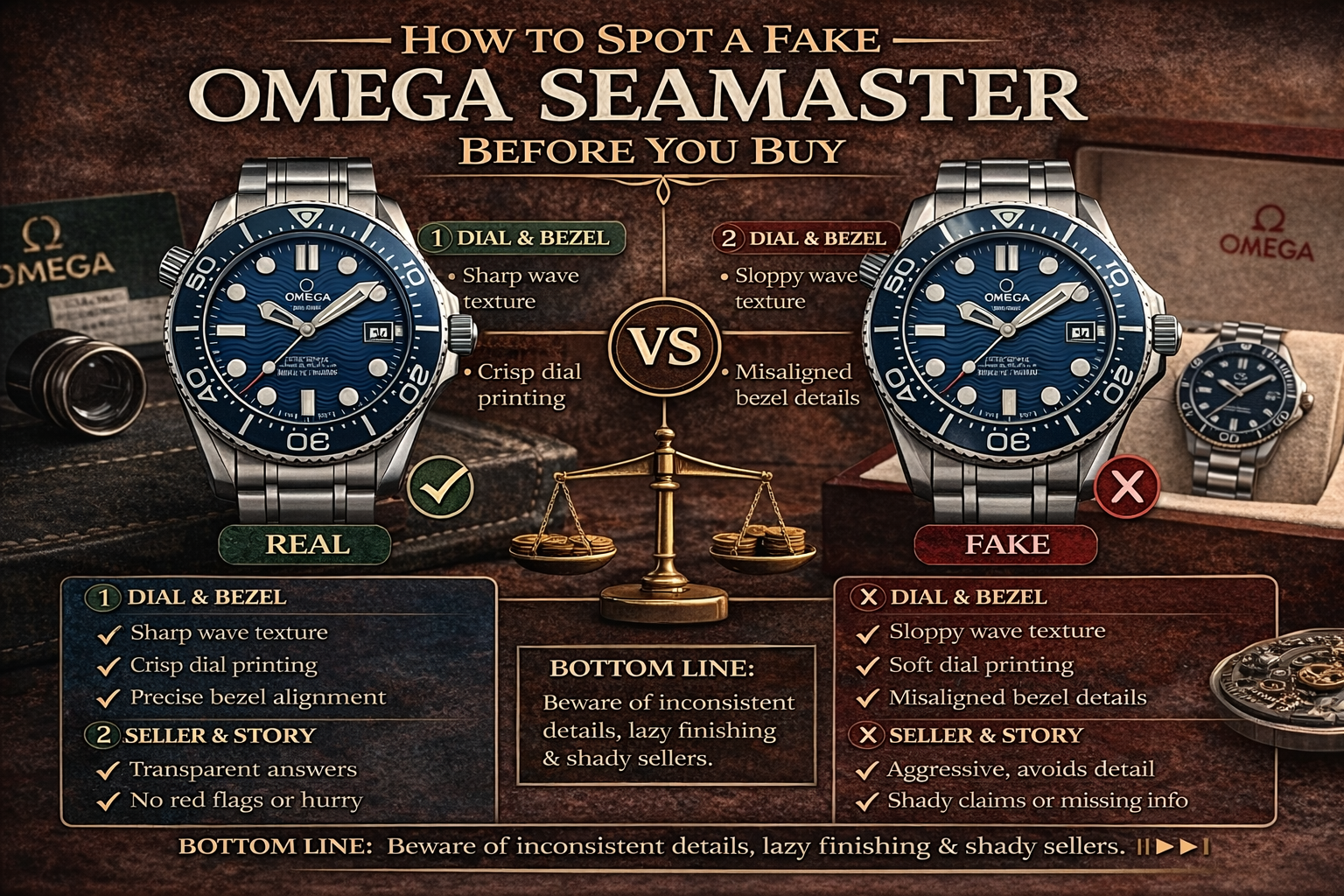
The Omega Seamaster is one of those watches that looks familiar even to people who are not deep into watches.
That is exactly why it gets copied.
It has the right mix of things counterfeit sellers love: a famous name, recognizable design cues, strong daily-wear appeal, and enough price gap between real and fake to make “almost convincing” very profitable.
And because the Seamaster comes in more than one look—different dials, bezel styles, bracelet types, and generations—buyers can talk themselves into uncertainty far too easily.
They think:
Maybe Omega changed that detail on another version.
Maybe this seller just takes bad photos.
Maybe I’m overthinking it.
Maybe it’s still a good deal.
That is how people get burned.
So let’s start with the main point:
The safest way to spot a fake Omega Seamaster is not to hunt for one magic flaw. It’s to check the watch, the seller, the parts, and the story together.
If one of those falls apart, the whole deal changes.
The short answer
A fake Omega Seamaster usually gives itself away through a combination of problems:
- soft or uneven dial printing
- sloppy wave dial texture or incorrect marker placement
- bezel details that look slightly wrong in font, shape, or alignment
- hands that feel too generic or poorly finished
- bracelet and clasp finishing that do not match the price level
- a helium valve, date window, or case shape that feels “close enough” but not precise
- a seller who avoids strong close-up photos
- packaging being used as the main proof instead of the watch itself
In other words:
Most fake Seamasters fail the consistency test before they fail the branding test.
That is good news for buyers, because consistency is easier to test than myth.
Why fake Omega Seamaster watches fool people
Because buyers often underestimate Omega in two different ways.
First, they assume counterfeiters only focus on Rolex-level targets.
Not true.
Second, they assume a fake Seamaster will be obviously bad.
Also not true.
A lot of fake Omega Seamasters are not trying to fool seasoned collectors under a loupe. They are trying to fool normal buyers looking at listing photos on a phone.
That changes the game.
If the watch has:
- the right general case shape
- a blue or black dial
- a dive bezel
- the Omega logo
- a bracelet that looks reasonably heavy
- a decent overall photo
many buyers relax too early.
That is the mistake.
A real Seamaster is not just the sum of recognizable parts.
It is a very specific combination of finishing, proportion, detail, and quality.
A real-world buying scenario: the “clean private deal” that feels almost right
A buyer sees a modern Omega Seamaster Diver 300M listed by a private seller.
The listing says:
“Full set, worn carefully, no issues, keeping great time, priced to sell.”
That sounds normal.
The seller posts:
- one front-facing photo
- one wrist shot
- one box and card photo
- one angled bezel shot
At first glance, the watch looks fine.
Then the buyer asks for:
- straight-on macro dial photos
- close-up bezel photos
- a clasp shot
- caseback photos
- side profile shots
- bracelet end-link photos
- a clearer card image
The seller becomes slightly irritated.
The new photos arrive, but they are still oddly soft. The wave pattern on the dial looks less crisp than expected. The bezel numerals feel a little too thick. The lume pip looks slightly off-center. The date window feels slightly cramped. The clasp finishing looks less sharp than the case. The seller keeps repeating:
“It’s 100% real as far as I know.”
That line matters.
Not because every honest seller knows every Seamaster reference by heart.
But because fake-watch deals often survive on soft confidence, not hard clarity.
That is when smart buyers stop chasing the deal and start testing the story.
What makes a real Omega Seamaster feel real
Before talking red flags, it helps to know what you are actually looking for.
A real Seamaster usually feels:
- more precise than flashy
- more engineered than decorative
- more refined in finishing than casual photos suggest
- more coherent overall than fake versions that only get the broad idea right
That coherence matters.
On a real watch, the dial, hands, bezel, case, bracelet, and clasp usually feel like they belong to the same quality standard.
On a fake watch, one part often falls behind the others.
That is what buyers should hunt for.
13 red flags that actually matter on an Omega Seamaster
1) Buy the seller before you buy the watch
This is still the first rule.
A trustworthy seller should be willing to provide:
- clear macro photos
- direct answers about ownership and service
- a plain explanation of included accessories
- comments on replaced parts or polishing
- a reasonable inspection or authentication process before final payment
Warning signs include:
- rushing you
- getting annoyed by basic questions
- repeatedly sending poor photos
- refusing caseback or clasp shots
- acting like box and papers should end the conversation
If you are buying remotely, start with our broader guide on Should You Buy a Used Luxury Watch Online? 12 Checks Before You Pay. Most fake-watch mistakes happen before the buyer ever touches the watch.
2) The dial should look sharp, not merely branded
A fake Seamaster often gets the layout broadly right but loses precision in the dial.
Look closely at:
- the Omega logo
- text spacing
- minute markers
- date window proportions
- the dial surface texture or wave pattern
On many fake Seamasters, the dial feels just a little too soft.
Not necessarily ugly. Just less controlled.
That matters because Omega’s modern sports-watch dials usually look crisp and deliberate in person.
If the dial looks fuzzy, approximate, or strangely flat under magnification, slow down.
3) Check the wave pattern and dial texture carefully
On many modern Seamaster models, the wave dial is one of the easiest places to spot trouble.
What goes wrong on fakes?
- waves that look too shallow or too aggressive
- poor spacing
- uneven texture
- waves that interfere awkwardly with markers or text
This is the kind of detail casual buyers ignore and careful buyers use.
A fake can get the “blue wave dial” idea correct while still getting the execution wrong enough to matter.
4) Look closely at the bezel font, pip, and alignment
Dive-bezel mistakes are common.
Check:
- numeral shape
- font thickness
- alignment at 12
- bezel insert finishing
- lume pip placement
- whether the bezel action feels precise if you handle it in person
A lot of counterfeit watches look acceptable until the bezel is examined properly. On a Seamaster, the bezel should feel controlled and intentional, not decorative or vague.
If the pip looks off, the numerals feel clumsy, or the insert seems cheaper than the rest of the watch, do not ignore that.
5) The hands should feel refined, not generic
Hands are one of the quiet truth-tellers on luxury sports watches.
Check whether they look:
- too thick
- too flat
- too polished in the wrong way
- poorly matched to the dial markers
- imprecise at the edges
Omega hands usually feel more exact in person than fake versions do.
This is not about memorizing one model photo. It is about sensing whether the watch feels like a coherent premium object.
6) The helium escape valve and case profile should not feel “approximate”
This matters especially on Seamaster Diver models.
The case architecture, crown area, and helium valve are often where fakes drift into “close enough” territory.
Look for:
- valve proportions that feel wrong
- crown guards that look off
- case thickness that seems awkward
- transitions between brushed and polished surfaces that feel less clean than expected
A counterfeit seller may hope you focus only on the dial.
Do not.
The case tells the truth faster than many buyers realize.
7) Bracelet and clasp quality matter a lot
A weak bracelet is one of the fastest ways a fake luxury sports watch loses the argument.
Check:
- link finishing
- clasp sharpness
- engraving quality
- push-button action
- bracelet-to-case fit
- whether the bracelet feels consistent with the case quality
A real Omega bracelet may not be perfect to every taste, but it should not feel cheap, loose in the wrong way, or casually finished.
This is also why How to Check a Used Watch in Person: 15 Things to Inspect Before You Buy is such a useful supporting guide here. Once the watch is in hand, the bracelet often says what the listing never did.
8) Box and papers should support the watch, not carry the deal
A lot of buyers still get hypnotized by a nice card set.
That is a mistake.
A fake Seamaster can absolutely come with:
- a box
- cards
- booklets
- tags
- a polished sales story
That is why Used Watch Full Set vs Watch Only: How Much Do Box and Papers Really Matter? matters so much. Accessories can support confidence, but they do not replace watch-level scrutiny.
If the watch is weak and the seller keeps redirecting you to the set, pay attention.
9) Watch out for aftermarket, mixed, or “custom” Seamaster parts
Not every risky Seamaster is fully fake.
Some are:
- genuine watches with aftermarket bezels
- modified dials
- swapped hands
- incorrect bracelets
- mixed parts from different generations
That is why you should also understand Fake vs Aftermarket vs Franken Watch: The Difference That Can Cost You Thousands.
A watch can be genuine Omega and still be a bad buy if:
- originality is weak
- parts do not match
- the seller describes it vaguely
- the price assumes factory-correct condition
Buyers lose money here all the time because they stop at “real or fake” and forget to ask, “Is it correct?”
10) Overpolishing can make a real watch look suspicious—or just overpriced
A real Seamaster with softened edges, weakened case lines, or overworked surfaces may not be fake, but it can still be a poor purchase.
That is why How to Tell If a Watch Is Overpolished Before You Buy belongs in your buying process too.
This is especially important because a heavily polished watch can distort how details appear in photos. Sometimes buyers think a watch is fake when it is just badly refinished. Other times they think it is “excellent” when it has already lost much of its original definition.
Either way, the price should change.
11) Ask direct questions about service and replacement parts
Do not ask vague questions like “Is everything good?”
Ask:
- Has the bezel ever been replaced?
- Are the dial and hands original?
- Has the crystal been changed?
- Has the bracelet or clasp been swapped?
- Has the watch been polished?
- Has it been pressure tested after service?
Fake sellers hate precise questions.
Weak sellers hate them too.
Good sellers usually answer them calmly, even if the answers are imperfect.
12) Water resistance claims should be treated as testable, not assumed
This matters more on a Seamaster than on many dress-watch purchases.
If the seller says the watch is swim-ready or recently serviced, ask what that actually means.
A dive watch is not water-safe just because:
- the crown screws down
- the watch looks clean
- the seller says “no issues”
That is why it helps to understand Watch Water Resistance Test: What a Pressure Test Checks, How Often Should You Pressure Test a Watch?, and Does a Watch Need a Pressure Test After Battery Change or Service?.
A fake watch can fail water fast.
A real watch with poor service history can fail too.
13) The safest move is still third-party authentication before payment
Here is the truth buyers resist when the watch already feels emotionally “theirs”:
If the money matters, verification matters.
That can mean:
- meeting at a reputable watchmaker
- using a platform with strong buyer protection
- making the deal subject to inspection
- having the watch opened if appropriate and agreed
A real seller may not love extra friction.
A fake seller usually fears it.
That difference is useful.
A practical 7-step Seamaster inspection routine
If you are looking at an Omega Seamaster in person, use this order.
Step 1: Look at the whole watch from normal distance
Does it feel coherent and premium, or just recognizable?
Step 2: Go straight to the dial and bezel
Do not start with the box. Start with the watch itself.
Step 3: Check the wave pattern, markers, and hands
This is where small quality gaps often appear.
Step 4: Examine the case, crown, and helium valve
Look for precision, not just general resemblance.
Step 5: Work the bracelet and clasp
Feel the level of finishing and fit.
Step 6: Ask direct originality and service questions
You want plain answers, not mood-based reassurance.
Step 7: Pause the deal if the story gets weaker under detail
You do not need a dramatic smoking gun to walk away.
A message you can send any Omega Seamaster seller
Use this before paying:
Hi, I’m seriously interested, but before moving forward I need a few verification details. Could you please send clear close-up photos of the dial, wave pattern, bezel, clasp, bracelet, caseback, crown, and side profile? Also please confirm whether the watch has had any replaced, aftermarket, polished, or serviced parts to the best of your knowledge. If we proceed, I’d want the sale to be subject to inspection/authentication. Thanks.
That message is polite, specific, and very revealing.
A trustworthy seller should not struggle with it.
The emotional mistake buyers make with Seamaster deals
They focus too much on whether the watch “looks cool” and not enough on whether it “holds up.”
This happens because the Seamaster is easy to imagine yourself wearing:
- on vacation
- in the office
- on weekends
- in the water
- as your one serious sports watch
That broad appeal makes people rush.
They see the right shade of blue or the right bezel look and stop asking difficult questions.
That is where smart buyers separate themselves.
They do not buy the vibe first.
They buy the facts first.
FAQ
Is a fake Omega Seamaster easy to spot?
Not always. Some are obvious, but many are convincing enough in photos to fool first-time buyers. The best protection is checking the seller, dial detail, bezel execution, bracelet quality, and overall consistency together.
Do Omega box and cards prove a Seamaster is real?
No. They help, but they should support the watch—not replace scrutiny of the watch.
Can a real Omega Seamaster still be a bad buy?
Absolutely. Overpolishing, mixed parts, aftermarket components, weak service history, or a bad seller can still make a genuine watch a poor purchase.
Are fake Omega Seamasters common?
Common enough that any buyer shopping pre-owned should take authentication seriously, especially in private or online deals.
Is water resistance a sign of authenticity?
No. A fake can still survive minor water exposure, and a real watch can fail if seals or service history are poor. Treat water resistance as something to verify, not assume.
Should I buy a Seamaster from a private seller?
You can, but only if the seller is transparent, the watch details are consistent, and the deal allows proper inspection or authentication.
Final thoughts
The best Omega Seamaster buyers are not the people who memorize the most trivia.
They are the people who stay calm, ask better questions, and refuse to let brand familiarity replace evidence.
If you are trying to spot a fake Omega Seamaster, do not search for one magic giveaway.
Search for consistency:
- consistency in the seller
- consistency in the dial
- consistency in the bezel
- consistency in the bracelet
- consistency in the service story
- consistency in the price
That is how buyers stay safe.
And if the watch still looks tempting but the facts are not clean, the right move is simple:
Walk away.