Do You Need a Watch Winder? Pros, Cons & Best Settings
 If you own one simple automatic watch and wear it most days, you probably do not need a watch winder. If you rotate several automatic watches—especially pieces with a day-date, GMT, moonphase, or annual calendar—a winder can save time and frustration. The key is to treat it as a convenience tool, not a magic machine that every automatic watch must live on.
That distinction matters more than most people think.
A lot of watch owners buy a winder too early. Their watch stops over the weekend, they reset the time on Monday, and suddenly a winder feels like the obvious solution. But in many cases, a stopped watch is not a “winder problem.” It may simply be a normal power reserve issue, or a sign that the watch was never fully wound in the first place. Before spending money, it’s worth reading Power Reserve Explained: Why Your Watch Stops Early (and How to Fix It) and How to Wind a Mechanical Watch Properly (Manual vs Automatic + Mistakes to Avoid).
The short answer
A watch winder is usually worth it if:
- you rotate multiple automatic watches,
- you own complication-heavy pieces that are annoying to reset,
- you care more about convenience than squeezing every last bit of unnecessary runtime out of the movement.
A watch winder is usually not worth it if:
- you own one simple three-hand automatic,
- you wear the same watch most days,
- your watch is manual-wind or quartz,
- your watch already has a mechanical issue and you are hoping a winder will hide it.
What a watch winder actually does
A watch winder is a motorized holder that slowly rotates an automatic watch to keep the rotor moving and the mainspring topped up. In simple terms, it imitates wrist motion just enough to keep the watch running.
That is all it does.
It does not improve accuracy.
It does not repair poor power reserve.
It does not replace servicing.
And it does not make sense for every watch owner.
The reason people like winders is convenience. If you own a watch with a day-date, moonphase, or GMT function, resetting everything after the watch stops can be annoying. That is especially true if you are trying to avoid unsafe setting times. If that sounds familiar, these guides are worth keeping nearby:
- Day-Date & Triple Calendar Setting Guide: Safe Order, Danger Zone & Common Mistakes
- Moonphase Setting Guide: How to Set a Moonphase Watch Safely (Avoid Common Damage)
- GMT Watch Explained: How to Set & Use a GMT Hand (2nd & 3rd Time Zone Guide)
Who should buy a watch winder?
The easiest way to answer this is by looking at real-world use.
Scenario 1: One everyday automatic, simple three-hand dial
You wear the same dive watch Monday to Friday. It has decent water resistance, a date window, and around 40 hours of reserve. You take it off Friday night, and by Monday morning it has stopped.
Do you need a winder?
Probably not.
Resetting one simple automatic takes less than a minute. In this case, a winder adds cost, takes up space, and keeps the movement running when it could simply rest.
Scenario 2: You rotate 4–6 watches, including a calendar piece
This is where a winder starts to make sense.
Let’s say you wear a simple sports watch on weekdays, but rotate in a moonphase or day-date watch on weekends. If that watch stops every time it sits for two or three days, you have to reset the time, date, and possibly the moonphase before wearing it. That gets old fast.
For this owner, a winder is not essential—but it is genuinely useful.
Scenario 3: You think you need a winder because the watch stops too early
This is where many people buy the wrong solution.
A common example: someone wears an automatic watch at a desk, assumes normal daily movement is enough, and notices it keeps stopping overnight or the next afternoon. They buy a winder, the watch stays alive, and they conclude the winder “fixed” the issue.
But what really happened?
In many cases, the watch was not being wound efficiently in normal use. Or the power reserve was weaker than expected. Or the movement may have needed inspection. In that case, a winder is acting like a workaround, not a fix.
That is exactly why Power Reserve Explained: Why Your Watch Stops Early (and How to Fix It) should come before the purchase decision.
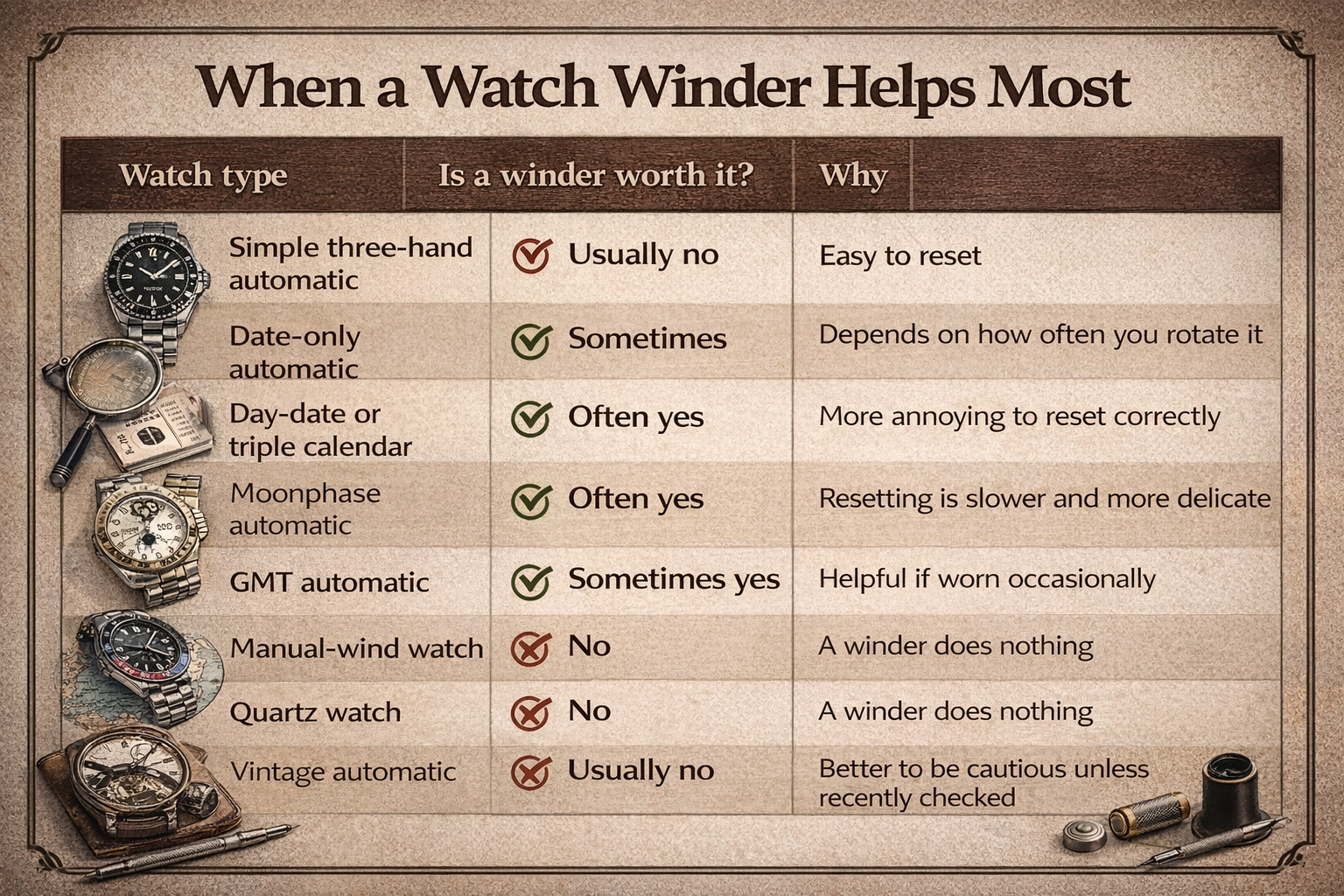
When a watch winder helps most
A winder is most useful for watches that are annoying to restart, not just watches that are annoying to wind.
That sounds like a small difference, but it changes the whole buying decision.
A winder is most useful for:
| Watch type | Is a winder worth it? | Why |
|---|---|---|
| Simple three-hand automatic | Usually no | Easy to reset |
| Date-only automatic | Sometimes | Depends on how often you rotate it |
| Day-date or triple calendar | Often yes | More annoying to reset correctly |
| Moonphase automatic | Often yes | Resetting is slower and more delicate |
| GMT automatic | Sometimes yes | Helpful if worn occasionally |
| Manual-wind watch | No | A winder does nothing |
| Quartz watch | No | A winder does nothing |
| Vintage automatic | Usually no | Better to be cautious unless recently checked |
Can a watch winder damage a watch?
This is the question that makes people nervous.
The honest answer: a properly set watch winder usually will not harm a healthy modern automatic watch. But a poorly used winder can create unnecessary wear, and cheap winders can create other problems like poor fit, extra vibration, noise, or simply running the watch longer than needed.
The real risk is not usually “instant damage.”
The real risk is unnecessary continuous running.
Every mechanical movement wears gradually as it runs. So if a watch could be resting in the box for five days, but instead spends five days spinning just to avoid a 60-second reset, that is a convenience tradeoff—not a free win.
Here are the most common winder mistakes:
1. Using a winder for a watch that does not need one
This is the biggest mistake because it is the most common. A basic automatic that is easy to set does not need to live on a machine.
2. Using the wrong turns-per-day setting
Too low, and the watch stops anyway. Too high, and the watch spends too much time running for no real benefit.
3. Treating the winder like a repair tool
If the watch has poor amplitude, weak reserve, or inconsistent winding efficiency, the answer may not be “buy a winder.” If you are checking performance, Timegrapher Readings Explained: Amplitude, Beat Error & What’s Normal is the better place to start.
4. Putting a loose-fitting watch on a bad cushion
If the watch flops around, the bracelet is strained, the clasp rubs, or the lugs keep shifting, the setup is wrong.
5. Leaving the winder in heat, humidity, or direct sun
A winder is still part of your storage setup. It should live in a stable, dry place.
How to set a watch winder correctly
This is where many articles get vague. Let’s keep it practical.
Step 1: Fully wind the watch first
Do not put a half-dead automatic on a winder and expect the machine to do everything. Start with a proper manual wind so the movement begins with a healthy reserve.
If you are unsure how to do that safely, follow How to Wind a Mechanical Watch Properly (Manual vs Automatic + Mistakes to Avoid).
Step 2: Start with a conservative turns-per-day setting
If your movement’s recommended setting is known, use that. If not, start low rather than high. A moderate setting is a better starting point than continuous spinning.
You are not trying to “max out” the watch. You are trying to keep it running with the least unnecessary motion.
Step 3: Use the correct direction—or a bidirectional mode
Some movements wind clockwise, some counterclockwise, some both. If you know the movement’s requirement, great. If you do not, a bidirectional setting is usually the practical starting point.
Step 4: Watch the result for 2–3 days
This part matters.
After setting the winder, check whether the watch:
- stays running,
- shows normal timekeeping,
- has enough reserve when removed,
- is not being kept under a needlessly aggressive cycle.
If it still stops, increase slightly. If it is obviously overworked for no reason, reduce the setting.
Step 5: Re-check functions before wearing complication watches
A watch that stayed running on a winder still deserves a quick glance before going on the wrist. Check date, AM/PM position, GMT hand, and moonphase if relevant.
For that, these guides pair naturally with a winder-based routine:
- Day-Date & Triple Calendar Setting Guide: Safe Order, Danger Zone & Common Mistakes
- Moonphase Setting Guide: How to Set a Moonphase Watch Safely (Avoid Common Damage)
- GMT Watch Explained: How to Set & Use a GMT Hand (2nd & 3rd Time Zone Guide)
A practical rule most owners can use
Here is a simple rule that works for most people:
If resetting the watch takes under one minute, you probably do not need a winder.
If resetting the watch is annoying enough that you avoid wearing it, a winder may be worth it.
That is the real decision point.
A winder is about reducing friction. If it helps you actually wear the watches you own, it has value. If it exists only to keep a simple automatic permanently spinning on a shelf, it is probably just an expensive habit.
What to look for when buying a watch winder
If you decide you do want one, shop for function first, not luxury looks.
Prioritize these features:
Quiet motor
If it sits in a bedroom or office, noise matters more than glossy wood.
Adjustable turns per day
This is not optional. Avoid one-speed units.
Direction settings
Clockwise, counterclockwise, and bidirectional modes are worth having.
Secure but gentle fit
The watch should sit firmly without excessive pressure on the bracelet or strap.
Intermittent operation
A good winder should not just spin endlessly like a toy display stand.
Stable power and build quality
A badly built winder defeats the whole point of protecting a watch.
Who should skip a watch winder entirely?
Some watches simply do not belong on one.
Skip a winder if the watch is:
- manual-wind,
- quartz,
- vintage and mechanically unknown,
- showing service issues,
- running abnormally fast or slow,
- stopping early for reasons you have not diagnosed yet.
If your watch is acting strange, a winder is not your first move. Start with basic diagnosis. These pages are more useful than buying a gadget too quickly:
- Why Is My Watch Running Fast or Slow? 9 Common Causes (And Fixes)
- Magnetized Watch Symptoms: Why Your Watch Runs Fast & How to Fix It (Safely)
- How to Demagnetize a Watch at Home (Tool, Steps & When to Stop)
Bottom line
A watch winder is a convenience tool, not a requirement of automatic watch ownership.
For a simple everyday automatic, it is usually unnecessary.
For a rotated collection with calendar-heavy pieces, it can be genuinely helpful.
For a watch with a hidden mechanical problem, it is often the wrong solution.
Buy one when it solves a real wearing problem. Skip it when it only saves you a few seconds and keeps the movement running for no meaningful reason.
That is the smart way to think about it.
FAQ
Do automatic watches need a watch winder?
No. Automatic watches can be owned and enjoyed perfectly well without a winder. Most owners do not need one.
Is a watch winder bad for a Rolex or other luxury automatic watch?
Not inherently. A properly set winder used for a healthy automatic is generally fine. The bigger question is whether you actually need the convenience.
Should I keep my watch on a winder all the time?
Usually no. Continuous use only makes sense if the watch is hard to reset and you wear it often enough to justify that convenience.
Can a watch winder overwind a modern automatic watch?
Modern automatics are designed to avoid traditional overwinding in normal use, but that does not mean endless running is always beneficial. Unnecessary runtime is still unnecessary runtime.
What is the best watch to keep on a winder?
A watch you rotate regularly that is annoying to reset—especially a day-date, moonphase, GMT, or calendar-heavy automatic.