Bought a Used Dive Watch? 7 Things to Do Before You Ever Take It Near Water
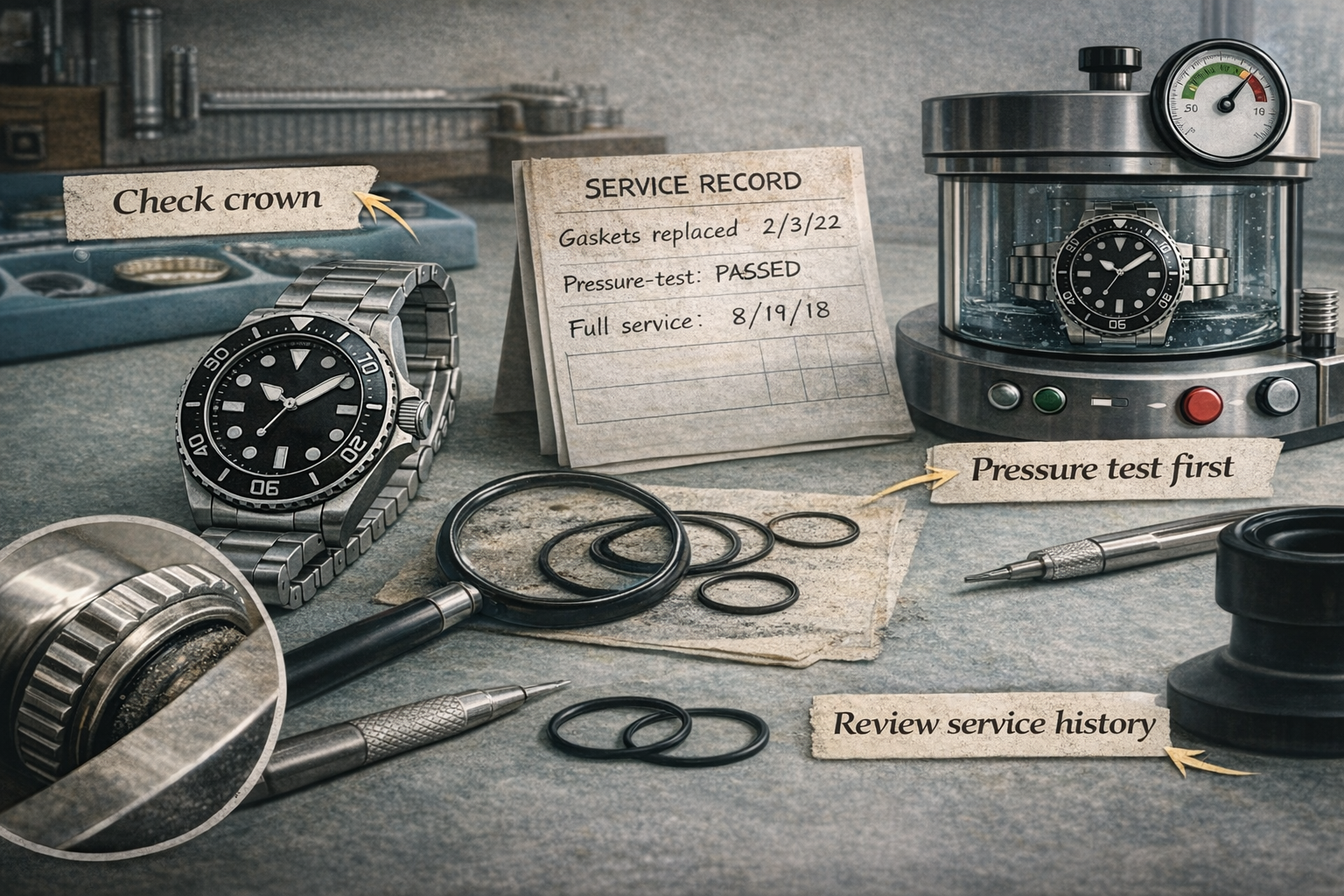
Buying a used dive watch is one thing.
Trusting it near water is another.
That is where a lot of owners make the same mistake. They buy the watch, see “200m” on the dial or caseback, feel reassured by the rotating bezel and screw-down crown, and start treating it like a ready-to-go water tool from day one.
That is not always smart.
A used dive watch may be a fantastic buy. It may be well maintained, freshly tested, and fully capable of real water use. Or it may simply look like a water-ready watch while carrying years of unknown history in the seals, crown, caseback, and service record.
So here is the honest short answer:
Before you take a used dive watch near water, you should verify the watch’s current condition—not trust its original specification.
That means doing a few very specific things first.
This guide walks you through the 7 most important ones.
Who this guide is for
This article is for you if:
- you just bought a used dive watch,
- you are about to take a pre-owned diver on holiday,
- you want to know what to do before swimming or daily wet use,
- or you are trying to avoid the classic “it looked fine until it fogged” mistake.
If you are still in the buying stage, start with Should You Buy a Used Luxury Watch Online? 12 Checks Before You Pay, How to Check a Used Watch in Person: 15 Things to Inspect Before You Buy, and Can You Trust a 10-Year-Old Dive Watch in Water? What Age, Gaskets & Service History Really Mean. This article starts after the purchase is done.
The short answer
Before taking a used dive watch near water, you should:
- stop trusting the printed depth rating automatically,
- check the crown and case condition carefully,
- review the real service history,
- get a recent pressure test if you do not already have one,
- treat the watch as unverified until that test exists,
- clean and inspect it properly,
- and match your water use to the level of evidence you actually have.
In simple terms:
A used dive watch is not water-ready because it is a dive watch. It is water-ready when current evidence says it is.
Why owners get this wrong
Used dive watches are visually convincing.
That is part of the problem.
They have:
- chunky bezels,
- screw-down crowns,
- sporty cases,
- often 100m, 200m, or more on the dial or caseback,
- and the whole design language of confidence.
So owners naturally think:
“If it was built for water, I’m good.”
But used-water resistance is not a style category. It is a maintenance reality.
A watch can look sharp and still have:
- aging gaskets,
- a tired crown tube,
- a poorly seated caseback gasket,
- unknown moisture history,
- or a battery change from years ago that was never followed by proper testing.
That is why used dive watches deserve a different mindset from new ones.
Not fear.
Just verification.
A real-world example
Let’s say you buy a used 200m dive watch from a reputable seller.
The watch looks great.
The bezel clicks cleanly.
The bracelet is solid.
The seller says, “I wore it on trips all the time.”
It arrives on Wednesday.
You leave for the beach on Saturday.
Do you take it straight into the water?
Not yet.
The smart next move is not:
- “It should be fine.”
The smart next move is:
- “What do I actually know about its current seals, crown, and test history?”
That question can save you a lot of money.
1. Stop trusting the printed water-resistance rating automatically
This is the first mental reset you need.
If the dial says 200m, that tells you what the watch was designed to achieve when it was in proper condition. It does not prove the watch still performs that way today.
That distinction matters more on a used dive watch than almost anywhere else.
A pre-owned diver may have:
- been opened for service,
- had a battery change,
- seen years of pool or salt-water use,
- been stored badly,
- or simply gone too long without testing.
So before doing anything else, stop treating the original rating like a current certificate.
If you want the larger context, Water Resistance Explained: What Watch Depth Ratings Really Mean and 100m vs 200m Water Resistance: Do You Really Need a Dive Watch? are the right foundational reads.
Practical takeaway
Think of the rating as the watch’s original capability, not as current proof.
2. Check the screw-down crown before you trust anything else
On a used dive watch, the crown is one of the fastest ways to spot whether your confidence should go up or down.
Before you take the watch near water, check:
- does the crown unscrew smoothly,
- do the threads feel healthy,
- does it screw back down cleanly,
- does anything feel gritty, cross-threaded, loose, or hesitant?
If the crown feels wrong, your water confidence should drop immediately.
Why? Because the crown is one of the most important real-world seal points on the watch, and also one of the parts most likely to reflect years of owner handling.
A tired crown system does not always mean disaster. But it absolutely means “test first, trust later.”
This is exactly why Screw-Down Crown Mistakes: The Fastest Way People Ruin Water Resistance matters so much, especially on pre-owned dive watches.
Practical takeaway
If the crown feel is anything less than confidently normal, do not take the watch into water until it has been checked.
3. Read the service history like a water-risk document, not a sales feature
A lot of buyers hear “serviced” and relax too quickly.
That is a mistake.
Service history only helps if it tells you something useful about water resistance.
What you want to know is:
- when was it last serviced,
- was the case opened recently,
- were the gaskets replaced,
- was the crown or tube addressed,
- was the watch pressure-tested afterward,
- and did it pass?
That is useful service history.
Weak service history sounds like:
- “It was serviced a few years ago.”
- “The previous owner told me it was checked.”
- “Battery was changed at some point.”
- “Never had any issues.”
That is not water-resistance evidence.
That is conversational comfort.
If you are still learning how to evaluate used-watch risk more broadly, Used Watch Full Set vs Watch Only: How Much Do Box and Papers Really Matter? and How to Negotiate the Price of a Used Watch Without Losing the Deal also fit naturally into this stage.
Practical takeaway
A dive watch with strong service records and no box is often a safer water bet than a full set with vague history.
4. Get a pressure test before water use if you do not already have one
This is the most important action in the whole article.
If you bought a used dive watch and you do not already have recent, credible proof of a passing pressure test, get one before taking the watch near meaningful water exposure.
That includes before:
- swimming,
- beach trips,
- resort travel,
- pool days,
- or even casual “I’ll probably wear it in the rain and around sinks” life if you plan to rely on its water resistance.
A pressure test does not make the watch immortal.
But it gives you something much more useful than hope.
That is why Does a Watch Need a Pressure Test After Battery Change or Service?, Can a Watchmaker Guarantee Water Resistance After Repair? What “Water Resistant” Really Means After Opening the Case, and How Often Should You Pressure Test a Watch? A Simple Schedule by Watch Type and How You Use It form the core maintenance cluster around this topic.
Practical takeaway
If you just bought the watch and have no recent test record, assume it is unverified.
5. Treat the watch as splash-cautious until it earns more trust
This is the habit that saves people from the most avoidable mistakes.
Until the used dive watch has:
- a known test result,
- or a known recent service and test path,
treat it as splash-cautious, not as a fully trusted water tool.
That means:
- no swimming,
- no beach use,
- no showering,
- no hot tub,
- no “it’s a diver so it’s probably okay.”
This is not about paranoia.
It is about sequencing.
First verify. Then trust.
Not the other way around.
And yes, this matters even if the watch “looks perfect.” Some of the most expensive water mistakes start with clean-looking watches and confident assumptions.
Practical takeaway
A used diver should earn your trust with evidence, not with appearance.
6. Clean the watch and inspect it before first wet use
This sounds basic, but it is more useful than people expect.
Before first water use, clean the watch gently and inspect it closely.
Look for:
- grime around the crown,
- salt or residue around the caseback edge,
- signs of past moisture,
- debris in the bezel,
- and anything that suggests the watch has lived a harder life than the listing implied.
A gentle inspection can also tell you whether the watch feels like something you want to trust around water in the first place.
If you notice anything odd, that is your cue to slow down.
This is also a good time to read:
- Does Chlorine Damage Watches? What Pool Water Really Does
- Does Salt Water Damage Watches? Ocean Exposure Explained
- After Swimming With a Watch: The 7-Step Rinse & Dry Routine (Pool vs Ocean)
Because a used dive watch does not just need to survive water. It also needs to be treated well after exposure.
Practical takeaway
A quick clean and close inspection often reveals whether your confidence is grounded or just emotional.
7. Match the watch’s first water exposure to the level of proof you actually have
This is where smart owners separate themselves from careless ones.
Not every used dive watch needs to go from “just bought” to “full vacation duty” immediately.
If the watch has:
- recent pressure-test proof,
- clear service history,
- and healthy crown feel,
then ordinary water use may be very reasonable.
If the watch has:
- vague history,
- no current test,
- and an owner relying mostly on optimism,
then even a pool day is too much too soon.
A simple rule
The first water exposure should match the strength of the evidence.
That means:
- weak evidence = dry caution,
- moderate evidence = light cautious use,
- strong recent evidence = more normal confidence.
This is a much better rule than simply asking, “Is it a dive watch?”
What not to do with a newly bought used dive watch
Here are the five biggest mistakes people make in the first week of ownership.
1. Wearing it straight into the pool because the dial says 200m
That is not verification.
2. Assuming “never had issues” means “currently safe”
That is seller language, not test data.
3. Ignoring crown feel because everything else looks good
The crown matters more than many buyers realize.
4. Taking it into hot water or steam first
If you have not even verified the watch in normal conditions, do not jump into showers, saunas, or hot tubs. Related reads:
- Is It Safe to Wear a Watch in the Shower? The Truth About Water, Steam & Soap
- Is It Safe to Wear a Watch in the Sauna or Hot Tub? Heat Damage Explained
5. Waiting until fogging to start caring
At that point, you are no longer doing preventive ownership. You are reacting to a problem.
A simple 7-step checklist you can actually follow
If you want the shortest practical version, use this:
Step 1
Ignore the original depth rating until you verify the watch’s current condition.
Step 2
Check the crown feel carefully.
Step 3
Review any actual service or test records.
Step 4
Get a pressure test if recent proof does not exist.
Step 5
Keep the watch away from real water until that happens.
Step 6
Clean and inspect the watch before first wet use.
Step 7
Only increase water exposure once the evidence supports it.
That is the whole process.
It is simple.
And it prevents a surprising number of expensive mistakes.
A practical ownership example
Let’s say you buy a used 300m diver from a reputable marketplace seller.
The watch arrives Friday.
You have a beach trip Monday.
Here is the wrong version:
- size it,
- admire it,
- screw down the crown,
- assume the rating is enough,
- and swim with it.
Here is the smart version:
- check the crown feel,
- review the seller’s records,
- confirm whether a recent pressure test exists,
- and if not, keep it dry until tested.
That second version feels less exciting.
It is also the version that protects the watch.
Bottom line
A used dive watch can absolutely be a great water watch.
But before it goes near water, it should earn that role.
That means you do not trust:
- the bezel,
- the caseback rating,
- the seller’s confidence,
- or the watch’s appearance.
You trust:
- the crown feel,
- the service history,
- the seal condition,
- and the pressure test.
So the real answer is simple:
Before you ever take a used dive watch near water, verify first and relax later.
That is how smart ownership starts.
FAQ
Can I swim with a used dive watch right after buying it?
Not unless you have recent evidence that its water resistance is still valid, ideally through a recent pressure test.
Is the original 200m or 300m rating enough?
No. It tells you the watch’s original design capability, not its current seal condition.
What is the first thing I should check on a used dive watch?
The screw-down crown feel is one of the fastest and most useful first checks.
Should I pressure-test a used dive watch even if it looks perfect?
Yes, if you plan to trust it near water.
What if the seller says it was always fine in water?
That is not the same as current verification.
Can I at least wear it in rain before testing?
You can, but if you do not have recent evidence, the smarter habit is to treat it cautiously until it has earned trust.