Best Entry-Level Luxury Watch Brands: Tudor vs Longines vs Oris vs TAG Heuer
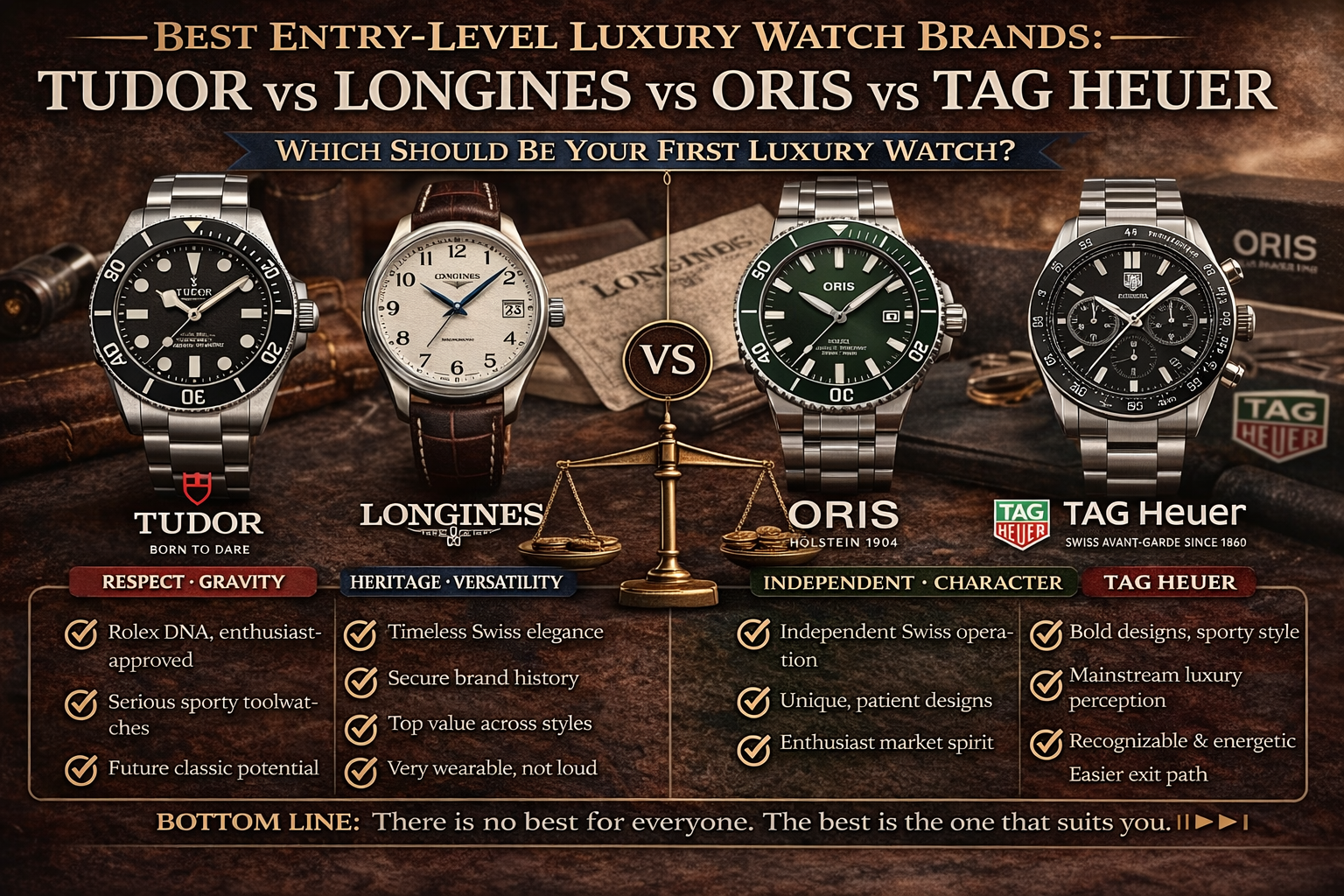
Best Entry-Level Luxury Watch Brands: Tudor vs Longines vs Oris vs TAG Heuer
Most people do not buy their first luxury watch the way watch forums imagine.
They do not start with movement architecture charts.
They do not begin by debating escapement philosophy.
They usually start with a much more human question:
What is the smartest first luxury watch brand that still feels special when I put it on?
That is the real problem.
Because once your budget moves above ordinary watches, the choices get confusing fast. Tudor feels serious and brand-strong. Longines looks classic and safer than many people expect. Oris feels more independent and enthusiast-friendly. TAG Heuer often looks sportier, more recognizable, and easier for mainstream buyers to understand.
All four can make sense.
All four can also be the wrong first luxury watch if you buy the brand instead of the fit.
So let us get straight to it:
There is no universal best entry-level luxury watch brand. There is only the brand that best matches what you want your first luxury watch to do.
If you want the strongest “serious watch” credibility, Tudor usually leads.
If you want classic Swiss value and broad style flexibility, Longines is extremely hard to beat.
If you want independent-brand personality and less mainstream baggage, Oris makes a strong case.
If you want sporty recognition and a more obvious luxury-brand feel to non-watch people, TAG Heuer often makes the most sense.
That is the short answer.
Now let us make it useful.
What “entry-level luxury” actually means
This phrase confuses buyers because it sounds dismissive and aspirational at the same time.
Some people hear “entry-level luxury” and think “not real luxury yet.”
That is the wrong way to look at it.
In practice, entry-level luxury usually means:
- serious brand identity
- better case and dial execution than mass-market watches
- stronger finishing
- better bracelet, clasp, or strap quality
- more emotional purchase weight
- enough value that you start thinking like an owner, not just a shopper
It does not have to mean:
- the cheapest watch with a famous logo
- buying a placeholder before “real luxury”
- chasing status before taste
A good first luxury watch should not feel like a waiting room.
It should feel like a real answer.
That is why this comparison matters.
The short answer: which brand is best for what kind of buyer?
Here is the cleanest overview.
Tudor is best for buyers who want the strongest enthusiast credibility, more serious long-term brand gravity, and a watch that feels closest to the “future classic” zone.
Longines is best for buyers who want classy Swiss value, versatile design, and a brand that makes sense without needing to explain it too much.
Oris is best for buyers who want something less obvious, more independent, and often more emotionally relaxed to own.
TAG Heuer is best for buyers who want a sportier brand image, strong mainstream recognition, and a first luxury watch that feels modern and easy to understand.
That is the simplest map.
But watch buying is emotional, so let us go deeper.
Why first-time luxury buyers usually get this wrong
Because they ask the wrong first question.
They ask:
- Which brand is most respected?
- Which one is best value?
- Which one holds prestige better?
- Which one would watch people approve of?
Those are not useless questions.
They just are not the first question.
The first question should be:
What kind of satisfaction am I actually trying to buy?
For example:
- Do you want the watch to feel like a milestone?
- Do you want a watch that disappears easily into daily life?
- Do you want one that gets noticed?
- Do you want to be “done” for a few years?
- Do you want a brand story you can connect to?
- Do you want a watch person’s watch, or a public-facing luxury watch?
Until you answer that, brand comparison stays shallow.
Tudor: the strongest “serious first luxury watch” answer for many buyers
Tudor often wins when buyers want their first luxury watch to feel substantial, grounded, and future-proof.
It tends to attract people who say:
- I want something with real watch credibility
- I want to buy once and buy well
- I do not need the biggest logo, but I do care about brand strength
- I want something sporty, wearable, and respectable
That is why Tudor keeps showing up in first-luxury-watch conversations.
And if you have already read Rolex vs Tudor: Which Brand Makes More Sense for Real Buyers?, you already know the appeal: Tudor often gives buyers a lot of the emotional seriousness of luxury watch ownership without some of the pressure that comes with buying straight into Rolex territory.
Where Tudor feels strongest
Tudor is especially compelling for:
- sporty everyday watches
- buyers who care about long-term brand respect
- people who want their first luxury watch to still feel “serious” years later
- buyers who may one day move upmarket but still want the first purchase to stand on its own
Where Tudor can be the wrong choice
Tudor can disappoint when:
- the buyer really wants Rolex and is trying to be rational
- the buyer wants a dressier or more elegant first impression
- the buyer wants the broadest mainstream recognition outside watch circles
Tudor is very often the most respected answer in this group.
It is not always the most emotionally correct one.
Longines: the smartest classic-choice brand for a huge number of people
If Tudor feels like the serious enthusiast’s first luxury brand, Longines often feels like the intelligent adult’s first luxury brand.
That sounds understated, but it is a compliment.
Longines makes sense for buyers who want:
- Swiss brand history
- cleaner, more traditional aesthetics
- less social baggage
- strong everyday wearability
- a watch that feels tasteful rather than performative
For a lot of real buyers, Longines is the brand that quietly avoids regret.
Because it does not ask you to become a watch personality.
It just gives you a very solid answer.
Where Longines feels strongest
Longines often shines when the buyer wants:
- classic looks
- office-to-weekend flexibility
- less hype, more stability
- a first luxury watch that will not feel embarrassing or overly trendy later
This brand also connects naturally with your more practical content. Buyers considering Longines often care about watch size, case materials, and whether the watch actually fits their daily clothing and routine.
Where Longines can be the wrong choice
Longines can feel underwhelming if the buyer wants:
- stronger brand excitement
- more sport-luxury energy
- more obvious wrist presence
- a stronger feeling of “I’ve arrived”
That is why Longines is often the best answer for sensible buyers and sometimes the wrong answer for emotionally ambitious ones.
Oris: the best independent-minded first luxury brand
Oris is where the conversation gets more personal.
Because people rarely buy Oris by accident.
They buy it because they want something a little less expected. A little less corporate. A little more personal. Oris tends to attract buyers who enjoy the idea of wearing a luxury watch without entering the most status-heavy lanes of the hobby.
That matters.
A lot of first-time buyers do not realize how much they want to avoid brand theater until they try on watches in person.
Where Oris feels strongest
Oris is strongest for buyers who want:
- independent-brand identity
- a more personal ownership story
- sporty or tool-watch energy without too much social weight
- a first luxury watch that feels enthusiast-led rather than purely prestige-led
It is also a good fit for people who want to actually wear the watch hard without feeling like every scratch creates a philosophical crisis.
Where Oris can be the wrong choice
Oris can disappoint when the buyer wants:
- maximum mainstream recognition
- easy prestige explanation to non-watch people
- the safest “everyone knows this is luxury” signal
- the simplest resale psychology later
In other words, Oris is often the happiest choice for buyers who buy with taste first.
It is less ideal for buyers who buy partly for validation.
TAG Heuer: the most mainstream-friendly sporty luxury entry point
TAG Heuer is one of those brands that watch enthusiasts sometimes overcomplicate and normal buyers often understand immediately.
That matters more than people admit.
If someone wants a first luxury watch that feels sporty, modern, recognizable, and easy to explain, TAG Heuer often makes a lot of sense. It has stronger public familiarity than many watch-forum conversations would suggest.
For some buyers, that matters a lot.
Where TAG Heuer feels strongest
TAG Heuer works well for buyers who want:
- a sportier image
- a clearer mainstream luxury identity
- a first luxury watch that feels contemporary
- something friends and coworkers may recognize more quickly
It is also often easier for buyers who are coming from fashion-adjacent or automotive-adjacent taste rather than pure horology culture.
Where TAG Heuer can be the wrong choice
TAG Heuer can feel less satisfying for buyers who want:
- stronger old-school enthusiast approval
- more understated watch-nerd prestige
- a quieter, more timeless first purchase
- a brand that feels less marketing-forward
That does not make it worse.
It just makes it more dependent on what kind of first luxury watch story you want.
Real-life case study 1: the buyer who should buy Tudor
A buyer in his early 30s wants one serious watch to wear most days. He dresses casually, reads watch content for fun, and knows that if he buys something too “light,” he will upgrade emotionally within a year.
He compares Tudor, Longines, Oris, and TAG Heuer.
Longines feels elegant, but a little too polite.
Oris feels cool, but maybe too niche for what he wants.
TAG Heuer feels energetic, but not quite as grounded.
Tudor feels like the first watch he could still respect five years later.
He should probably buy Tudor.
Not because Tudor is objectively best.
Because he is the exact buyer who needs his first luxury watch to feel serious enough to end the search for a while.
Real-life case study 2: the buyer who should buy Longines
Another buyer wants a first luxury watch for office wear, dinners, travel, and occasional weekend use. He likes classic design, does not care much about impressing watch geeks, and wants a purchase that feels refined without becoming a project.
This buyer often ends up happiest with Longines.
Why?
Because Longines is often where taste, practicality, and adult restraint meet. It gives enough luxury to feel like a step up, without forcing the buyer into hype, over-analysis, or symbolic overreach.
This is the person who buys Longines and quietly keeps enjoying it instead of reopening the search three months later.
Real-life case study 3: the buyer who should buy Oris
A third buyer wants something special, but does not want the feeling of wearing an obvious status object. He likes watches, but does not want the purchase to become a social performance.
He tries on more mainstream options and realizes they feel slightly too expected.
Then he lands on Oris.
This buyer often values:
- independence
- design personality
- less crowded brand territory
- a watch that feels like his choice, not the internet’s choice
That is where Oris becomes a very satisfying first luxury watch brand.
Real-life case study 4: the buyer who should buy TAG Heuer
A fourth buyer wants a sporty, attractive, recognizable luxury watch. He is less interested in enthusiast hierarchy and more interested in buying something that feels exciting, modern, and premium.
This buyer often ends up happier with TAG Heuer than with the “watch forum approved” option.
That is because he is not trying to win a collectors’ debate.
He is trying to buy a watch he genuinely likes wearing.
That is a better reason than many people think.
So which brand gives the best value?
This depends on what you mean by value.
If value means brand seriousness plus long-term credibility, Tudor is very strong.
If value means classic Swiss quality without needing to overspend for hype, Longines is one of the best answers here.
If value means personality and satisfaction without buying into the obvious luxury script, Oris often feels like the healthiest purchase.
If value means recognition, sporty energy, and easy first-luxury excitement, TAG Heuer can absolutely be the best value for the right buyer.
This is why blanket recommendations fail.
The same watch can be a brilliant purchase for one person and a mistake for another.
What about resale?
This is where buyers start acting more rational than they really are.
Yes, resale matters.
No, it should not be the only thing you use to choose your first luxury watch.
Most first-time buyers are not buying a spreadsheet. They are buying a watch they want to wear.
Still, it is fair to say that some brands feel easier to explain to the next buyer than others. That is also why your readers should understand used-buying discipline early, especially through pieces like How to Check a Used Watch in Person, Used Watch Full Set vs Watch Only, and Should You Buy a Used Luxury Watch Online?.
A first luxury watch is usually better chosen for fit than for exit strategy.
If you are already worrying mainly about resale before you even own the watch, there is a decent chance you are shopping the wrong way.
The hidden factor: how much pressure do you want on the purchase?
This matters more than specs.
A first luxury watch purchase can come with a lot of pressure:
- to get it “right”
- to make it count
- to buy something respectable
- to avoid regret
- to choose the brand people will approve of
That pressure changes behavior.
Some brands reduce it.
Some increase it.
Tudor can reduce pressure if you want brand seriousness without going full status-symbol.
Longines often reduces pressure because it feels balanced and sane.
Oris reduces pressure when you want to enjoy the watch without performing ownership.
TAG Heuer reduces pressure when you want a straightforward, recognizable luxury-sports entry point.
The wrong brand is often not the one with worse specs.
It is the one that makes you feel like you are auditioning rather than owning.
New or used for your first luxury watch?
A lot of first-time buyers assume used is automatically smarter.
Not always.
If you are confident checking condition, asking hard questions, and walking away from weak deals, used can be an excellent route. But if your first luxury purchase already makes you nervous, peace of mind may be worth more than saving some money.
That is exactly the logic behind New vs Used Rolex: Which Is Smarter in 2026?, and while that article is Rolex-specific, the broader buyer psychology still applies here.
If buying used, keep the process simple:
- inspect the watch before the accessories
- ask whether it has been polished
- ask whether parts are original
- compare multiple examples
- never let a seller’s confidence replace evidence
And if you want help handling the money conversation without damaging the transaction, How to Negotiate the Price of a Used Watch Without Losing the Deal is a natural next read.
A practical 7-step test to choose your first luxury watch brand
If you are stuck, do this.
Step 1: Decide whether you want sporty, classic, or independent personality
This alone removes a lot of noise.
Step 2: Be honest about how much brand recognition matters
Not morally. Personally.
Step 3: Think about what you actually wear
A watch that fits your real clothes beats a “best brand” that lives in the box.
Step 4: Ask whether you want the watch to feel serious, easy, personal, or obvious
That often maps directly to Tudor, Longines, Oris, or TAG Heuer.
Step 5: Try at least two different styles on wrist
Do not buy only by brand reputation.
Step 6: Think about daily comfort
A first luxury watch should fit your life, not just your feed. That is where guides like watch bracelet sizing, strap materials, and even leather vs FKM rubber strap for summer become more practical than they look.
Step 7: Buy the brand that still makes sense after the excitement fades
That is the real test.
My honest ranking by buyer type
If you want the most watch-enthusiast-approved first luxury brand here, start with Tudor.
If you want the most balanced, elegant, low-regret first luxury brand, start with Longines.
If you want the most personal and independent-minded first luxury brand, start with Oris.
If you want the most sporty, mainstream-friendly, instantly understandable first luxury brand, start with TAG Heuer.
That is the clearest way to think about it.
Not best in theory.
Best by type of buyer.
Which one would I recommend most often?
For the average thoughtful first-time buyer, Longines is probably the safest broad recommendation.
For the buyer who already knows they care about brand gravity and long-term seriousness, Tudor is often the better answer.
For the buyer who values independence and wants to avoid obvious-brand ownership patterns, Oris is extremely compelling.
For the buyer who wants sporty mainstream luxury without needing watch-forum permission, TAG Heuer can be exactly right.
That is probably the most useful summary I can give.
FAQ
What is the best entry-level luxury watch brand?
There is no single best brand for everyone. Tudor, Longines, Oris, and TAG Heuer all make sense for different buyer types.
Is Tudor better than Longines for a first luxury watch?
Often yes for buyers who want stronger brand seriousness and enthusiast credibility. Longines may be better for buyers who want classic versatility and less emotional pressure.
Is Oris a luxury watch brand?
Yes, especially in the practical ownership sense. It appeals strongly to buyers who want quality and personality without chasing obvious status.
Is TAG Heuer a good first luxury watch brand?
Yes. It is often one of the easiest sport-luxury brands for mainstream buyers to understand and enjoy.
Which brand is best for daily wear?
That depends on your style, but Longines and Oris often feel especially easy to integrate into everyday life. Tudor also works very well if you want a sportier, more serious tone.
Should I buy new or used for my first luxury watch?
If you are comfortable with inspection and seller risk, used can work well. If you want more certainty and less stress, new may be the smarter first move.
Final thoughts
The best entry-level luxury watch brand is not the one with the loudest fan base.
It is the one that fits what you actually want your first serious watch to do.
Tudor is often the strongest answer for seriousness.
Longines is often the strongest answer for balance.
Oris is often the strongest answer for individuality.
TAG Heuer is often the strongest answer for sporty mainstream appeal.
That is the real decision.
Your first luxury watch should not feel like a compromise you are already planning to replace.
It should feel like a watch you can wear, trust, and enjoy without constantly reopening the search.
That is what makes it the right first brand.