Rolex vs Tudor: Which Brand Makes More Sense for Real Buyers?
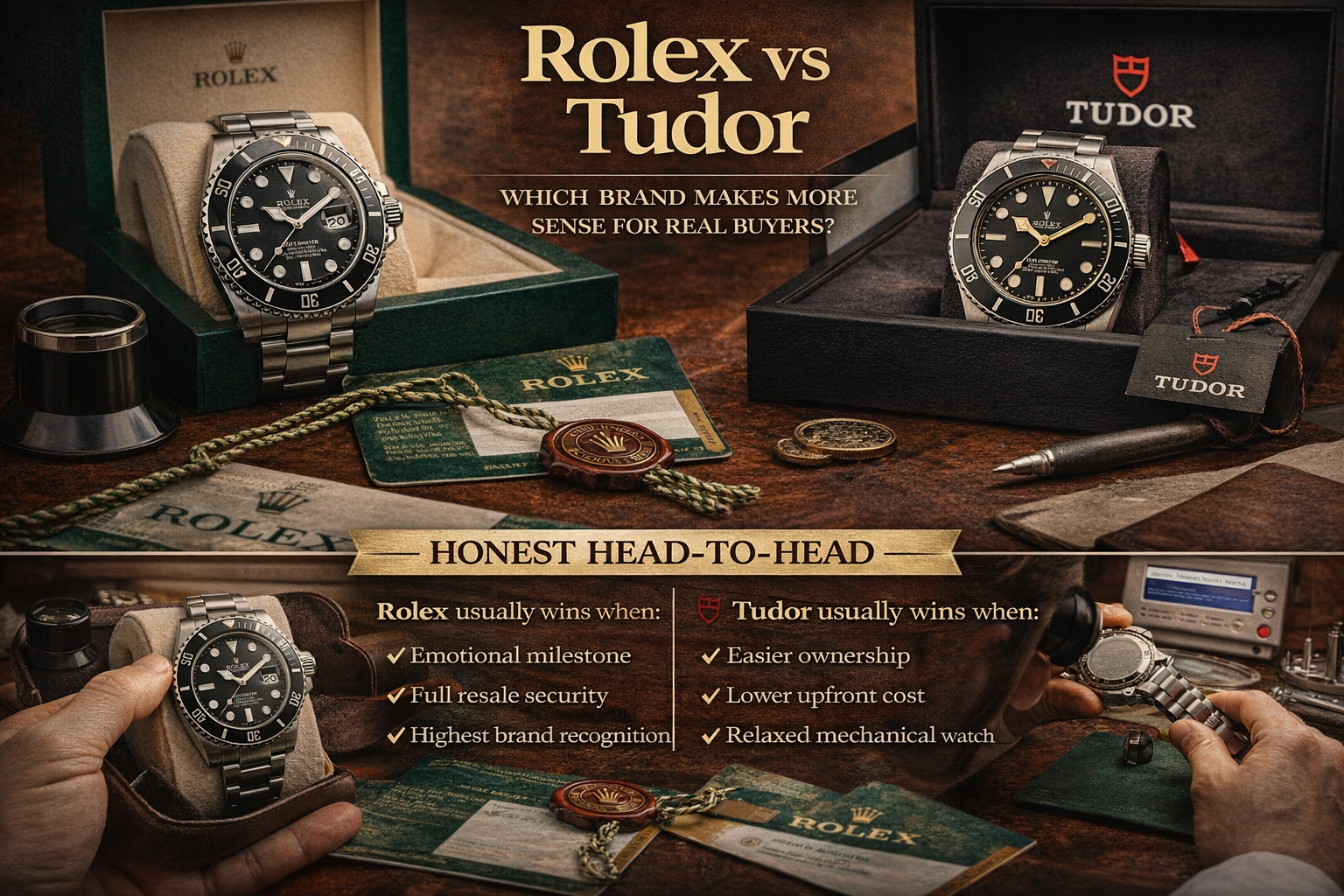
Rolex vs Tudor: Which Brand Makes More Sense for Real Buyers?
If you spend enough time around watches, the Rolex vs Tudor debate starts to sound predictable.
One side says Rolex is the obvious answer because it is Rolex.
The other says Tudor is smarter because you get most of the substance for much less money.
Both sides miss the real question.
Most buyers are not choosing between two logos in a vacuum. They are choosing between two very different ownership experiences.
One gives you the crown, the status, the stronger resale, and the cleaner “I finally bought a Rolex” moment.
The other often gives you less stress, better value, easier wearability, and a much more relaxed relationship with the watch on your wrist.
So which one actually makes more sense?
For most real buyers, the answer depends less on watch geek theory and more on five things:
- how much the brand name matters to you
- whether you care about resale or long-term value retention
- whether you want to wear the watch freely or protect it constantly
- whether you are buying new or pre-owned
- whether you want the emotional payoff of Rolex, or the practical satisfaction of Tudor
This guide is not about internet chest-thumping.
It is about what happens when real people spend real money.
The short answer
If you want the strongest brand recognition, the classic milestone-watch feeling, and the best resale security, Rolex makes more sense.
If you want a serious Swiss mechanical watch that you can wear more casually, buy more easily, and enjoy with less financial pressure, Tudor often makes more sense.
That is the clean answer.
The useful answer is more specific, so let us get into it.
Why people compare Rolex and Tudor in the first place
Rolex and Tudor will always be linked because Tudor was founded by Hans Wilsdorf, the same man behind Rolex.
That shared history matters, but the modern buying decision is not really about heritage. It is about where each brand sits today.
Rolex feels like the polished final form: more prestige, more demand, more mainstream recognition, more money.
Tudor feels like the grounded enthusiast choice: still respected, still serious, but less inflated by hype and social signaling.
That is why buyers keep circling back to this comparison. Not because the watches are identical, but because they often compete for the same money in the same buyer’s head.
A person looking at a Tudor Black Bay 58 is often not just shopping for a Tudor.
They are asking themselves whether they should keep saving for a Submariner.
A buyer considering a Black Bay GMT is often not only choosing a GMT watch.
They are wondering whether they really need a GMT-Master II, especially after reading our guide on Travel GMT vs Office GMT: What’s the Difference and Which One Is Better for Real Life?
That internal comparison is where this article lives.
Rolex and Tudor are not just different brands. They create different kinds of owners.
This is the part people do not say out loud enough.
Rolex ownership often changes how people behave.
They think more about:
- scratches
- theft risk
- resale value
- insurance
- whether the watch “fits” the room
- whether the watch is real enough, original enough, complete enough
That last point matters more than ever in today’s market. If you are shopping pre-owned, the safest move is to understand how counterfeits, mixed-part watches, and questionable sellers operate before you pay. That is exactly why articles like How to Check a Used Watch in Person, Used Watch Full Set vs Watch Only, and Should You Buy a Used Luxury Watch Online? 12 Checks Before You Pay are so important for Rolex buyers in particular.
Tudor ownership usually feels looser.
People wear Tudors to the office, on weekends, on trips, and in bad weather without turning every door frame into a source of anxiety. They still care about condition, of course. But the watch more often feels like a tool, not a fragile financial object.
That difference alone decides the answer for many buyers.
Case study 1: the buyer who wanted a Submariner, but ended up happier with a Black Bay 58
A buyer in his mid-30s wants a one-watch collection. He loves dive watches, wears casual clothes most days, works in a normal office, and does not enjoy “luxury performance” in social settings.
At first, he tells himself he wants a Rolex Submariner because it is the benchmark. Fair enough.
Then real life enters the chat.
He notices that:
- he does not love the current buying experience around Rolex
- he is uncomfortable tying that much money into one daily watch
- he does not want to baby the watch every time he travels
- he actually prefers the warmer, slightly more vintage character of Tudor’s design language
He buys a Black Bay 58.
Six months later, he is still wearing it constantly.
He stops thinking about “upgrading” because the watch solved the actual problem: he wanted a great everyday watch, not a permanent aspiration project.
That is a classic Tudor win.
Not because the Black Bay 58 is “better” than the Submariner in some universal sense.
Because it was better for that buyer’s real life.
Case study 2: the buyer who kept buying around Rolex, then bought Rolex
This one is just as common.
Another buyer starts with a Tudor because it feels rational. He likes the quality, appreciates the history, and enjoys the no-drama ownership experience.
But every few months, he still opens listings for Datejusts and GMT-Master IIs. He keeps comparing the watch on his wrist to the watch in his head. He is not unhappy. He is just not finished.
Eventually, he buys the Rolex anyway.
The lesson here is not that Tudor failed.
The lesson is that some buyers do not actually want “the sensible alternative.” They want the specific emotional closure of owning Rolex.
If that is you, it is often cheaper to admit it early.
Buying one Tudor, then another, then trading up later can cost more than simply buying the Rolex once.
Rolex wins where it matters most to status-conscious and long-term-minded buyers
Let us be honest about Rolex.
The brand does not dominate only because of quality.
It dominates because it combines quality with cultural weight.
When people who know nothing about watches hear “Rolex,” they already understand the signal.
That matters more than enthusiasts like to admit.
Rolex is usually stronger in these areas:
1) Brand recognition
No contest.
Rolex is one of the few watch brands that works outside the watch world.
That matters if you want your watch to feel like a milestone purchase, a career marker, or a once-in-a-decade reward.
2) Resale and liquidity
In general, Rolex is easier to resell and easier to explain to the next buyer.
Tudor has a respectable pre-owned market, but Rolex is still the stronger asset-like brand. If resale, exit flexibility, or long-term trade value matters to you, Rolex has the edge.
This also ties into buying discipline. If you are paying pre-owned money, you need to understand condition, originality, and negotiation. Our guides on How to Tell If a Watch Is Overpolished Before You Buy and How to Negotiate the Price of a Used Watch Without Losing the Deal become even more useful once Rolex-level money is involved.
3) Finishing and refinement
Tudor is good. Very good, in fact.
But Rolex usually feels more complete in the details: the bracelet feel, clasp crispness, case refinement, dial execution, and the general sense that every surface has been pushed a little further.
This is not always obvious in photos.
It is often obvious on the wrist.
4) Emotional payoff
A Rolex scratches a very specific itch.
A Tudor can be satisfying.
A Rolex can feel conclusive.
That sounds irrational, but it is real.
And real buyers should factor in emotional honesty, not pretend they are robots.
Tudor wins where it matters most to practical daily wearers
Now for the part the internet sometimes oversimplifies.
Tudor is not “cheap Rolex.”
At its best, Tudor is what a lot of buyers actually need.
Tudor often wins in these areas:
1) Value without apology
Tudor makes it easier to buy a serious Swiss mechanical watch without crossing into the financial discomfort zone.
That matters because a watch is supposed to add enjoyment, not create low-level stress every time you glance at your bank account.
2) Easier ownership
Owners often wear Tudor more freely.
They travel with it more casually.
They knock it around less fearfully.
They do not spend every week checking market prices.
That usually translates into a healthier ownership experience.
3) Strong identity of its own
Older watch culture sometimes treated Tudor as a shadow of Rolex. That is increasingly outdated.
Modern Tudor has a real identity: Black Bay, Pelagos, Ranger, BB GMT. These do not survive because buyers cannot afford Rolex. They survive because many people genuinely like Tudor’s design language, proportions, matte textures, vintage cues, and slightly rougher charm.
4) Less counterfeit pressure and status baggage
This is not talked about enough.
Rolex sits much deeper in the fake, replica, and “look at me” ecosystem. That creates friction for normal buyers. You worry more about getting fooled. You worry more about attracting the wrong kind of attention. You worry more about whether the watch feels too loud in certain settings.
Tudor often sidesteps that.
That does not mean Tudors are never faked or never misunderstood. It means the social and transactional pressure is usually lower.
Which brand is better built?
This is the wrong question in the form most people ask it.
Neither Rolex nor Tudor is “badly built.”
Neither is a compromise brand in the sense casual buyers imagine.
The better question is:
Which one feels better built for the way you will actually use it?
If you want maximum refinement, better finishing, and a more elevated overall ownership feel, Rolex usually wins.
If you want robustness, strong everyday practicality, and fewer nerves about using the watch like a watch, Tudor often feels better suited to real daily life.
That is especially true in sporty models. A lot of buyers love the idea of a Submariner but end up wearing a Black Bay more often. The same thing happens with GMT buyers who need actual travel function and should also understand how to set and use a GMT watch properly.
Rolex vs Tudor for daily wear
For most people, Tudor is the easier daily wear brand.
That is not because the watches are more durable in some dramatic technical sense. It is because the ownership psychology is easier.
You are usually:
- less worried about theft
- less worried about resale micro-damage
- less emotionally tense about scratches
- less likely to leave the watch at home “just in case”
This creates a strange truth:
The watch you can relax in is often the better daily watch, even if the more expensive watch is technically nicer.
So if your question is specifically, “Which would I actually wear more?” Tudor often wins.
If your question is, “Which would feel more meaningful every time I put it on?” Rolex may still win.
Rolex vs Tudor on servicing and long-term cost
A lot of first-time buyers underestimate this part.
Buying price is not the whole cost of ownership.
Service, pressure testing, seals, bracelet wear, and downtime all matter too.
If you have not read it yet, our breakdown of How Much Does Watch Servicing Cost? Quartz vs Mechanical vs Chronograph is a useful reality check.
Neither Rolex nor Tudor is a “cheap to maintain” brand in the broad consumer sense. But once you step into Rolex ownership, people are usually more sensitive to every cost around the watch, because the initial emotional and financial buy-in is already higher.
For buyers who want a serious mechanical watch without feeling like every future service decision needs a committee meeting, Tudor usually feels lighter.
Also, if your watch is going to see water, service condition matters far more than brand prestige. That is why articles like Watch Water Resistance Test: What a Pressure Test Checks and How Often Should You Pressure Test a Watch? still matter whether the dial says Rolex or Tudor.
If you are buying pre-owned, Rolex and Tudor are not equally risky
This is where the decision gets more practical.
A used Tudor purchase can still go wrong.
A used Rolex purchase can go wrong more expensively.
That is the clean version.
With Rolex, you face more issues around:
- counterfeits
- mixed parts
- polished cases sold as “excellent”
- overpaying for box and papers
- buying the name and missing the condition
That does not mean you should avoid pre-owned Rolex.
It means you should treat the transaction with more structure.
At minimum:
- compare multiple examples first
- insist on strong photos
- verify the seller
- inspect condition in detail
- understand whether the watch is original or merely convincing
That is why a buyer considering used Rolex should already be comfortable with the logic in How to Check a Used Watch in Person, Used Watch Full Set vs Watch Only, and Should You Buy a Used Luxury Watch Online?.
With Tudor, the lower price and lower hype usually make mistakes less catastrophic. Not harmless, but less catastrophic.
What real buyers usually regret
Here are the two most common regrets in this comparison.
Regret type 1: “I bought Tudor, but I really wanted Rolex.”
This usually happens when the buyer was never actually open-minded. They were trying to out-reason an emotional desire.
Symptoms:
- constant Rolex browsing after purchase
- using Tudor mostly as a placeholder
- talking about the watch mainly in terms of value
- treating satisfaction like a math equation
If that sounds like you, be careful. Tudor may be the sensible move, but it may not be the satisfying one.
Regret type 2: “I bought Rolex, but now I barely wear it.”
This usually happens when the buyer loved the idea of Rolex more than the ownership reality.
Symptoms:
- feeling self-conscious wearing it in ordinary settings
- leaving it in the box for travel
- getting annoyed by every tiny mark
- checking market value too often
- realizing the watch became an object to manage, not enjoy
If that sounds like you, Tudor may have been the better life choice.
A simple 6-step decision test
If you are stuck between Rolex and Tudor, do this.
Step 1: Ask what you really want the watch to do
Is it a milestone watch, an everyday watch, a travel watch, or a one-watch collection?
Step 2: Ask whether the name matters to you emotionally
Not socially. Emotionally.
If you know the crown logo matters deeply, do not pretend it does not.
Step 3: Ask how you handle expensive objects
Do you wear them freely, or do you start protecting them from life?
Step 4: Ask whether resale matters
If you think you may trade, sell, or reshape the collection later, Rolex has a stronger safety net.
Step 5: Ask whether you enjoy the buying process
Some people enjoy the chase. Others hate the dance and just want a great watch now. Tudor is often easier on that front.
Step 6: Imagine both watches with three years of ownership behind them
Which one feels more like your life?
Not your fantasy life. Your actual life.
That question usually reveals the answer faster than specs do.
My honest take: Rolex is the better trophy, Tudor is often the better life watch
That is the most honest one-line summary I can give.
Rolex is the better trophy.
Tudor is often the better life watch.
A Rolex usually wins when:
- you want the full emotional milestone effect
- you care about resale
- you want maximum brand recognition
- you know you will not feel “done” without it
A Tudor usually wins when:
- you want real quality without lifestyle tension
- you value wearability over status
- you want better cost-to-enjoyment ratio
- you want to use the watch hard, not admire it cautiously
Neither answer is more moral.
It is just more honest depending on the buyer.
What I would recommend for different buyers
For the buyer who wants one meaningful watch and plans to keep it a long time:
Buy Rolex if the dream is specific and persistent. Buy Tudor only if you genuinely love Tudor for itself.
For the buyer who wants the best daily-wear experience with less stress:
Buy Tudor.
For the buyer entering watches for the first time:
Tudor is often the healthier first serious purchase because it teaches ownership without turning the hobby into a financial performance.
For the buyer who treats watches partly as portable value:
Rolex is usually the safer answer.
For the buyer who keeps almost buying “Rolex alternatives”:
Stop circling. Either admit you want Rolex, or admit you do not.
FAQ
Is Tudor just a cheaper Rolex?
No. That is too simple and increasingly outdated. Tudor shares history with Rolex, but modern Tudor has its own design language, buyer base, and identity.
Is Rolex better made than Tudor?
Usually more refined, yes. But “better made” does not automatically mean “better for your life.”
Does Tudor offer better value than Rolex?
In many cases, yes. You often get a very high level of watch for materially less money and less ownership pressure.
Which brand is better for daily wear?
For most normal owners, Tudor is easier to wear daily because it brings less psychological and financial tension.
Which brand holds value better?
Generally, Rolex.
Should I buy Tudor now and Rolex later?
Only if you genuinely want Tudor for its own sake. If Tudor is just a placeholder, that strategy often becomes more expensive than buying Rolex once.
Final thoughts
The Rolex vs Tudor debate gets messy because people try to solve an emotional purchase with a purely rational script.
But watches do not work that way.
Rolex makes more sense when the dream is specific, the emotional payoff matters, and you want the strongest combination of prestige and resale.
Tudor makes more sense when you want real watch quality, easier ownership, lower pressure, and a watch that fits into everyday life more naturally.
The smartest buyers are not the ones who repeat brand myths.
They are the ones who know themselves well enough to buy the watch they will actually enjoy.
If that is Rolex, buy Rolex honestly.
If that is Tudor, buy Tudor proudly.
Trying to split the difference is where people usually waste the most money.