- Home
- Rolex Datejust vs Day-Date: Which One Actually Makes More Sense?
Rolex Datejust vs Day-Date: Which One Actually Makes More Sense?
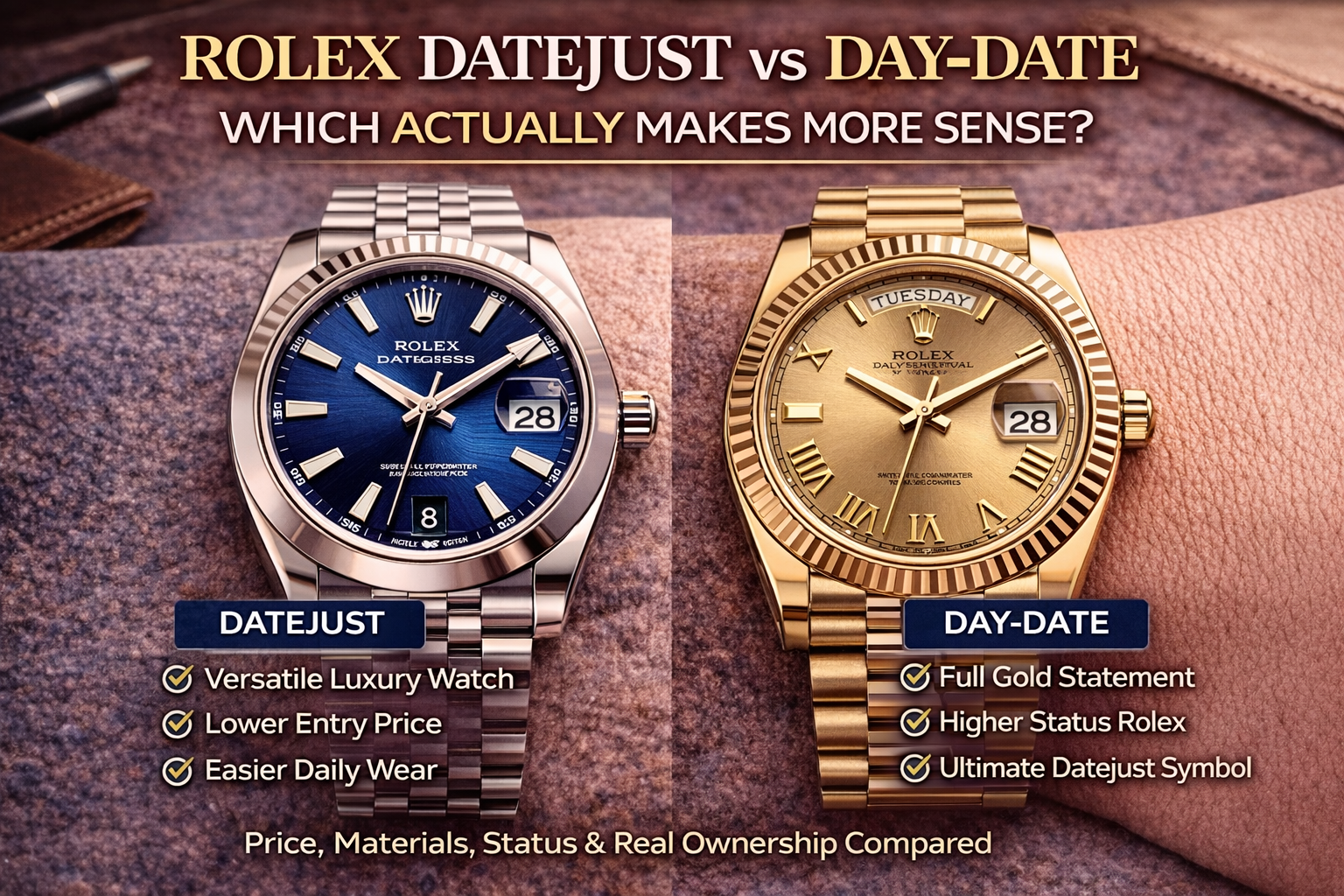
If you are comparing the Rolex Datejust and the Rolex Day-Date, you are not just choosing between two watches.
You are choosing between two very different kinds of ownership.
On paper, the difference seems simple: one shows the date, the other shows the day and the date. One is available in steel, the other is made only in precious metals. One is relatively accessible, the other sits firmly in luxury territory.
But in real life, the gap is not just technical.
It is psychological.
Because most buyers are not asking, “Which one is better?”
They are asking something else:
“Do I actually want the full Day-Date experience, or do I just like the idea of it?”
That question matters more than specs, more than price, and more than what anyone else thinks.
So which one actually makes more sense?
The short answer is this: buy the Datejust if you want a versatile, lower-friction luxury watch you will wear often. Buy the Day-Date if you specifically want the full gold Rolex experience and are comfortable paying for what it represents, not just what it does.
That is the simple version.
But the real answer depends on how you want the watch to feel in your life after the purchase is no longer new.
The short answer
Buy the Rolex Datejust if you want:
- a more versatile daily luxury watch
- a significantly lower entry price
- a watch that works across almost all situations
- easier ownership with less pressure to “dress around the watch”
Buy the Rolex Day-Date if you want:
- the full gold Rolex experience
- maximum brand presence and recognition
- a watch that feels like a milestone purchase
- something that clearly sits above the Datejust in the Rolex hierarchy
If you are unsure, the Datejust is usually the safer choice.
If you are not unsure, the Day-Date usually does not need to justify itself.
Why this comparison is not really about features
On paper, the Day-Date offers more.
It shows both the day and the date. It uses precious metals. It sits higher in the Rolex lineup. It carries more prestige. It costs more.
But in reality, almost no one buys a Day-Date because they need to see the day of the week.
They buy it because of what it represents.
That is why this comparison is not about functionality.
It is about intention.
The Datejust is a luxury watch you can fit into your life.
The Day-Date is a luxury watch your life often adjusts around.
That is not a flaw.
That is the point.
The Datejust: why it makes more sense for most real buyers
Let’s start with the watch that wins most practical arguments.
The Rolex Datejust is one of the easiest luxury watches to own long term.
It works with almost everything. Office, casual, travel, everyday wear, light formal situations — it fits naturally without demanding too much from you. It is refined, but not fragile. Recognizable, but not overwhelming. Expensive, but still within reach compared to the top end of Rolex.
That balance is exactly why it works.
A Datejust does not need a specific moment.
It becomes part of your normal life.
That is why so many buyers end up choosing it even after considering more expensive options. Not because they cannot stretch to a Day-Date, but because they know they would wear the Datejust more often.
And in watch ownership, frequency matters more than theoretical prestige.
If you are still deciding how to configure a Datejust properly, you should already have Rolex Datejust 36 vs 41: Which Size Is Actually Better for Real Daily Wear?, Rolex Datejust Jubilee vs Oyster Bracelet: Comfort, Style, and Resale Differences, and Rolex Datejust Smooth Bezel vs Fluted Bezel: Which One Should You Actually Buy? open, because getting the right combination matters more than just choosing the model name.
The Day-Date: why it feels like something more
Now let’s talk about the watch people think about long before they are ready to buy it.
The Rolex Day-Date is not just another step up from the Datejust.
It is a different category of ownership.
First, it is always precious metal. Gold or platinum. That changes everything immediately. The weight, the presence, the way the watch reflects light, and the way other people perceive it.
Second, it carries a very specific identity.
The Day-Date has long been associated with success, milestones, and status. That reputation is part of the appeal. It is not trying to be subtle in the same way a Datejust can be. It is not trying to blend into every environment.
It is supposed to stand out more.
That is exactly why some buyers feel drawn to it.
And it is also why some buyers hesitate.
Because owning a Day-Date means you are not just buying a watch.
You are buying everything that comes with it.
A real buyer example: the watch that made sense vs the watch that felt like an achievement
A buyer I know spent months deciding between a steel Datejust and a yellow gold Day-Date.
Financially, he could afford both.
Logically, the Datejust made more sense. It was easier to wear. Less attention-grabbing. More aligned with his daily routine. More practical in almost every measurable way.
But emotionally, the Day-Date was the one he kept thinking about.
Every time he looked at watches online, every time he walked past a display, every time he imagined what his “ideal” watch looked like, it was always the Day-Date.
He bought the Datejust first.
Six months later, he was still looking at Day-Dates.
Eventually, he sold the Datejust and bought the Day-Date anyway.
His conclusion was simple: “The Datejust made sense. The Day-Date was what I actually wanted.”
That is a common pattern.
The mistake is not choosing the Datejust.
The mistake is choosing it when you already know it is not the watch you really want.
Daily wear: which one actually fits real life better?
For most people, the Datejust.
This is not even close.
The Datejust is easier to wear in more situations, easier to style, and easier to integrate into everyday life. It does not demand attention, and it does not create friction with casual environments.
The Day-Date can still be worn daily, especially by people who are comfortable with it.
But it is not neutral.
It carries more visual weight. More presence. More expectation. In some environments, that is perfect. In others, it can feel slightly out of place.
That is why the Datejust usually wins the daily wear argument.
It asks less from you.
Style and presence: subtle vs unmistakable
This is where the difference becomes obvious.
The Datejust can be subtle or expressive depending on configuration. A smooth bezel on Oyster can feel almost understated. A fluted bezel on Jubilee can feel more classic and noticeable.
The Day-Date, especially in gold, is rarely subtle.
Even in its more restrained configurations, it still carries a level of presence the Datejust does not try to match. It feels heavier visually and physically. It looks more like a statement.
That is not a negative.
It is the entire appeal.
So the question becomes:
Do you want a watch that fits into your style, or a watch that defines it more strongly?
The Datejust fits.
The Day-Date defines.
Price: what are you actually paying for?
The price gap between the Datejust and Day-Date is not small.
And it is not just about the extra complication.
You are paying for:
- precious metal case and bracelet
- heavier construction
- stronger brand positioning
- historical and cultural status
- the emotional weight of the model
That is why the Day-Date does not make sense if you evaluate it purely on function.
It only makes sense if you value what it represents.
If you are thinking strictly in terms of value-for-use, the Datejust almost always wins.
If you are thinking in terms of milestone, symbolism, or personal reward, the Day-Date starts to justify itself.
Which one feels more “Rolex”?
This is a subtle but important question.
The Datejust feels Rolex in a broad, classic way. It represents what many people think of when they picture a Rolex: elegant, versatile, and widely recognizable.
The Day-Date feels Rolex in a more specific, top-tier way. It represents the brand at a higher level of presence and status.
So if by “more Rolex” you mean more universally representative, the Datejust has a strong case.
If by “more Rolex” you mean more exclusive and more symbolic of success, the Day-Date takes it.
Resale: which one is the safer place to put your money?
In general, the Datejust is the safer and more liquid watch.
It has a broader buyer base, lower entry price, and more consistent demand across different configurations. That makes it easier to sell and easier to price.
The Day-Date can hold value well, especially in desirable configurations, but it is a more expensive and more specific purchase. That means the buyer pool is smaller, and pricing can be more sensitive to condition, metal, and market timing.
So:
- the Datejust is usually easier to sell
- the Day-Date can hold strong value but depends more on the right buyer
If you are buying pre-owned, this matters even more. You should already have How to Spot a Fake Rolex Before You Buy: 13 Red Flags That Actually Matter, How to Tell If a Watch Is Overpolished Before You Buy, and Fake vs Aftermarket vs Franken Watch: The Difference That Can Cost You Thousands open before committing. At this level, condition mistakes hurt more than model choice.
Which one is better as your first Rolex?
For most people, the Datejust.
It is easier to own, easier to wear, and less likely to create regret from lifestyle mismatch. It gives you the Rolex experience without forcing you into a very specific identity.
But again, there is an exception.
If you already know the Day-Date is the watch you actually want, buying a Datejust first “to be sensible” often just delays the inevitable.
That is not smart planning.
That is buying twice.
Which one should you buy if you only want one Rolex?
If you want one Rolex that covers almost everything, buy the Datejust.
It is the more flexible, more adaptable, more practical choice.
If you want one Rolex that feels like a milestone and carries strong presence every time you wear it, buy the Day-Date.
Just be honest about your life.
If your environment supports it, the Day-Date can feel incredible.
If it does not, you may find yourself reaching for something else more often.
A practical 5-minute decision test
If you are stuck, do this.
Imagine both watches on your wrist tomorrow.
Not at an event.
Not in perfect lighting.
Just a normal day.
Now ask yourself:
- Which one feels more natural in your daily life?
- Which one would you wear more often without thinking?
- Which one fits your real wardrobe, not your ideal wardrobe?
- Which one still makes sense after the initial excitement fades?
- If you bought the other one, which would you keep thinking about?
That last question is the one most buyers try to ignore.
And it is usually the most important.
So which one actually makes more sense?
Here is the honest answer.
If you are thinking logically, buy the Datejust.
If you are thinking emotionally — and you know it — buy the Day-Date.
The Datejust is the better everyday decision.
The Day-Date is the stronger personal statement.
And because watches live on your wrist, not on spreadsheets, the right answer depends on which of those matters more to you.
Final verdict
Choose the Rolex Datejust if you want a versatile, lower-friction luxury watch you will actually wear often across real life.
Choose the Rolex Day-Date if you want the full gold Rolex experience and everything it represents, not just what it does.
The Datejust is easier to live with.
The Day-Date is harder to ignore.
And when you are spending this kind of money, that difference matters.
FAQ
Is the Day-Date worth the extra money over the Datejust?
Only if you value the precious metal, status, and emotional significance. It is not about function alone.
Is the Datejust a better daily watch?
For most people, yes. It is more versatile and easier to wear across different situations.
Which one holds value better?
The Datejust is usually easier to sell. The Day-Date can hold strong value but depends more on configuration and buyer demand.
Which one should I buy as my first Rolex?
Most buyers should start with the Datejust, unless they already know the Day-Date is the watch they truly want.
Can you wear a Day-Date casually?
Yes, but it depends on your comfort level and environment. It is not as neutral as a Datejust.