- Home
- Replica Watch Maintenance Guide: Service, Movement, Water Resistance and Daily Wear Tips
Replica Watch Maintenance Guide: Service, Movement, Water Resistance and Daily Wear Tips
Buying a replica watch is only the first step. If you want it to look good, run reliably, and stay comfortable for daily wear, maintenance matters more than many buyers think.
A good replica watch can deliver a lot of style value. It can give you the wrist presence of a well-known design, help you test a look before spending more, or simply become a watch you enjoy wearing every day. But like any mechanical or quartz watch, it still needs basic care.
The problem is that many buyers treat a replica watch in one of two wrong ways. Some treat it like a disposable accessory and never maintain it. Others treat it exactly like a genuine luxury watch and expect the same official service path. The smarter approach is somewhere in the middle: understand what you own, know the movement, use it realistically, and maintain it with practical expectations.
This guide explains how to maintain a replica watch in real life, including movement care, accuracy checks, water resistance, crown handling, bracelet cleaning, storage, service timing, and what to ask before buying.
If you are still learning the difference between replica, homage, and other watch categories, start with our guide on Homage vs Replica Watches. If your main concern is movement type, our guide to Miyota vs ETA vs Sellita vs NH35 movements is also useful.
Quick Answer: How Do You Maintain a Replica Watch?
To maintain a replica watch well, keep it clean, avoid unnecessary water exposure unless it has been pressure tested, do not force the crown or date setting, learn what movement is inside, check time accuracy regularly, store it away from moisture and magnets, and service it only when the movement needs attention.
For most buyers, the best maintenance plan is simple:
Wear it carefully.
Clean it lightly.
Avoid risky water use.
Do not overwind it.
Do not change the date during the danger zone.
Check accuracy every few weeks.
Ask a local watchmaker about movement service when performance changes.
That may sound basic, but these habits can prevent many common problems.
Why Replica Watch Maintenance Is Different
A replica watch is usually bought for design, style, and daily enjoyment. It may look very close to the model it is inspired by, but the service path is different from a genuine luxury watch.
With a genuine Rolex, Omega, Cartier, Tudor, or Grand Seiko, you can often rely on brand-authorized service, documented parts, and a clearer ownership path. With a replica watch, service depends more on the movement inside, the seller’s support, and whether a local watchmaker is willing to work on it.
That does not mean maintenance is complicated. It just means you should be practical.
For example, if your replica uses a common automatic movement, a watchmaker may be able to regulate, clean, or replace the movement more easily. If it uses a more specialized clone-style movement, service may require more specific knowledge or parts. If it is quartz, maintenance may be as simple as battery replacement and gasket checking.
The key is knowing what you have before something goes wrong.
Practical Case: The Buyer Who Wore His Watch Every Day
A buyer named David bought a replica Omega-style daily watch because he liked the clean blue-dial look and wanted something he could wear to work. For the first month, everything felt fine. The watch looked good with shirts, sweaters, and casual jackets.
But after a few weeks, he started wearing it while washing his hands, working out, and occasionally showering. He also pulled the crown out quickly whenever he adjusted the time. After two months, the watch started gaining time and the crown felt less smooth.
The issue was not that the watch could not be worn daily. The issue was that David treated it like a fully tested sports watch without confirming water resistance or crown quality first.
A better approach would have been simple: avoid showering with it, keep the crown fully pushed or screwed down, wipe the watch after sweat exposure, and check timekeeping before assuming anything was wrong.
Daily wear is fine. Careless daily wear is what creates problems.
Know the Movement Before You Buy
The movement is the engine of the watch. Before buying any replica watch, ask what movement is inside.
This matters more than dial photos.
A watch can look excellent from the front, but if the movement is unknown, difficult to service, or poorly adjusted, the ownership experience may be less predictable.
Common movement questions include:
Is it automatic, manual, or quartz?
Is it a Miyota, Seiko NH-style, ETA-style, Sellita-style, or clone-style movement?
Can the seller provide a movement photo?
Can the movement be replaced if needed?
What is the expected daily accuracy?
Does the seller offer support if the movement arrives with an issue?
If a seller cannot answer basic movement questions, that is a sign to slow down.
For buyers who are not movement experts, the goal is not to memorize every caliber. The goal is to know whether the movement is common enough to maintain and whether the seller understands what they are selling.
You can compare common movement families in our guide: Miyota vs ETA vs Sellita vs NH35: Watch Movements Explained for Real Buyers.
Automatic Replica Watches: Daily Wear Tips
Most popular replica luxury watches use automatic movements. That means the watch winds itself as you move your wrist. It may also allow manual winding through the crown.
For daily use, automatic watches are convenient. If you wear the watch often, it should stay running. If you leave it on the desk for a day or two, it may stop. That is normal.
The first tip is simple: do not panic if the watch stops after not being worn. Pick it up, give it a gentle wind if the movement supports manual winding, set the time, and wear it again.
The second tip is not to overwind. Many automatic movements have protection against overwinding, but rough crown use is still unnecessary. A gentle 20 to 30 turns is usually enough to start most automatic watches.
The third tip is to avoid violent shaking. Some buyers shake an automatic watch hard to make it run. That is not good practice. Gentle wrist movement is enough.
If your watch starts running noticeably fast or slow, read our practical guide on watch running fast or slow causes and fixes. Accuracy changes can come from magnetism, impact, low power reserve, movement regulation, or service needs.
Date Setting: Avoid This Common Mistake
One of the easiest ways to damage a watch movement is incorrect date setting.
Many mechanical watches have a “danger zone” during the hours when the movement is already preparing to change the date. On many watches, this is roughly between 9 PM and 3 AM, though the exact range can vary.
If you quick-set the date during this period, you may put stress on the date mechanism.
A safe habit is this:
First, move the hands to around 6:30.
Then set the date.
Then set the correct time.
Finally, push or screw the crown back in carefully.
This habit is useful for both genuine and replica watches. It is especially important if you do not know the exact movement inside your watch.
Many buyers damage a watch not by wearing it, but by setting it carelessly.
Crown Care: Small Part, Big Problem
The crown is one of the most important parts of the watch because it controls winding, time setting, date setting, and sometimes water resistance.
On many sports-style watches, the crown may screw down. A screw-down crown should be handled gently. Never force it.
When closing a screw-down crown, turn it backward slightly until you feel the thread align, then screw it down carefully. If you feel resistance immediately, stop and try again. Cross-threading the crown can create expensive problems.
This is especially important on replica dive-style watches and sport models inspired by the Rolex Submariner, Omega Seamaster, or similar designs. These watches often look water-ready, but crown handling still matters.
We covered this issue in detail in Screw-Down Crown Mistakes That Can Damage Your Watch. That guide is worth reading if you wear any watch with a screw-down crown.
Water Resistance: Do Not Guess
Water resistance is one of the most misunderstood areas of replica watch ownership.
A watch may look like a diver. It may have a screw-down crown. It may even say a water resistance rating on the dial or caseback. But that does not automatically mean it is ready for swimming.
For replica watches, the safest rule is: do not rely on water resistance unless the exact watch has been pressure tested.
This does not mean you must be afraid of every drop of water. Normal hand washing may be fine if the crown is closed and the watch is built properly. But showering, swimming, hot tubs, steam rooms, and saltwater are different.
Heat, soap, pressure changes, and salt can all create problems.
If water use matters to you, ask for a pressure test before wearing the watch in water. If the seller cannot provide one, have it tested locally.
This matters even more for replica Omega Seamaster, Rolex Submariner, Tudor Black Bay, and other diver-style watches. The design may feel sporty, but real-world water use should be confirmed.
If you are comparing dive-style replica options, you may also find our Replica Omega Seamaster vs Real and Replica Rolex Submariner vs Real guides helpful.
Cleaning a Replica Watch After Daily Wear
A watch touches skin, sweat, dust, soap residue, and desk surfaces every day. Cleaning it does not need to be complicated.
For most replica watches, use a soft microfiber cloth after wearing. This removes fingerprints, sweat, and light dust. If the bracelet is stainless steel, you can use a slightly damp cloth to clean between links, but avoid soaking the watch unless water resistance has been tested.
For bracelet gaps, use a soft toothbrush lightly and carefully. Do not scrub hard around the crown, crystal edge, or caseback.
Avoid strong chemicals. Do not use alcohol, harsh cleaners, polishing compounds, or abrasive cloths on coated, plated, gold-tone, or polished surfaces unless you know exactly what you are doing.
Leather straps need different care. Keep them away from water and sweat when possible. If the strap smells, feels sticky, or becomes cracked, replacing the strap is usually better than trying to rescue it.
Rubber straps are easier. Wipe them clean with a damp cloth and dry them fully.
Bracelet Comfort: Adjust It Properly
A watch can look perfect but feel wrong if the bracelet is poorly sized.
Too tight, and it becomes uncomfortable. Too loose, and the watch slides around and hits things. A poor fit also makes the watch look less natural on the wrist.
For steel bracelets, try to size the bracelet so the watch stays centered but still allows a little wrist movement. Your wrist expands slightly during the day, especially in warm weather. Do not size it too tight in the morning and then wonder why it feels uncomfortable later.
If the bracelet has micro-adjustment, use it. If it does not, remove or add links carefully.
If you are not comfortable resizing a bracelet, take it to a local watch shop. It is usually a quick job.
Bracelet comfort is especially important on daily watches like a Rolex Datejust-style, Omega Aqua Terra-style, or Cartier Santos-style replica. These watches are often worn for long hours, so small comfort differences matter.
For more daily-wear thinking, see our Replica Omega Aqua Terra vs Real guide.
Storage: Keep It Simple
You do not need a luxury watch safe for one or two replica watches. But you do need clean, dry, safe storage.
Keep the watch away from moisture. Do not leave it in a bathroom. Steam and humidity are not good for watches.
Keep it away from strong magnets. Speakers, magnetic phone chargers, laptop magnets, and some bags or cases can affect mechanical movement accuracy.
Do not throw it loose into a drawer with keys, coins, or metal accessories. Scratches often come from careless storage, not from wearing the watch.
A simple watch box, soft pouch, or clean drawer insert is enough.
If you own several watches, store them with enough space so bracelets and cases do not rub against each other.
Do You Need a Watch Winder?
Most buyers do not need a watch winder.
A watch winder can keep an automatic watch running when you are not wearing it, but it is not essential. For simple time-and-date watches, setting the watch again is usually easy.
A winder may be useful if your watch has a more complicated calendar or if you rotate several automatic watches and dislike resetting them. But for many replica watches, a winder adds cost without solving a real problem.
If you do use a winder, make sure it is gentle and appropriate for the movement. Constant unnecessary motion is not always better.
For most buyers, a clean watch box is enough.
When Should You Service a Replica Watch?
There is no single service interval that applies to every replica watch. It depends on the movement, usage, quality control, and whether the watch shows symptoms.
For a daily-worn automatic replica watch, consider service or inspection if you notice:
The watch suddenly runs very fast or very slow.
The power reserve becomes much shorter than before.
The crown feels rough, loose, or inconsistent.
The rotor becomes unusually loud.
The date change stops working correctly.
Moisture appears under the crystal.
The watch stops even after winding and wearing.
If the watch is running well, you may not need immediate service. Many buyers choose a practical approach: service when performance changes, not just because a calendar date arrives.
For genuine mechanical watches, service planning is often more structured. We discuss that in Mechanical Watch Service Interval: When Should You Actually Service Your Watch?. For replica watches, the same general mechanical logic applies, but the service path depends more on the movement and parts availability.
Should You Repair or Replace the Movement?
This is an important practical question.
For some replica watches, repairing the existing movement makes sense. For others, replacing the movement may be more affordable and reliable.
If the watch uses a common movement, replacement can be a practical solution. If it uses a specialized clone movement, repair may depend on parts availability and watchmaker experience.
Ask a watchmaker what is more sensible. Do not assume repair is always better. Do not assume replacement is always cheaper. The right answer depends on the exact watch.
A useful rule: if the watch has strong sentimental or style value to you, repair may be worth it. If it is an affordable daily watch with a common movement, replacement may be easier.
What to Ask the Seller Before Buying
A lot of maintenance problems can be avoided before you buy.
Ask these questions:
What movement is inside?
Is it automatic or quartz?
Has the watch been tested before shipping?
What is the expected accuracy range?
Has water resistance been pressure tested?
Can I see photos or videos of the exact watch?
What happens if the watch arrives with a movement issue?
Are bracelet links included?
Can the seller provide crown, clasp, side-case, and dial close-ups?
Good sellers answer clearly. Vague answers create risk.
A buyer should never make a decision based only on one beautiful front-facing photo.
Practical Case: The Buyer Choosing Between Replica and Pre-Owned Genuine
Imagine a buyer named Alex. He likes the Rolex Datejust look and is deciding between a top-tier replica Datejust and a pre-owned genuine watch. He wants a daily watch for work, dinners, and travel.
If Alex wants long-term ownership, documentation, service history, and possible resale, the pre-owned genuine path may feel better.
But if Alex mainly wants to enjoy the Datejust design and does not want to commit a large budget yet, a replica may fit his current stage.
Maintenance should be part of this decision. A genuine watch usually has a clearer service path. A replica may be easier to enjoy without worrying about large service bills, but it requires practical expectations.
We compare this decision more deeply in Top-Tier Replica Rolex Datejust vs Pre-Owned Genuine and Replica Rolex Datejust vs Real.
Magnetism: A Hidden Cause of Bad Accuracy
If your watch suddenly runs very fast, magnetism may be the reason.
Mechanical watches can become magnetized when placed near strong magnets. Modern life is full of magnetic objects: speakers, magnetic phone mounts, laptop covers, tablet cases, and some wireless chargers.
A magnetized watch can run fast, sometimes dramatically fast.
The fix is often simple. A watchmaker can demagnetize the watch quickly. Small demagnetizers also exist, but if you are unsure, ask a professional.
Before assuming the movement is damaged, check whether magnetism could be involved.
Impact and Shock: Avoid Rough Treatment
A watch is built to be worn, but that does not mean it likes every activity.
Avoid wearing your replica watch during heavy gym sessions, basketball, tennis, golf, cycling on rough roads, or any activity with repeated shocks. Even if the watch survives, the movement, bracelet screws, crown, and crystal can all be stressed.
A sports-style watch may look tough, but mechanical movements are still precision machines.
For heavy activity, use a purpose-built beater watch, sports watch, or smartwatch. Keep the replica for normal daily wear.
Travel Tips for Replica Watch Owners
When traveling, choose watches practically.
If you are going on a beach holiday, think carefully before bringing a replica watch unless it has confirmed water resistance. Saltwater, sand, sunscreen, and heat are not friendly to watches.
If you are traveling for business, a clean daily-style watch can work well. An Aqua Terra-style, Datejust-style, Santos-style, or Tank-style watch can be easy to wear with different outfits.
Carry the watch in a soft pouch if you are not wearing it. Do not pack it loose in a bag. Keep it away from liquids and chargers.
If the watch has a screw-down crown, check that it is fully closed before leaving.
Quartz Replica Watches: Easier but Not Maintenance-Free
Not every replica watch is automatic. Some are quartz, especially dress-watch styles inspired by Cartier Tank, Cartier Santos, or slim daily watches.
Quartz watches are easier in many ways. They do not need winding. They are usually accurate. They can be simple to maintain.
But they still need care.
Replace the battery when it dies. Do not leave a dead battery inside for a long time. Battery leakage can damage the movement.
Keep the case dry. Check the crown. Clean the strap. Replace worn leather.
If you like Cartier-style watches, our guides on Replica Cartier Tank vs Real and Replica Cartier Santos vs Real can help you think through daily wear and ownership expectations.
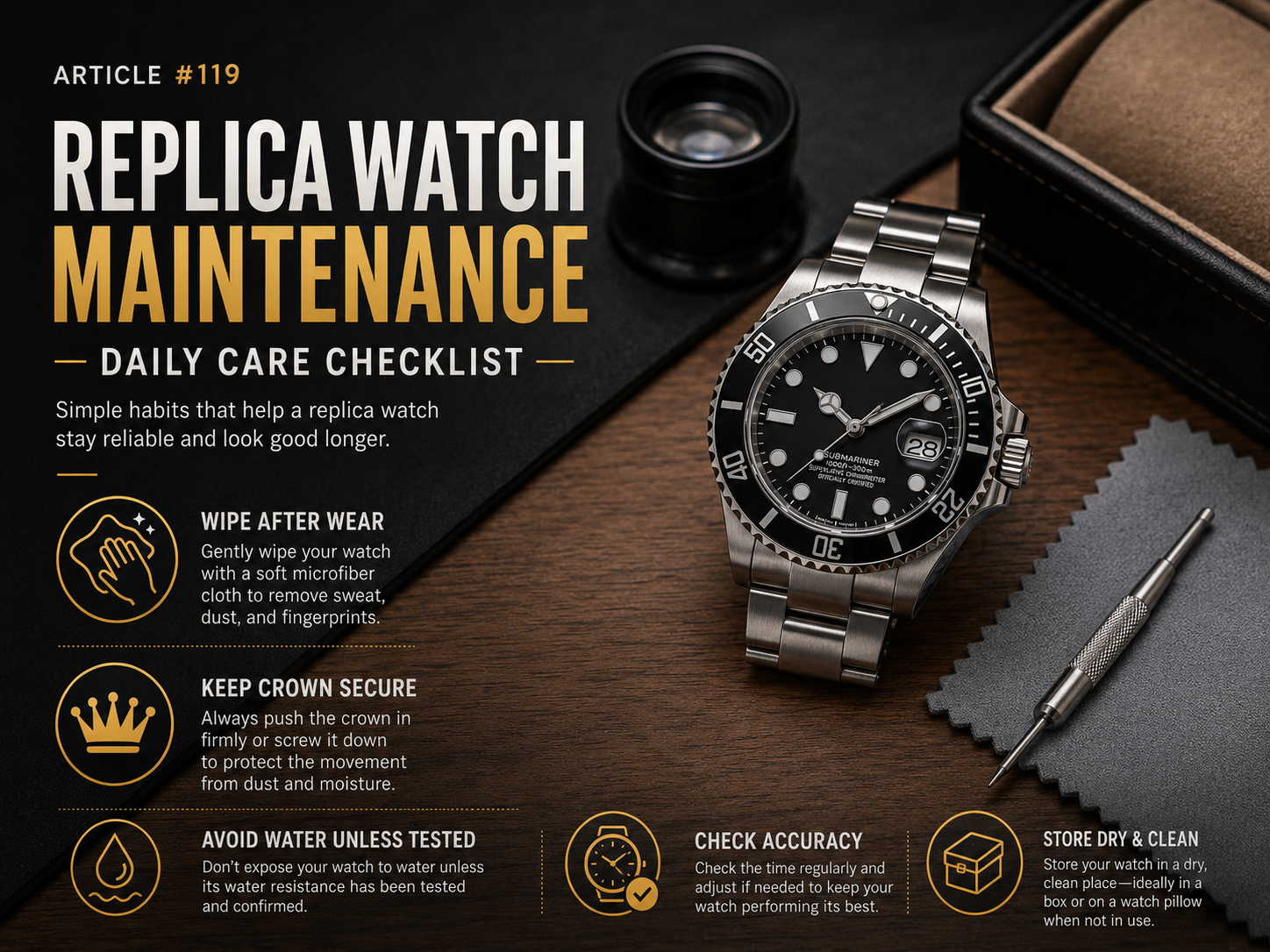
Daily Maintenance Checklist
Here is a simple routine you can actually follow.
After wearing: wipe the case, crystal, bracelet, and clasp with a soft cloth.
Once a week: check the bracelet screws or links if your watch uses them, especially after resizing.
Every few weeks: compare the watch time against your phone and see if it is running noticeably fast or slow.
Before water exposure: ask yourself whether the watch has been pressure tested. If not, avoid water.
Before setting the date: move the hands away from the date-change danger zone.
Before storage: make sure the watch is dry and clean.
Before travel: check crown position, bracelet fit, and whether the watch is suitable for the trip.
This routine takes very little time, but it protects the watch.
Final Buying and Maintenance Advice
A replica watch can be enjoyable, stylish, and practical when you buy it with clear expectations and maintain it sensibly.
The most important rule is not complicated: understand what you own.
Know the movement.
Know the water resistance status.
Know how to use the crown.
Know when the date should be adjusted.
Know whether service or replacement makes more sense.
Do not treat a replica watch as disposable if you want it to last. But do not expect the same official ownership path as a genuine luxury watch either. The best approach is practical, transparent, and realistic.
A well-chosen replica watch can be a great daily style piece. A well-maintained one can stay enjoyable for much longer.
FAQ
How often should I service a replica watch?
There is no universal service interval. If the watch is running well, many buyers wait until performance changes. If it starts running very fast or slow, stops often, loses power reserve, or has crown/date issues, it may need inspection.
Can I swim with a replica watch?
Only if the exact watch has been pressure tested and confirmed for water use. Do not rely only on the design, dial text, or screw-down crown.
Why is my replica watch running fast?
Possible causes include magnetism, impact, low movement quality, regulation issues, or service needs. Start by checking magnetism and comparing accuracy over several days.
Should I wind my automatic replica watch every day?
If you wear it daily, wrist movement may be enough. If it has stopped, a gentle manual wind can help start it. Avoid rough or excessive winding.
Can a local watchmaker service a replica watch?
Some can, depending on the movement and the watchmaker’s policy. Common movements are usually easier to service or replace than specialized clone movements.
Is a quartz replica watch easier to maintain?
Usually yes. Quartz watches are often simpler and more accurate, but they still need battery replacement, moisture protection, and basic cleaning.
What is the most common mistake replica watch buyers make?
The most common mistake is assuming the watch is water-ready without pressure testing. The second is forcing the crown or setting the date at the wrong time.