How to Tell if a Cartier Santos Is Fake Before You Buy
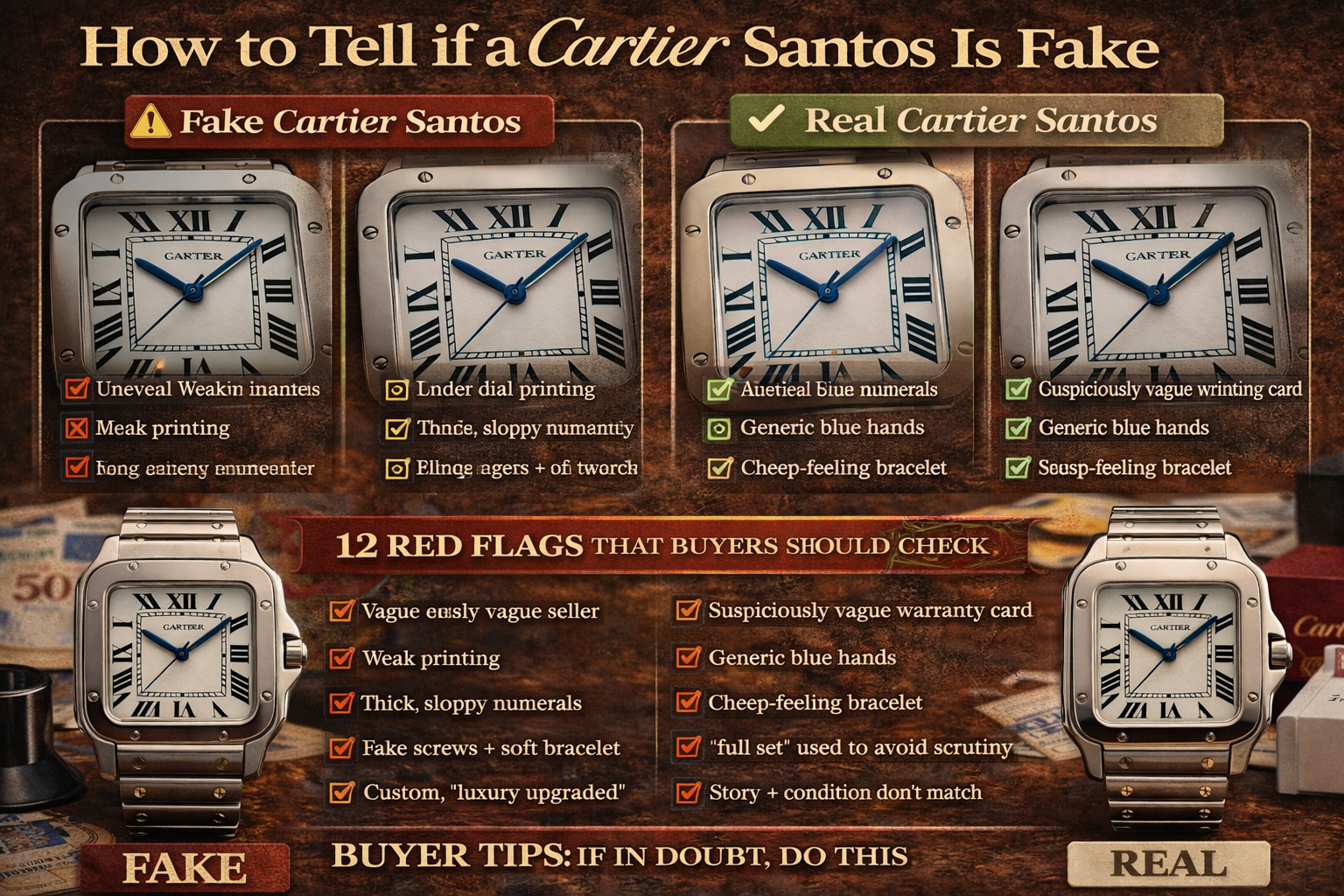
The Cartier Santos is one of those watches that looks simple until you actually try to buy one.
At first glance, it seems easy enough:
- square case
- exposed screws
- Roman numerals
- clean silvered dial
- bracelet or strap
- strong brand recognition
But that visual simplicity is exactly why buyers get caught.
A fake Cartier Santos does not need to copy a busy chronograph dial or a complicated diver bezel. It only needs to look “close enough” to a design most people recognize from a few feet away.
And because the Santos sits in a dangerous sweet spot—luxury, recognizable, wearable, and often bought pre-owned—it attracts exactly the kind of listings that make normal buyers second-guess themselves.
So let us start with the main point:
The safest way to spot a fake Cartier Santos is not to look for one dramatic giveaway. It is to check whether the watch, the seller, the parts, and the story all make sense together.
That is the same buying logic behind any strong secondhand purchase, and it becomes even more important when the brand is as recognizable as Cartier.
The short answer
A fake Cartier Santos usually reveals itself through a combination of issues:
- dial printing that looks slightly soft or uneven
- Roman numerals and minute track that feel off-balance
- hands that look the wrong shape, shade, or finish
- screws that look decorative rather than precise
- bracelet or clasp finishing that feels cheaper than the case
- a seller who avoids straight answers
- packaging or “full set” being used as the main proof instead of the watch itself
- aftermarket or mixed parts being hidden behind vague words like “custom” or “upgraded”
In other words:
A fake Santos often fails the consistency test before it fails the visual test.
That is the mindset that protects buyers.
Why the Cartier Santos is easier to underestimate than Rolex buyers expect
A lot of people approach Cartier fake-checking with the wrong mental model.
They assume fake Cartier works just like fake Rolex.
It does not.
With Rolex, many buyers obsess over bezel feel, date magnification, rehaut details, and sports-watch proportions. With Cartier Santos, the danger is different. The watch lives or dies on refinement.
That means the biggest tells are often:
- typography
- dial balance
- case finishing
- bracelet screw execution
- how elegant the whole thing feels in hand
A bad fake Cartier Santos can look fine in a small online photo.
A convincing fake can still look “luxury enough” to a first-time buyer.
But once you start examining the watch closely, the differences usually show up in places Cartier owners care about most: harmony, precision, and finishing discipline.
A real-world buying scenario: the “clean full set” Santos that felt slightly wrong
A buyer finds a Cartier Santos listing from a private seller. The price is not suspiciously low. In fact, it is almost reassuringly normal.
The listing says:
“Full set, worn carefully, minor hairlines, running perfectly, selling to fund another watch.”
Again, sounds reasonable.
The seller posts:
- a front dial shot
- a wrist shot
- the box
- warranty card
- one bracelet photo
At first glance, everything looks polished and expensive.
Then the buyer asks for:
- a straight-on dial close-up
- side profile photos
- clasp shots
- bracelet screw photos
- macro shots of the crown and case screws
- a clearer shot of the papers
That is where things start slipping.
The seller sends dimmer photos than expected.
The dial printing looks slightly thicker than it should.
The blue hands do not quite feel right in color.
The bezel screws look a little too rounded and less precise than expected.
The bracelet finishing seems softer than the rest of the watch.
And the seller keeps saying some version of:
“It’s all original as far as I know, but I’m not a Cartier expert.”
That last sentence matters.
Not because every private seller must be an expert.
But because vague reassurance is often what appears when the hard details do not hold up.
That is where smart buyers slow the deal down.
Why people still get fooled by fake Cartier Santos watches
Because the Santos feels “elegant,” not “technical.”
People expect fake luxury watches to fail in dramatic ways. They imagine:
- ticking quartz seconds on the wrong watch
- an obviously wrong logo
- a case shape that looks cartoonish
- grossly bad finishing
Sometimes that happens.
More often, the fake only needs to get the broad strokes right:
- square watch
- white or silver dial
- Roman numerals
- blue hands
- exposed screws
- familiar name on the dial
That is enough to fool people who are buying the idea of the Santos rather than the actual watch.
And that is exactly why your buying process matters more than your confidence.
12 red flags that actually matter on a Cartier Santos
1) Buy the seller before you buy the Santos
This rule matters on almost every used luxury watch, but it matters even more on Cartier because buyers often relax too early around “dressier” brands.
A trustworthy seller should be willing to provide:
- clear macro photos
- direct answers about ownership and service
- honest disclosure of any changed parts
- straight comments about scratches, bracelet wear, or polishing
- a reasonable path to verification before final payment
Warning signs include:
- blurry photos that somehow never improve
- refusal to photograph the bracelet screws closely
- avoiding questions about service history
- over-relying on box and papers
- pushing urgency instead of clarity
This is the same common-sense framework we use in higher-risk online purchases more broadly, which is why https://www.globalwatchindustry.com/blogs/buy-used-luxury-watch-online-checks-before-you-pay is still one of the most important internal references for Cartier buyers too.
2) The dial should feel precise, not merely attractive
A Santos dial is one of the fastest places to sense something is wrong.
Look for:
- Roman numerals that feel too thick or clumsy
- printing that looks slightly soft
- minute track misalignment
- poor spacing around the Cartier signature
- an overall dial that looks “luxury-ish” but not crisp
A real Cartier Santos dial should feel controlled.
Not loud. Not approximate. Not “pretty close.”
This is one of those categories where bad fakes do not always look ugly. They just look less disciplined.
That is a different standard—and a more useful one.
3) Check whether the hands look elegant or generic
Cartier hands matter more than many buyers realize.
On a Santos, the hands should feel deliberate and refined. If they look:
- too thick
- too shiny
- too bright in the wrong way
- the wrong shade of blue
- slightly awkward in proportion to the dial
pause there.
Many buyers cannot articulate what feels off.
They only feel that the watch has lost the effortless elegance that makes a Santos a Santos.
Trust that instinct—but verify it with close-up comparison and patience.
4) The screws should look engineered, not decorative
The Cartier Santos uses visible screws as part of its identity. That means fakes often get trapped by them.
Check:
- whether the bezel screws look evenly finished
- whether their slots are clean and consistent
- whether the bracelet screws feel sharp and precise
- whether the metal around them looks crisp instead of mushy
A fake or weakly finished Santos often gets the screws “conceptually correct” but execution-wise wrong.
This matters because on the Santos, the screws are not just hardware. They are visual punctuation.
If the punctuation is sloppy, the whole sentence changes.
5) Bracelet quality tells the truth fast
A Cartier Santos bracelet should not feel cheap, vague, or careless.
Things to check:
- link articulation
- edge finishing
- clasp feel
- bracelet-to-case integration
- whether the screws and surfaces feel equally well made
A lot of fake or questionable Santos listings focus heavily on the dial and front view because that is where casual buyers look first.
Smart buyers also want:
- side profile shots
- clasp shots
- bracelet back shots
- screw close-ups
- wrist-flex photos
That is because a weak bracelet often tells the truth faster than a flattering dial photo.
6) Watch for aftermarket diamonds, custom dials, and “upgraded” language
Cartier is a brand where aftermarket work shows up often enough to create real confusion.
If a seller says:
- custom
- iced
- upgraded bezel
- aftermarket diamonds
- factory style
- luxury customized
slow down immediately.
That does not always mean the base watch is fake.
It may mean the watch is genuine but altered.
It may also mean the seller is mixing together a story that sounds more valuable than the watch actually is.
That is exactly why the logic in https://www.globalwatchindustry.com/blogs/fake-vs-aftermarket-vs-franken-watch matters so much here. On a Cartier Santos, a buyer can overpay not only by buying a fake, but by buying a genuine watch that is no longer original enough to justify the price.
7) “Full set” should support the watch, not replace scrutiny
This point keeps trapping buyers.
A Cartier box, card, booklet, or receipt can be useful.
But none of them should become the center of the deal.
The real object you are buying is still the watch.
A fake or altered Santos can absolutely come with:
- a convincing box
- paperwork
- tags
- accessories
- a smooth seller story
That is why https://www.globalwatchindustry.com/blogs/used-watch-full-set-vs-watch-only remains relevant here too. Accessories support a watch. They do not clean up a suspicious watch.
8) Ask whether the watch has been polished—and how much
The Santos has sharp geometry. That means overpolishing can hurt it faster than some buyers expect.
A heavily polished Santos may show:
- softened edges
- less distinct transitions
- rounded case geometry
- screws that no longer look as crisp in relation to the bezel
- an overall “melted luxury” feel
That does not make the watch fake.
It can still make it overpriced.
That is why buyers should also keep https://www.globalwatchindustry.com/blogs/how-to-tell-if-a-watch-is-overpolished-before-you-buy in mind. A real Cartier that has lost too much case definition can still be a bad buy at a strong asking price.
9) Make sure the condition story matches the object
If the seller says:
- lightly worn
- careful owner
- only desk wear
- all original
then the watch should broadly look like that story makes sense.
If the case is heavily polished, bracelet screws look tired, clasp shows more use than expected, or dial condition and case wear do not seem to belong to the same life, ask more questions.
You are not accusing anyone.
You are testing for consistency.
That is what safe buyers do.
10) Be extra careful with pre-owned Santos models bought remotely
The Santos is exactly the kind of watch people love buying online:
- famous brand
- versatile design
- recognizable silhouette
- high enough value to feel special
- low enough relative price to attract first luxury-watch buyers
That combination is great for the market and dangerous for the careless buyer.
If you are shopping remotely, use the same structured logic you would use for any pre-owned luxury watch:
- demand better photos
- ask direct originality questions
- compare multiple examples
- avoid emotional rushing
- set authentication expectations before payment
In other words, do not buy the romance first and inspect later.
11) A “real Cartier” can still be the wrong Cartier
This is a major mistake in the used market.
Some buyers think the only danger is buying a fake.
Not true.
A genuine Santos can still be:
- heavily polished
- fitted with aftermarket parts
- mixed from non-matching components
- overpriced because of accessories
- poorly serviced
- not as original as the seller implies
That is why the real/fake question is only the beginning.
A smarter buyer also asks:
- Is it original?
- Is it correct?
- Is it honestly described?
- Is the price fair for this exact example?
Those are better questions.
12) The safest move is still third-party inspection before final payment
This is the part buyers resist when they are already emotionally sold.
But it remains true:
If the watch is expensive enough to hurt you, it is expensive enough to verify.
That can mean:
- meeting at a trusted watchmaker
- buying through a platform with strong buyer protection
- making the sale subject to authentication
- having the case, bracelet, and movement checked professionally
A good seller does not need to love that process.
They do need to tolerate it.
If they refuse reasonable verification, treat that refusal as information.
A practical 7-step Cartier Santos inspection routine
If you are looking at a Santos in person, use this order.
Step 1: Look at the whole watch from normal viewing distance
Does it feel elegant and balanced, or merely expensive-looking?
Step 2: Go straight to the dial
Ignore the box for now. Check the printing, Roman numerals, hands, and overall symmetry.
Step 3: Examine the screws
Bezel screws, bracelet screws, case details. Precision matters here.
Step 4: Work the bracelet and clasp
Feel the quality, not just the look.
Step 5: Ask what has been replaced or serviced
Hands, bracelet, screws, bezel, crystal, polishing, anything custom.
Step 6: Compare the story to the wear
Does this watch look like what the seller says it is?
Step 7: Pause the deal if clarity drops
You do not need courtroom proof to walk away from a fuzzy transaction.
A message you can send any Cartier Santos seller
Use this before paying:
Hi, I’m seriously interested, but I need a few verification details before moving forward. Could you please send clear close-up photos of the dial, hands, bezel screws, bracelet screws, clasp, case sides, and paperwork? Also please confirm whether the watch has had any replaced, aftermarket, polished, or serviced parts to the best of your knowledge. If we proceed, I’d want the sale to be subject to inspection/authentication. Thanks.
That message is polite, practical, and very revealing.
A trustworthy seller should be able to handle it calmly.
Buyer mistake: wanting the Cartier feeling more than the Cartier facts
This is the emotional trap.
A lot of people are drawn to the Santos because it offers something Rolex often does not:
- elegance without being fragile-looking
- luxury without feeling too loud
- strong design identity
- a watch that works with a T-shirt or a blazer
That appeal is real.
But it can also make buyers forgive weak evidence too quickly.
They start thinking:
- the price is not bad
- the seller seems nice
- it comes with papers
- maybe Cartier details are just subtle
- maybe I’m overthinking it
Sometimes you are overthinking.
Often, you are noticing what matters.
The safest buyers do not let their taste outrun their process.
FAQ
Is a fake Cartier Santos easy to spot?
Not always. Some are obvious, but many are convincing enough in listing photos to fool first-time buyers. The watch often gives itself away in finishing, dial precision, bracelet quality, and seller behavior.
Do Cartier box and papers prove a Santos is real?
No. They help, but they should support the watch—not replace inspection of the watch.
Can a real Cartier Santos still be a bad buy?
Absolutely. Overpolishing, aftermarket parts, mixed components, or weak pricing can all make a genuine watch a poor purchase.
Are aftermarket Cartier Santos parts common?
They are common enough that buyers should ask directly. Anything described as custom, upgraded, or aftermarket should immediately change how you evaluate price and originality.
Is the bracelet important when checking authenticity?
Very. On a Santos, bracelet finishing and screw quality can be among the fastest ways to spot trouble.
Should I buy a Cartier Santos from a private seller?
You can, but only if the seller is transparent, the photos are strong, the story is consistent, and the deal allows for verification.
Final thoughts
The best Cartier Santos buyers are not the people who memorize every tiny detail.
They are the people who stay calm, ask better questions, and refuse to let elegance replace evidence.
If you are trying to tell whether a Cartier Santos is fake, do not hunt for one magic giveaway.
Look for consistency:
- consistency in the seller
- consistency in the finishing
- consistency in the parts
- consistency in the wear
- consistency in the story
That is how buyers stay safe.
And if the watch still feels tempting but the facts are not clean, the right move is simple:
Walk away.