- Home
- Best Rolex Datejust Dial Colors Ranked: Which One Ages Best and Resells Best?
Best Rolex Datejust Dial Colors Ranked: Which One Ages Best and Resells Best?
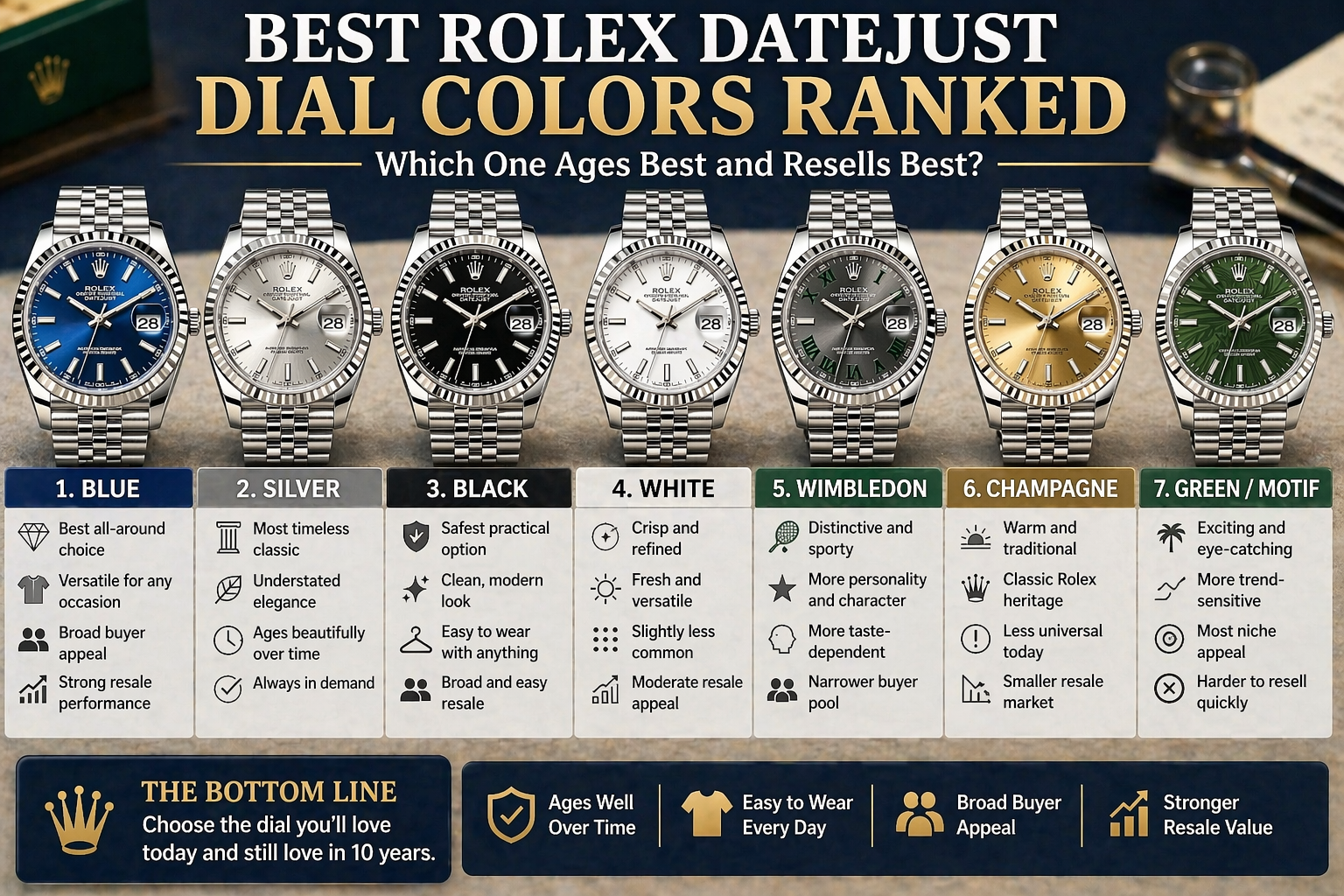
If you are buying a Rolex Datejust, there is a good chance you already know the hardest part is not deciding whether the watch is good.
It is deciding which one.
And once you get past size, bezel, and bracelet, the next trap appears: dial color.
At first, that sounds like a minor style choice.
It is not.
On a Datejust, dial color changes everything. It changes how timeless the watch feels, how easy it is to wear, how quickly it dates itself, how broadly it appeals to other buyers, and how likely you are to still love it a few years later.
That is why dial choice matters so much.
A dial can make a Datejust feel classic, sporty, formal, understated, or overly specific. It can make the watch easier to resell or harder to move. It can make your first Rolex feel like the perfect long-term buy — or the watch you loved in photos but got tired of surprisingly fast.
So which Rolex Datejust dial colors age best and resell best?
The short answer is this: blue is usually the strongest all-around Datejust dial, silver is the safest classic choice, black is the cleanest no-drama option, and more specific dials like Wimbledon or motif dials should only be bought if you truly love them.
That is the simple version.
But the real answer depends on whether you want the easiest long-term choice, the most timeless choice, or the most personality-driven choice.
The short answer
If you want the fastest answer, here is the ranking for most buyers:
- Blue – best all-around mix of beauty, flexibility, and buyer appeal
- Silver – most classic and quietly timeless
- Black – safest clean modern option
- White – crisp and elegant, but a little less emotionally sticky for some buyers
- Wimbledon – stronger personality, but more taste-dependent
- Champagne – classic for the right buyer, but less universal today
- Green or motif/special dials – appealing, but more trend-sensitive and more buyer-specific
If you are buying your first Datejust and want the lowest-regret answer, blue is usually the best place to start.
If you want the most traditional long-term Datejust tone, silver has a very strong argument.
Why dial color matters more than people think
Many first-time buyers assume dial color is easy to fix later in their mind.
They think, “As long as I get the right size and bracelet, I’ll be happy.”
That is not usually how it works.
The dial is what you actually look at all day.
The bezel and bracelet shape the watch from a distance. The dial is what creates the emotional relationship. It is the face of the watch. It decides whether the Datejust feels warm, cold, modern, classic, loud, conservative, or quietly perfect.
That is why people can love a Datejust configuration in theory but still hesitate when the dial feels wrong.
If you have already worked through the bigger decisions, this article fits naturally after Best Rolex Datejust Configuration to Buy First: Size, Bezel, Bracelet, and Dial Explained, because once the size, bezel, and bracelet are settled, dial color becomes the final thing that determines whether the watch really feels like yours.
How I’m ranking Datejust dial colors
This ranking is not based on hype alone.
It is based on four practical questions:
1. How well does the dial age visually?
Does it still look good after the novelty wears off?
2. How easy is it to wear?
Does it work across seasons, outfits, and occasions?
3. How broad is the resale appeal?
Will lots of buyers say yes, or only a narrow group?
4. How much regret risk does it carry?
Is this the kind of dial buyers often second-guess later?
That last one matters more than people expect.
Because a Datejust dial can be beautiful and still be a bad long-term choice for the wrong buyer.
1. Blue dial: the best all-around Datejust dial color
If I had to recommend one Datejust dial color to the widest range of buyers, it would be blue.
That is the cleanest answer.
The blue dial works because it does almost everything well. It feels rich without being loud. It feels sporty enough for daily wear but elegant enough for dressier settings. It catches light beautifully without relying on gimmick or novelty. Most importantly, it stays interesting over time.
That is rare.
A lot of dial colors win the first impression.
Blue keeps working after the first impression fades.
It also tends to appeal to a broad buyer pool. For resale, that matters. Blue is easy to like. Easy to imagine wearing. Easy to justify. It gives the Datejust a little personality without making it too specific.
That is why so many buyers end up here, and why so few regret it.
If you are deciding between blue and a more personality-driven option, Rolex Datejust Blue Dial vs Wimbledon: Which One Should You Actually Buy? is exactly the comparison that usually clarifies whether you want the safer long-term choice or the more distinctive one.
2. Silver dial: the most timeless classic choice
If blue is the best all-around answer, silver is the purest classic answer.
A silver Datejust feels calm, balanced, and deeply traditional. It does not scream for attention. It does not try to create drama. It simply makes the watch feel elegant and coherent in almost any era.
That is its strength.
Silver tends to age very well because it is not trying too hard. It also works especially well on classic Datejust configurations like fluted bezel and Jubilee bracelet, where the goal is not to make the watch feel trendy or sporty, but unmistakably like a Datejust.
The downside is that some buyers may find silver slightly less emotionally exciting than blue. It is often admired more quietly. It feels more mature, but sometimes a little less immediately rewarding.
That does not make it weaker.
It just makes it a dial for buyers who value lasting correctness over instant impact.
For the right owner, silver may actually be the best Datejust dial of all. It simply loses the top spot because blue usually combines timelessness with stronger emotional stickiness.
3. Black dial: the safest no-nonsense option
Black is the most straightforward dial in the ranking.
It is clean. Easy. Flexible. Hard to mess up.
A black Datejust makes sense for buyers who want the watch to feel sharper, a little more modern, and less decorative. It often works especially well on smoother or sportier Datejust setups, but it can also look excellent in more classic combinations.
Its biggest strength is clarity.
Black rarely feels confusing. It rarely clashes. It rarely becomes hard to style. It is the kind of dial that almost nobody hates and that many buyers can live with very easily.
Its main weakness is that it can feel slightly less special than blue or slightly less romantic than silver. It solves the practical side of the problem better than the emotional side.
That means black often makes a lot of sense.
It just does not always become the dial people obsess over.
Still, if you want a lower-risk Datejust dial that is easy to own and easy to resell, black remains one of the smartest choices.
4. White dial: crisp, elegant, slightly underrated
White is one of the most underrated Datejust dial colors.
Done right, it makes the watch feel fresh, precise, and very clean. It can look elegant and refined without becoming dull. In some configurations, it also makes the Datejust feel a bit lighter and more contemporary.
Its problem is not that it looks bad.
Its problem is that it often loses emotional battles to blue and classic battles to silver.
That puts it in an awkward spot.
White can be brilliant for the right buyer, especially someone who wants a cleaner, sharper, less expected Datejust. But it is slightly more taste-dependent than the top three colors, and that affects resale too.
A lot of buyers will like it.
Fewer will specifically hunt for it.
That is why it ranks just below the broadest safe options.
5. Wimbledon dial: memorable, specific, and riskier than it looks
The Wimbledon dial is one of the strongest examples of a Datejust dial that creates more excitement and more second-guessing at the same time.
That is exactly why it lands here.
The Wimbledon dial has real strengths. It feels distinctive. It has identity. It looks like a deliberate choice instead of a safe one. To the right buyer, that is a huge advantage. It can make the Datejust feel less generic and more personal.
But it is also more taste-driven.
That matters.
A more specific dial often feels stronger in the beginning because it creates a reaction. But over time, that same specificity can become a limitation if the buyer was attracted more by novelty than by true long-term preference.
That is why Wimbledon can absolutely be the right choice — but only for buyers who already know they genuinely love it.
For broader resale and lower-regret ownership, it usually sits below blue, silver, and black.
Again, if this is the choice bothering you most, Rolex Datejust Blue Dial vs Wimbledon: Which One Should You Actually Buy? is the right next step.
6. Champagne dial: classic, but no longer the easiest answer
There was a time when champagne felt like one of the most classic Rolex choices available.
In the right setting, it still does.
Champagne can look warm, luxurious, and unmistakably traditional. It works especially well when the buyer wants the Datejust to feel more overtly dressy or more old-school Rolex. In that context, it can be fantastic.
But for modern buyers, champagne is less universally easy than blue, silver, black, or even white.
It tends to be more polarizing. Some people love the warmth and heritage feel. Others find it too specific, too formal, or too tied to a certain image of luxury.
That narrows the resale audience.
It also raises the chance that a first-time buyer chooses it for the idea of “classic Rolex” rather than because it genuinely fits their taste.
That is why champagne is not a bad dial.
It is just a narrower dial.
7. Green, motif, and more trend-sensitive dials: exciting, but buy carefully
This category includes dials that feel more current, more visual, or more obviously special.
They can be stunning.
They can also be dangerous.
A distinctive green dial or patterned motif dial often wins the excitement test very easily. It photographs well. It feels special in the boutique. It looks like the kind of configuration a collector would notice.
All of that can be true.
But these dials are usually more trend-sensitive, more buyer-specific, and more vulnerable to long-term emotional fatigue. They are not bad. They are just less safe, especially for first-time buyers.
For resale, this matters a lot. Broad buyer pools usually respond more easily to blue, silver, and black than to more specific visual statements.
That is why these dials can be brilliant as “I know exactly what I want” purchases.
They are weaker as “I’m not sure, but this seems exciting” purchases.
A real buyer example: the dial that won in photos vs the dial that won in life
A buyer I know spent weeks deciding between a blue dial Datejust and a more specific, more eye-catching dial that he thought felt more special.
At first, the more unusual dial kept winning in photos. It felt less obvious. More like a watch enthusiast’s choice. More memorable.
Then he tried both on more than once.
That changed everything.
The unusual dial was still more exciting in the moment. But the blue dial looked better with his real clothes, felt easier on ordinary days, and seemed more likely to stay satisfying after the initial thrill faded.
He bought the blue dial.
Months later, he told me he was glad he had done it. Not because the other dial was bad, but because the blue dial turned out to be the one that kept working.
That is what this ranking is really about.
Not which dial looks coolest for ten minutes.
Which one keeps making sense later.
Which dial color resells best?
If we are talking broad, consistent buyer appeal, the safest resale order usually looks like this:
- Blue
- Black
- Silver
- Wimbledon
- White
- Champagne
- More specific special dials
Why is silver not above black here, even though it is more timeless?
Because resale is not just about timelessness. It is also about immediate buyer response. Black is often easier for casual buyers to understand quickly, while silver appeals a little more quietly.
Why is Wimbledon not higher?
Because it is more buyer-specific. People who love it may really love it, but the pool is narrower.
Why do special dials rank lower?
Because the more opinionated the dial, the smaller the resale audience usually becomes.
If resale is one of your top priorities, you should also be thinking beyond dial color. Configuration, authenticity, polishing, and set completeness matter too. That is why these articles belong in the same research session:
- How to Spot a Fake Rolex Before You Buy: 13 Red Flags That Actually Matter
- How to Tell If a Rolex Datejust Is Fake Before You Buy
- How to Tell If a Watch Is Overpolished Before You Buy
- Used Watch Full Set vs Watch Only: How Much Do Box and Papers Really Matter?
A great dial on the wrong watch is still the wrong buy.
Which dial color is best for a first Datejust?
For most people, blue.
That is the clearest answer.
Blue gives you the most balanced mix of emotional satisfaction, everyday wearability, and broad long-term appeal. It feels special enough to reward the purchase, but not so specific that it becomes risky.
If you want the most classic answer, go silver.
If you want the cleanest, easiest no-nonsense answer, go black.
If you want a more personality-driven answer and you know that is what you truly want, then Wimbledon or another more specific dial can absolutely be right.
But for a first Datejust, broad strength matters more than niche excitement.
That is why blue wins.
A practical way to decide before you buy
If you are stuck between dial colors, ask yourself these questions in order:
1. Which one still looks right in ordinary light?
Not boutique light. Real life light.
2. Which one works with my actual wardrobe?
Not your dream wardrobe. Your real one.
3. Which one feels more likely to age well with me?
Some dials feel exciting now. Others feel good for years.
4. Am I choosing the dial because I truly love it, or because it feels more interesting in the moment?
That distinction matters a lot.
5. If I bought the safer dial, would I still keep thinking about the distinctive one?
And the reverse is true too.
That last question often tells the truth better than any ranking can.
So which Datejust dial color ages best and resells best?
Here is the honest answer.
If you want the strongest all-around Datejust dial, choose blue.
If you want the purest timeless classic, choose silver.
If you want the easiest practical clean choice, choose black.
If you want something more distinctive, like Wimbledon, choose it only because you genuinely love it — not because it feels more exciting for ten minutes.
That is the real key.
Because the best Datejust dial is not always the most beautiful one in a photo.
It is the one that still feels right once the purchase becomes part of your life.
Final verdict
The best Rolex Datejust dial color for most buyers is still blue.
It ages well, resells well, and avoids the biggest trap in Datejust buying: choosing something more specific than you actually want to live with.
After that, silver and black remain the safest long-term choices.
More distinctive dials can be excellent, but they require more certainty from the buyer.
In other words:
- Blue is the best all-around answer
- Silver is the most timeless quiet answer
- Black is the safest practical answer
- Specific dials are best only when you are sure
And if you are not sure, do not overcomplicate it.
The dial you can live with longest is usually the dial you should buy.
FAQ
What is the best Rolex Datejust dial color overall?
For most buyers, blue. It offers the best combination of beauty, versatility, and resale appeal.
Which Datejust dial color is the most timeless?
Silver. It feels the most traditional and least trend-sensitive over time.
Which Datejust dial color resells best?
Usually blue, followed by black and silver, because those colors appeal to the broadest buyer pool.
Is Wimbledon a good Datejust dial?
Yes, but it is more specific and more taste-dependent than blue, silver, or black.
What is the safest dial color for a first Datejust?
Blue is the safest emotional and practical choice for most first-time buyers.