- Home
- Rolex Datejust 36 Blue Dial vs Silver Dial: Which One Should First-Time Buyers Choose?
Rolex Datejust 36 Blue Dial vs Silver Dial: Which One Should First-Time Buyers Choose?
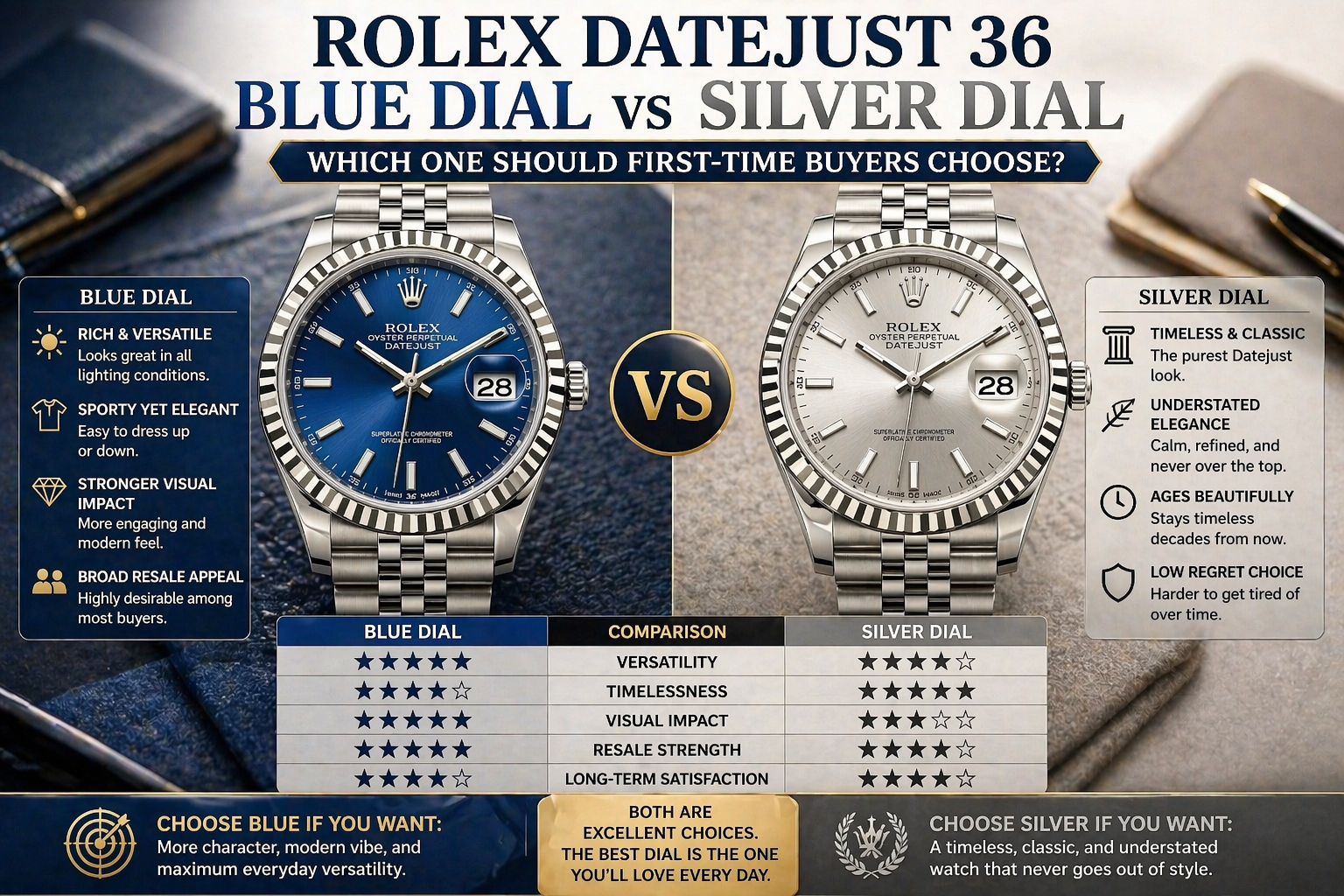
If you have narrowed your first Rolex down to a Datejust 36, you are already doing something right.
But now you’ve hit the part that actually causes hesitation.
Not the price.
Not the size.
The dial.
And more specifically:
blue dial vs silver dial.
At first, it feels like a simple choice.
One looks richer and more modern. The other looks more classic and timeless.
But after a few days of thinking about it, most buyers realize something uncomfortable:
both look right.
And that is exactly why this decision becomes difficult.
Because this is not about picking a better watch.
It is about picking the version you will still be happy wearing long after the “new watch” feeling is gone.
So which one should you actually choose?
The short answer is this: choose blue if you want a more versatile, slightly more modern, and emotionally engaging Datejust. Choose silver if you want the most timeless, classic, and low-regret long-term option.
That is the simple version.
But the real answer depends on how you actually live with the watch.
The short answer
Choose blue dial if you want:
- a more visually engaging watch
- stronger “first Rolex” satisfaction
- better balance between sporty and elegant
- broader resale appeal in many markets
Choose silver dial if you want:
- the most classic Datejust look
- a calmer, more understated presence
- a dial that feels timeless across decades
- a watch that is harder to regret stylistically
If you are unsure, blue is usually the safer emotional choice.
If you value long-term timelessness above all else, silver is the cleaner answer.
Why this comparison matters more than it seems
On paper, this is just color.
In reality, it changes how the watch feels every single day.
The dial is what you actually look at constantly. It defines the mood of the watch. It determines whether the Datejust feels lively or calm, modern or traditional, expressive or restrained.
That is why buyers often underestimate this decision.
They think they are choosing between two good options.
What they are really choosing is how they want the watch to feel over time.
If you haven’t already read it, this comparison sits directly on top of Best Rolex Datejust Dial Colors Ranked: Which One Ages Best and Resells Best?, because blue and silver consistently come out as the two strongest overall choices.
Blue dial: why it wins for most first-time buyers
The blue dial Datejust is the one that usually gets the strongest reaction first.
And that matters more than people like to admit.
It catches light better. It feels richer. It adds depth to the watch. It gives the Datejust a bit more personality without pushing it into something overly flashy.
That balance is exactly why it works.
A blue Datejust feels:
- slightly more modern
- slightly more dynamic
- easier to enjoy casually
- still appropriate in formal settings
That combination is very hard to beat.
It is also why blue tends to perform well in resale. It appeals to a wide range of buyers because it feels special without being risky.
For many first-time buyers, blue simply feels like the version that justifies the purchase emotionally.
And that is not a small thing.
Silver dial: why it quietly becomes the long-term favorite
The silver dial does not try to impress you in the first 10 seconds.
That is exactly why it ages so well.
A silver Datejust feels calm, balanced, and extremely coherent. It is not trying to be exciting. It is trying to be correct. And over time, that becomes more valuable than initial excitement.
Silver works because:
- it never looks out of place
- it does not depend on lighting to look good
- it fits effortlessly into almost any setting
- it carries the purest “Datejust DNA”
It is the dial that feels the least tied to trends.
That is why experienced buyers often respect it more over time.
But here is the trade-off:
Silver rarely gives you that immediate “this is amazing” feeling that blue often does.
It grows on you instead of grabbing you.
That difference matters depending on your personality.
A real buyer example: immediate impact vs long-term satisfaction
A buyer I spoke to was deciding between these exact two dials.
At first, the blue dial kept winning.
It looked better in photos. It felt more exciting. It felt more like a luxury purchase.
But he kept coming back to the silver dial in person.
Not because it was more impressive.
Because it felt easier.
Easier to imagine wearing every day. Easier to match. Easier to live with long term.
He chose silver.
Months later, his feedback was simple: “The blue impressed me. The silver stayed right.”
That is the difference in one sentence.
Daily wear: which one is easier to live with?
Both are easy.
But in slightly different ways.
The blue dial is easier if you want the watch to feel interesting every time you look at it. It adds energy. It keeps the watch from feeling too plain.
The silver dial is easier if you want the watch to disappear into your life without friction. It never clashes. It never feels too much.
So the question becomes:
Do you want your watch to add something to your outfit, or simply work with everything?
Blue adds.
Silver blends.
Versatility: which one works in more situations?
This is closer than people think.
Blue is surprisingly versatile because it sits between sporty and dressy. It works with casual clothes, business settings, and even more formal situations.
Silver is versatile in a different way.
It is neutral.
It does not lean sporty or flashy. It simply works everywhere without drawing attention.
If you want slightly more visual range, blue wins.
If you want maximum neutrality, silver wins.
Resale: which dial is easier to sell?
In most markets, blue has a slight edge.
Why?
Because it creates stronger immediate appeal.
Buyers scrolling listings tend to react faster to blue. It feels more “worth it” at a glance. That matters in a competitive resale environment.
Silver still resells well.
But it is often a quieter decision. Buyers choose it more deliberately rather than emotionally.
So:
- Blue = easier emotional resale
- Silver = steady, logical resale
If resale is a priority, you should also be thinking beyond dial color. Condition, authenticity, and originality matter just as much. That is why these should be part of your process:
- How to Spot a Fake Rolex Before You Buy: 13 Red Flags That Actually Matter
- How to Tell If a Rolex Datejust Is Fake Before You Buy
- How to Tell If a Watch Is Overpolished Before You Buy
A good dial on a bad watch is still a bad purchase.
Which one feels more “Rolex”?
This is subjective, but consistent.
The silver dial feels more traditionally “Rolex Datejust.”
It reflects the classic image people associate with the model.
The blue dial feels like a modern evolution of that idea.
Still Rolex.
Just slightly more contemporary.
So if your goal is the purest traditional Datejust identity, silver has a strong argument.
If your goal is a modern version of that identity, blue makes more sense.
The biggest mistake buyers make here
They try to choose the “correct” dial instead of the dial they actually want.
That usually leads to one of two problems:
- choosing silver because it feels safe, then missing the personality of blue
- choosing blue because it feels exciting, then wanting something calmer later
The mistake is not picking the wrong dial.
The mistake is ignoring your own preference pattern.
A simple decision test
If you are stuck, do this:
Imagine you already bought the silver dial.
Now you see a blue dial Datejust again.
Do you feel relief?
Or do you feel hesitation?
Now reverse it.
Imagine you bought the blue dial.
Now you see a silver dial again.
Same question.
That reaction usually tells you more than any spec sheet.
So which one should first-time buyers choose?
Here is the honest answer.
If you want the best all-around, emotionally satisfying, and versatile first Rolex, choose blue dial.
If you want the most timeless, understated, and long-term stable choice, choose silver dial.
There is no wrong answer here.
Only a better match for your mindset.
Final verdict
Choose the blue dial Datejust 36 if you want a watch that feels alive, slightly modern, and rewarding every time you look at it.
Choose the silver dial Datejust 36 if you want a watch that feels timeless, calm, and correct no matter when or where you wear it.
The blue dial wins more first impressions.
The silver dial wins more long-term arguments.
And the right choice depends on which of those matters more to you.
FAQ
Is blue or silver better for a first Rolex Datejust?
Blue for most buyers. Silver for those prioritizing timelessness above all.
Which dial is more versatile?
Both are highly versatile. Blue adds more personality, silver offers more neutrality.
Which dial holds value better?
Blue often has slightly stronger resale demand, but both perform well.
Does silver look too plain?
Not for most owners. It often becomes more appreciated over time.
Which one is harder to regret?
Silver is usually harder to regret. Blue is harder to resist.