The Enduring Philosophy of the Classic Dress Watch: A Style Anchor Beyond Trends
unassuming circle of metal and glass: the classic dress watch. For the discerning man, a simple, elegant timepiece is far more than an instrument to tell time; it is the foundational anchor of his personal style, a silent philosopher speaking a language of permanence, precision, and poise.
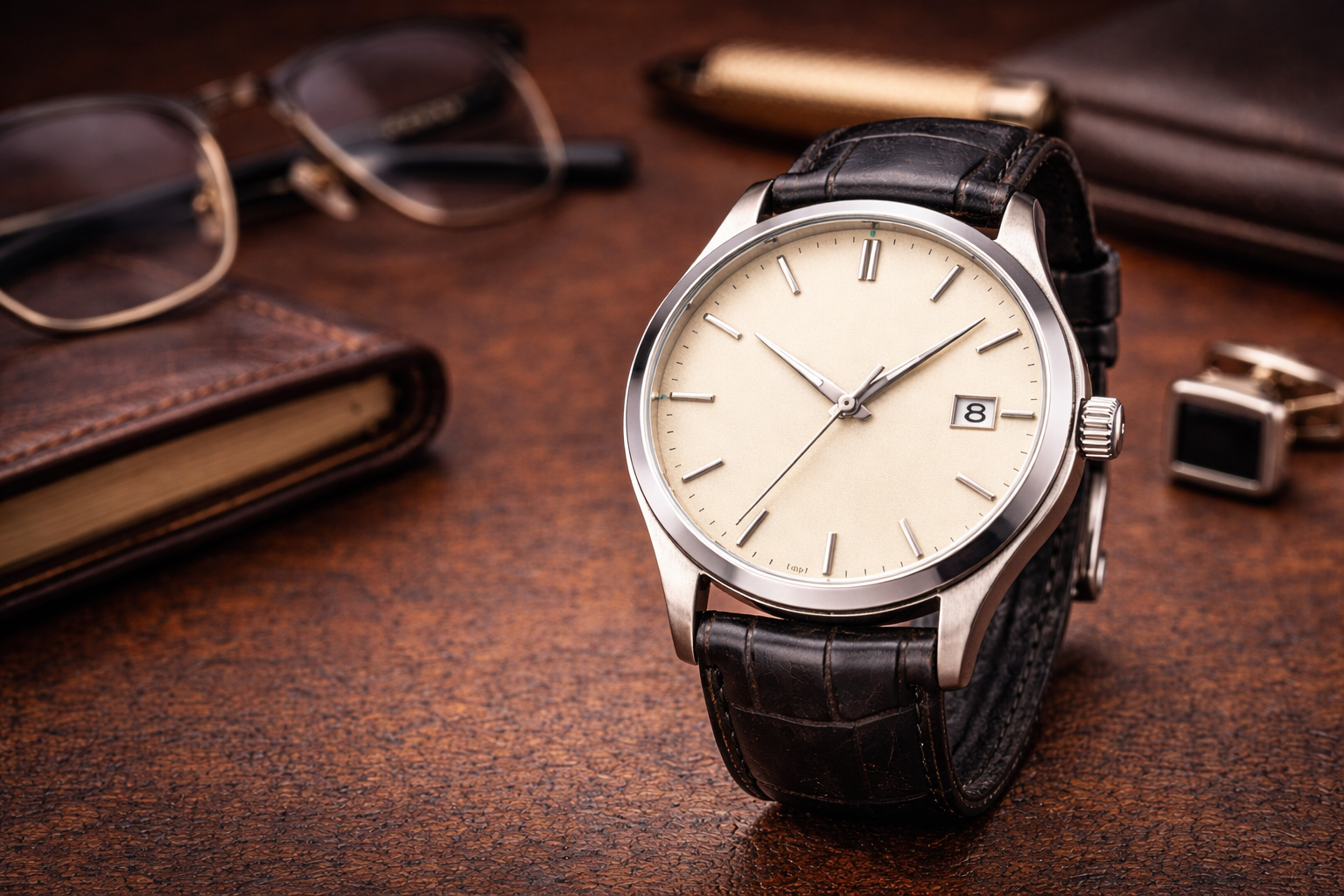
This is not about ostentation. The true dress watch is an exercise in reduction, a study in essentialism. In a world clamoring for attention, it chooses whispered elegance. It asks not to be seen first, but to be understood last, revealing its depth and craftsmanship to only the most observant eye. Why does this singular accessory hold such an irreplaceable position as the cornerstone of a wardrobe? The answer lies in its timeless philosophy, a confluence of design purity, mechanical integrity, and sartorial intelligence that transcends fleeting fashion.
The Anatomy of Quietness: Deconstructing the Design Language
The power of a classic dress watch is communicated through a vocabulary of subtle, intentional design elements. Each component is refined over centuries, not for novelty, but for clarity and harmony.
-
The Case: Thinness is paramount. A dress watch should slide effortlessly under a crisp shirt cuff, a physical manifestation of its role as a complement, not an obstruction. Its profile is often modest in diameter (typically 38-41mm), respecting the proportions of the wrist and the tailoring of the suit. The materials—polished stainless steel, warm rose gold, or understated platinum—speak of quality without shout.
-
The Dial: A Canvas of Clarity. Here, minimalism reigns. A clean, often white, ivory, silver, or black dial serves as a serene backdrop. It may feature subtle textures like guilloché (engine-turning), but the primary goal is legibility and balance. This is where iconic elements earn their reputation:
-
The Dauphine or Feuille Hands: Often mistakenly called "tapered," the true dress watch handset is refined. Dauphine hands (featuring multifaceted, diamond-cut facets that catch the light) or feuille (leaf) hands (softer and more organic) are hallmarks. They are elegant arrows pointing to the markers, not broad swords.
-
The Track or Railroad Minute Chapter Ring: Encircling the dial, a track or "chemin de fer" (railroad) minute ring provides a precise scale for the minutes. It’s a functional element transformed into a graphic signature, emphasizing the watch’s dedication to measured time.
-
Applied Indices: Instead of painted marks, fine dress watches use applied hour markers—thin batons, Roman numerals, or simple dots. They are three-dimensional, catching light and casting a subtle shadow, adding depth to the dial.
-
-
The Movement: The Soul Within. The philosophy extends beneath the surface. A thin, mechanical movement—whether automatic or hand-wound—is the heart of the classic dress watch. Its pursuit is not brute force or myriad complications, but reliability, precision, and the artistry of miniaturization. The gentle sweep of the seconds hand (often on a discrete sub-dial at 6 o'clock) is a testament to this mechanical life, a contrast to the stutter of quartz.
The Sartorial Keystone: From Boardroom to Bar
A classic dress watch is the ultimate sartorial translator, seamlessly bridging diverse environments. Its versatility stems from its neutrality and refinement.
-
The Foundation: Office & Formal Wear. Paired with a navy or charcoal suit, a white dress shirt, and a knotted tie, the watch disappears into the ensemble, only to reappear in moments of gesture—pointing to a document, reaching for a handshake. It confirms a respect for tradition, punctuality, and an attention to detail that colleagues and clients instinctively register. It says, "I am prepared."
-
The Strategic Transition: Evening & Smart Casual. This is where its magic truly shines. As the day softens into evening, the dress watch effortlessly transitions. With a blazer, dark jeans, and a quality knit, it elevates casual attire without a hint of pretension. It replaces the formality of the suit with intellectual cool. At a formal evening event, under the cuff of a tuxedo or dinner jacket, its slim profile is the only accessory needed—or permitted by classic style codes. A leather strap (black or brown alligator or calfskin) can be swapped for a more textured option for casual wear, but the watch itself remains the constant.
-
The Personal Signature. Unlike a sport or tool watch laden with technical associations, the dress watch is a clean slate. It becomes defined by the wearer. It can be a discreet heirloom, a personal reward, or simply a chosen companion for life’s journeys. It doesn’t scream wealth; it whispers taste.
Beyond the Object: The Philosophy of Anchored Style
To adopt a classic dress watch is to embrace a philosophy. It is a conscious rejection of the disposable and the distracting. In an age of digital notifications and relentless novelty strapped to our wrists, a simple mechanical watch grounds us in the physical, continuous flow of time. It is an anchor point in a chaotic stylistic sea.
It teaches patience—patience to appreciate craftsmanship that cannot be understood in a glance. It teaches confidence—the confidence to not need external validation through loud branding. Ultimately, it teaches that true style is not about following trends, but about building a personal canon of enduring pieces that reflect who you are and who you aspire to be.
The classic dress watch is not merely a purchase; it is an investment in a perspective. It asserts that some things—good design, honest materials, and timeless elegance—are not subject to the whims of seasons. They are, quite simply, always correct. In its quiet tick, it reminds us that while fads are fleeting, style is eternal. And in that philosophy lies its undeniable, and forever relevant, power.
Building Your Anchor: A Brief Guide
When considering your cornerstone piece, focus on these principles:
-
Prioritize Proportion: Ensure the case diameter and thickness complement your wrist and fit under a shirt cuff.
-
Embrace Simplicity: Seek a clean dial with high legibility and refined hands/markers. White, black, or silver are the most versatile.
-
Value the Movement: A mechanical movement is part of the soul of the classic dress watch tradition.
-
Mind the Strap: A high-quality leather strap in a neutral color is the starting point. Consider it part of the watch's aesthetic.
-
Connect to the Story: Choose a design that speaks to you personally—whether it’s a specific historical period, a type of dial, or a particular handset.
In the end, the perfect classic dress watch is the one that, when you put it on, doesn’t feel new, but feels like it has always been a part of you. It becomes not just a way to tell time, but a way to define it.