Celestial Ballet on the Wrist: The Poetic Mechanics of the Moon Phase Complication
In the microcosm of a watchmaking masterpiece, this cosmic rhythm finds its most enchanting mechanical expression: the Moon Phase complication. More than a charming decoration, it is a profound statement—a testament to humanity’s enduring desire to capture the poetry of the heavens within the confines of human ingenuity. This is the story of how a complex function transcends mere mechanics to become wearable art that connects us to the universe.
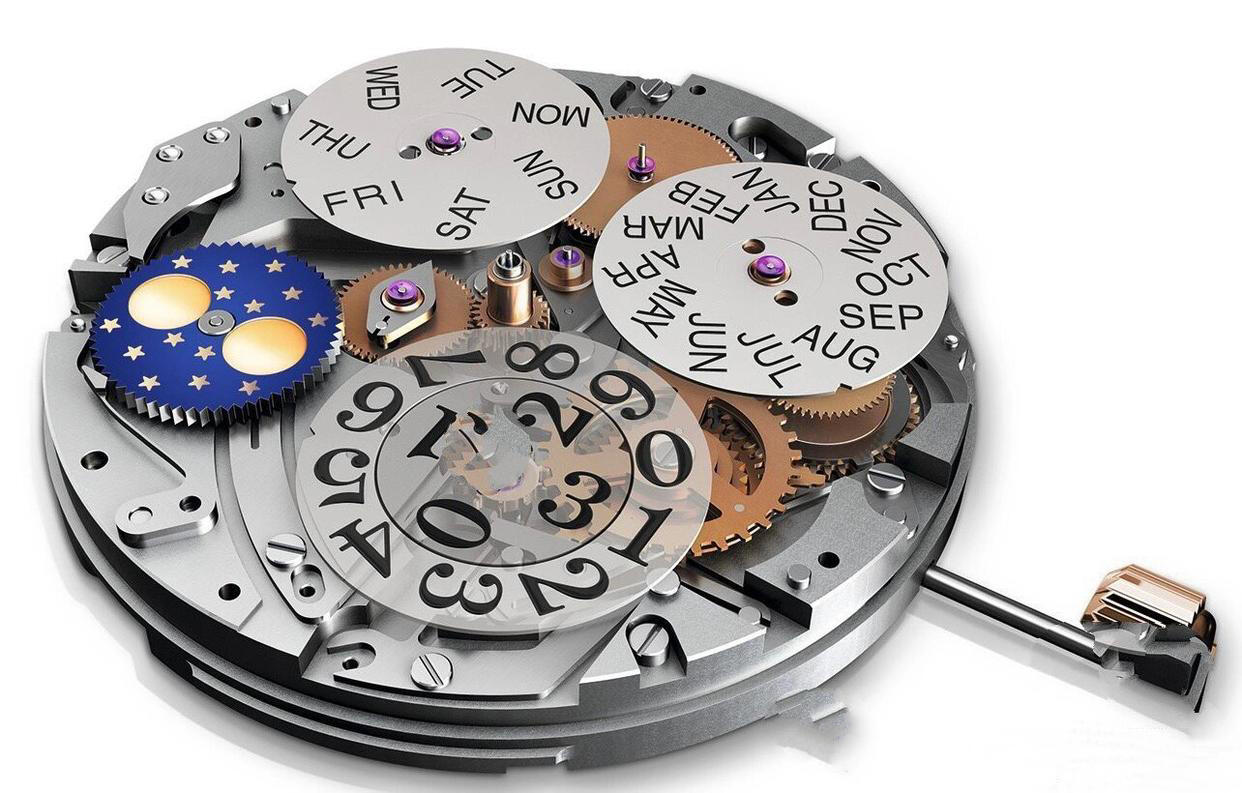
The Eternal Muse: Our Lunar Obsession
Long before the tick of a clock, humans marked time by the moon. Its 29.5-day cycle governed agriculture, religious ceremonies, and cultural storytelling. It represented mystery, romance, and the cyclical nature of life itself—the ultimate symbol of periodic renewal. The Moon Phase complication on a watch is a direct descendant of this ancient bond. It is a personal, intimate link to that celestial clock, a reminder that our days are part of a much larger, beautiful pattern.
The Ingenious Mechanics: Capturing the Moon’s Cycle in Gears
The mechanical principle behind a traditional moon phase display is a masterpiece of elegant simplification. At its heart is a specific, cleverly calculated gear train.
-
The 59-Tooth Marvel: The star of the show is a disc, painted with two identical moons on opposite sides. This disc is advanced one notch every 24 hours by a driving wheel linked to the timekeeping train. The magic number is the disc’s teeth: 59. Why 59? Because one full lunar cycle (a synodic month) is approximately 29 days, 12 hours, 44 minutes, and 2.8 seconds. By having two moons on the disc, the mechanism only needs to complete half a rotation per cycle. 59 teeth divided by 2 equals 29.5 days—a brilliant mechanical approximation of the moon’s average cycle.
-
The Theater of the Night Sky: This disc rotates behind a fixed aperture—the "stage" on the dial. The curved edges of this aperture precisely mask and reveal the painted moons, mimicking the waxing and waning we see from Earth. Each evening, as you glance at your wrist, you see a slightly different sliver of that golden orb, perfectly synchronized with the sky above (clouds permitting).
-
The Pursuit of Perfection: Watchmakers have long sought to refine this approximation. The standard 59-tooth system will gain one day of error roughly every 2 years and 7 months. For purists, a more sophisticated "astronomical" or "precision" moon phase exists, using a 135-tooth gear or a special differential system. This ingenious mechanism reduces the discrepancy to one day in 122 years, a staggering feat of micro-engineering that borders on the obsessive.
Beyond the Gear: The Art of the Display
The moon phase is where horological art meets mechanical science. The craftsmanship shines in the depiction of the moon itself:
-
The Classic Golden Moon: Often a polished, raised gold or rhodium moon set against a deep blue, star-speckled disc.
-
The "Man in the Moon": A traditional, stylized human face, evoking folklore and ancient mystery.
-
The Photorealistic Moon: Achieved through painstaking painted miniature or micro-engraving, replicating the actual lunar maria (the dark "seas") with astonishing accuracy. This turns the aperture into a true telescope view.
-
The Dreamy "Pierced" Moon: Where the moon is cut from the disc, revealing a luminous layer beneath, creating a radiant, almost magical glow.
The Poetic Resonance: Why It Captivates
Owning or admiring a moon phase watch is not about needing to know the moon’s phase for practical purposes. It’s about something deeper:
-
A Connection to Natural Time: In our digital world of endless, linear seconds, it re-anchors us to cyclical, biological, and astronomical time.
-
A Symbol of Romance and Mystery: It carries an inherent, timeless romance—the same that inspired sonnets and symphonies.
-
A Celebration of Miniaturization: It represents the apex of the watchmaker’s art: condensing a cosmic phenomenon into a tiny, precise, and beautiful mechanical simulation.
It is, in essence, a mechanical poem. Each component—the calculated gear, the painted disc, the shaped aperture—is a word in a stanza about our relationship with the night sky. It doesn’t just tell the hour; it tells a story of human curiosity, our longing for beauty, and our ingenious attempt to hold a sliver of the infinite, ticking quietly on our wrist. It is watchmaking at its most philosophical and profoundly beautiful.